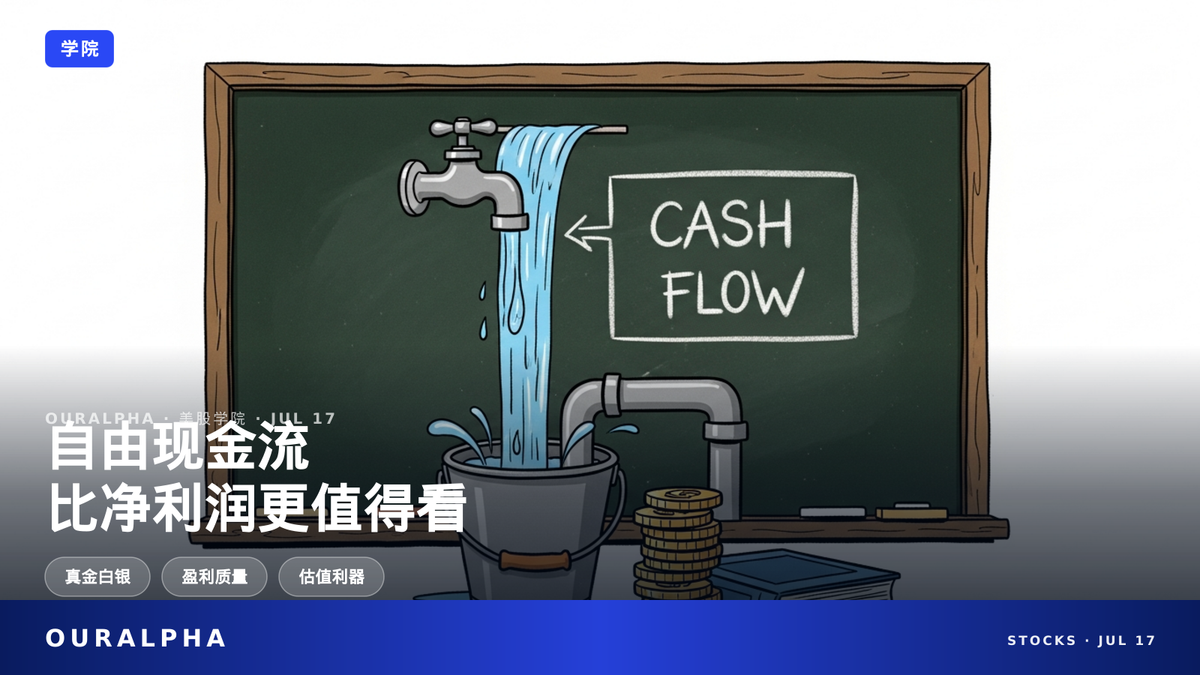
What Is Free Cash Flow? Why Is It More Important Than Net Income?
Free cash flow is a company's real money-making ability, more reliable than net income. This article explains the definition, calculation, common misconceptions, and practical uses in plain English.
What Is Free Cash Flow?
Why Is It More Important Than Net Income?
Net income is accounting profit; free cash flow is cold, hard cash.
A company can have positive net income but still be strapped for cash due to piled-up receivables.
Understanding free cash flow helps you avoid many earnings traps.
TL;DR · IN SHORT
- Free Cash Flow = Operating Cash Inflow - Money Needed to Maintain the Business
- Negative free cash flow isn't always bad—it could be strategic investment.
- FCF Yield is harder to manipulate with accounting tricks than P/E ratio.
KEY TERMS
Free Cash Flow (FCF): Cash generated from operations minus capital expenditures, available to distribute to shareholders and creditors.
Operating Cash Flow (OCF): Actual cash received from core business operations minus cash paid, from the cash flow statement.
Capital Expenditure (CapEx): Cash spent to acquire or upgrade long-term assets (e.g., equipment, factories).
FCF Yield: Free cash flow divided by market capitalization, used to gauge stock valuation.
FCF Margin: Free cash flow divided by revenue, showing how much free cash flow a company generates per dollar of revenue—useful for comparing cash conversion efficiency across companies of different sizes.
CONTENTS
- What Exactly Is Free Cash Flow and How Is It Calculated?
- What's the Difference Between Free Cash Flow and Net Income?
- Does Negative Free Cash Flow Mean the Company Is in Trouble?
- Why Does Warren Buffett Focus on 'Owner Earnings' Instead of Net Income?
- How to Use Free Cash Flow Yield (FCF Yield)?
- Can a Company with Negative Free Cash Flow Still Pay Dividends or Buy Back Stock?
- What to Watch Out for When Analyzing Free Cash Flow?
- FAQ
What Exactly Is Free Cash Flow and How Is It Calculated?
Simply put, free cash flow (FCF) is the cash a company has left over after a year of hard work—cash it can freely use. The formula is straightforward: Free Cash Flow = Operating Cash Flow - Capital Expenditures[1].
Operating cash flow is the net cash received from selling products and collecting payments; capital expenditures (CapEx) are the cash spent on equipment, factories, etc., to maintain or grow the business. Both come from the cash flow statement, one of the three key financial statements.
Another expanded formula: Free Cash Flow = Net Income + Depreciation & Amortization - Changes in Working Capital - Capital Expenditures[2]. This essentially converts net income from accrual accounting to cash accounting. For example: if a company has net income of $1 million, depreciation & amortization of $200,000 (non-cash), an increase in working capital of $300,000 (e.g., more receivables), and CapEx of $500,000, then FCF = 1,000,000 + 200,000 - 300,000 - 500,000 = $400,000. This shows that $600,000 of net income never turned into actual cash.
The key to understanding this formula: depreciation & amortization are non-cash expenses from past asset purchases; changes in working capital reflect the cash impact of items like receivables and payables; CapEx is real cash spent.
What's the Difference Between Free Cash Flow and Net Income?
Net income is accounting profit based on accrual accounting—basically, 'if it's agreed, it counts': as soon as a transaction occurs, revenue is recorded regardless of whether cash is received. For example, if a company sells $1 million worth of goods but the customer pays six months later, net income already includes that $1 million in revenue, but the cash hasn't arrived yet—the wallet is still empty.
Free cash flow is based on actual cash received and paid, making it harder to manipulate with accounting tricks. That's why it's often used as a key cross-check for 'earnings quality'[5]. If a company has high net income but its operating cash flow to net income ratio is consistently below 1—or even negative—it often signals piled-up receivables or aggressive accounting[14].
In a nutshell: net income is 'paper wealth,' free cash flow is 'real money.' For example: a retailer reports net income of $100 million but operating cash flow of only $20 million—a ratio of 0.2. This means most of the profit is tied up in receivables, actual cash collection is poor, and earnings quality is questionable.
Also, net income is heavily influenced by accounting policies—like depreciation method (straight-line vs. accelerated) or inventory valuation (FIFO vs. weighted average). Management can choose different policies to tweak net income, but free cash flow is much harder to manipulate that way.
Does Negative Free Cash Flow Mean the Company Is in Trouble?
Not necessarily. Many people panic when they see negative FCF, but for growing companies, negative FCF is often a sign of strategic reinvestment.
For example: in Q1 2026, Amazon's capital expenditures hit $43.2 billion due to AI data center and chip investments. As a result, its trailing twelve-month (TTM) free cash flow plunged about 95% to roughly $1.2 billion (while TTM operating cash flow grew 30% to $148.5 billion and TTM CapEx reached $147.3 billion). Management emphasized this was a long-term bet on future AWS/AI revenue, with data center assets having useful lives of 30+ years[10].
So, it's important to distinguish between 'maintenance CapEx' and 'growth CapEx.' The former is required just to keep the current business running (e.g., replacing old equipment); the latter is investment in future growth (e.g., building new factories). If negative FCF is mainly due to growth CapEx and the company has a clear growth outlook, there's no need to panic.
However, GAAP does not require companies to separately disclose these two categories, so management has some discretion[12]. Investors should be mindful of this. For instance, some companies might classify maintenance spending as growth CapEx to make FCF look better.
Why Does Warren Buffett Focus on 'Owner Earnings' Instead of Net Income?
In his 1986 letter to shareholders, Buffett introduced the concept of 'Owner Earnings': net income + depreciation & amortization and other non-cash charges - the capital expenditures required to maintain the company's competitive position. He argued this is the 'relevant' metric for valuation, not book net income[9].
Owner earnings are essentially a variant of free cash flow. Buffett believes net income is easily distorted by non-cash items like depreciation, while free cash flow better reflects a company's true earning power and dividend-paying ability.
For example: a capital-intensive company has net income of $100 million, depreciation & amortization of $50 million, but maintenance CapEx of $80 million. Owner earnings would be $100M + $50M - $80M = $70 million—far below net income. If you only looked at net income, you'd overestimate the company's actual profitability.
Buffett's insight reminds us: don't be fooled by accounting numbers—focus on how much freely available cash the company can actually generate.
How to Use Free Cash Flow Yield (FCF Yield)?
FCF Yield = Free Cash Flow ÷ Market Capitalization (or equity value). It's a common valuation tool alongside P/E ratio[7]. A higher FCF Yield generally suggests a cheaper valuation.
Compared to P/E, FCF Yield is less affected by non-cash accounting items like depreciation and stock-based compensation, making it harder to distort with accounting tricks. For example, a company can tweak depreciation policies to美化 net income, but free cash flow is much harder to fake.
However, there's no absolute 'fair' FCF Yield—it's usually compared to industry peers or historical data. For instance, if a software company has a 5% FCF Yield while the industry average is 3%, it might be undervalued. But if a capital-intensive company has an 8% yield versus a 10% industry average, it might be relatively expensive.
Note: FCF Yield measures valuation, not solvency. Just because a company's FCF Yield is higher than its bond yield doesn't mean it's low-risk. To assess solvency, look at how many times free cash flow covers interest expenses or maturing debt—not compare FCF Yield to interest rates.
By the way, to compare how efficiently two companies of different sizes convert revenue into cash, check the FCF Margin (FCF ÷ Revenue). Since it removes the impact of company size, it's more useful for peer comparison than raw FCF[6].
Can a Company with Negative Free Cash Flow Still Pay Dividends or Buy Back Stock?
Theoretically yes, but it's unsustainable. Dividends and buybacks require cash. If FCF is persistently negative, the company must rely on debt or asset sales to fund them, which can eventually lead to a crisis.
A cautionary tale: General Electric (GE) had industrial FCF well below its ~$8 billion dividend payout as early as 2017, yet it maintained high dividends. In October 2018, it was forced to slash its quarterly dividend by 92% to $0.01 per share[11].
So, when assessing dividend safety, don't just look at the dividend yield—check whether free cash flow can cover it. A simple check: compare FCF to total dividends. If FCF is consistently below dividends, be wary.
Similarly, buybacks need cash. If a company borrows money to buy back stock while FCF is negative, it may be using leverage to inflate EPS—a risky long-term strategy.
What to Watch Out for When Analyzing Free Cash Flow?
First, FCF is a 'non-GAAP' metric—GAAP is the official set of accounting rules in the U.S., and core numbers like net income must follow it. FCF is a supplementary metric that companies calculate from GAAP numbers, and different companies may use different formulas. The SEC requires companies to reconcile non-GAAP metrics with the most comparable GAAP measure[3][4], so always verify against the cash flow statement—don't just trust the numbers in a company's slide deck.
Second, distinguish between maintenance CapEx and growth CapEx. If FCF is negative due to heavy investment in the future, it may not be bad. But if it's due to deteriorating operations or surging receivables, be cautious.
Third, cross-check with the operating cash flow to net income ratio. If it's consistently below 1, earnings quality may be questionable[14].
Fourth, watch for '美化' of FCF. For example, management might classify some maintenance spending as growth CapEx, or boost operating cash flow by selling assets—both can temporarily inflate FCF but are unsustainable.
Fifth, only companies with positive and growing FCF have the ability to allocate capital to dividends, buybacks, or acquisitions[13]. Sustained positive FCF is the bedrock of financial health.
常见问题 FAQ
What's the difference between free cash flow and EBITDA?
EBITDA (Earnings Before Interest, Taxes, Depreciation, and Amortization) is an income statement metric that ignores changes in working capital and capital expenditures. Free cash flow comes directly from the cash flow statement and deducts the cash needed to maintain the business, making it a better reflection of actual disposable cash.
Can I invest in a company with negative free cash flow?
Yes, a company with negative FCF can still be worth investing in. The key is to understand why FCF is negative. If it's due to growth CapEx (like Amazon building AI data centers) and the company has a clear path to profitability, negative FCF might even be an opportunity. But if operating cash flow itself is deteriorating (weak sales, slow collections), be cautious.
What is a reasonable FCF Yield?
There's no one-size-fits-all 'reasonable' FCF Yield. It depends on the industry and interest rate environment. Generally, an FCF Yield above 5% might be considered cheap, but a more reliable approach is to compare it with industry peers rather than applying a fixed threshold.
Can free cash flow be faked?
FCF is harder to fake than net income because it's tied to actual bank cash flows in the cash flow statement, unlike net income which relies on many accounting estimates. However, it's not completely immune: management has some discretion in classifying CapEx as 'maintenance' vs. 'growth.' If they intentionally classify maintenance spending as growth, FCF can look better[12].
Where can I find a company's free cash flow?
You can calculate it yourself from the cash flow statement: Operating Cash Flow minus Capital Expenditures. Financial websites like Yahoo Finance and Bloomberg often provide FCF data, but since definitions may vary, it's best to cross-check with the company's original filings.
What is the relationship between free cash flow and dividends?
Free cash flow is a key measure of dividend sustainability: if FCF is consistently positive and well above dividend payments, the dividend is backed by real cash. If FCF is persistently below total dividends, the company will likely have to cut dividends or rely on debt to sustain them—both unsustainable.
What are FCFF and FCFE?
FCFF (unlevered FCF) measures cash available to all capital providers (equity + debt). FCFE (levered FCF) is cash left for equity holders after interest and net debt changes. Both are core inputs for DCF valuation models[8].
SOURCES
[1] Investopedia - Free Cash Flow (FCF)
[2] Nasdaq Glossary - Free Cash Flows
[3] SEC - Conditions for Use of Non-GAAP Financial Measures
[4] eCFR - 17 CFR 244.100 (SEC Regulation G)
[5] Corporate Finance Institute - Cash Flow vs Net Income
[6] Wall Street Prep - FCF Margin
[7] Wall Street Prep - Free Cash Flow Yield
[8] CFA Institute - Free Cash Flow Valuation
[9] Berkshire Hathaway - Warren Buffett's 1986 Letter to Shareholders
[10] CNBC - Andy Jassy says Amazon investors will be rewarded by AI spending
[11] The Motley Fool - GE Slashes Its Dividend by 92%
[12] NYU Stern (Aswath Damodaran) - Earnings and Cash Flows: A Primer on Free Cash Flows
[13] Corporate Finance Institute - FCF Formula, Calculation & Uses
[14] Financial Modeling Prep - How to Detect Earnings Quality Erosion via Cash Flow Statement
This content is for informational purposes only and does not constitute investment advice, trading advice, or any guarantee of returns.