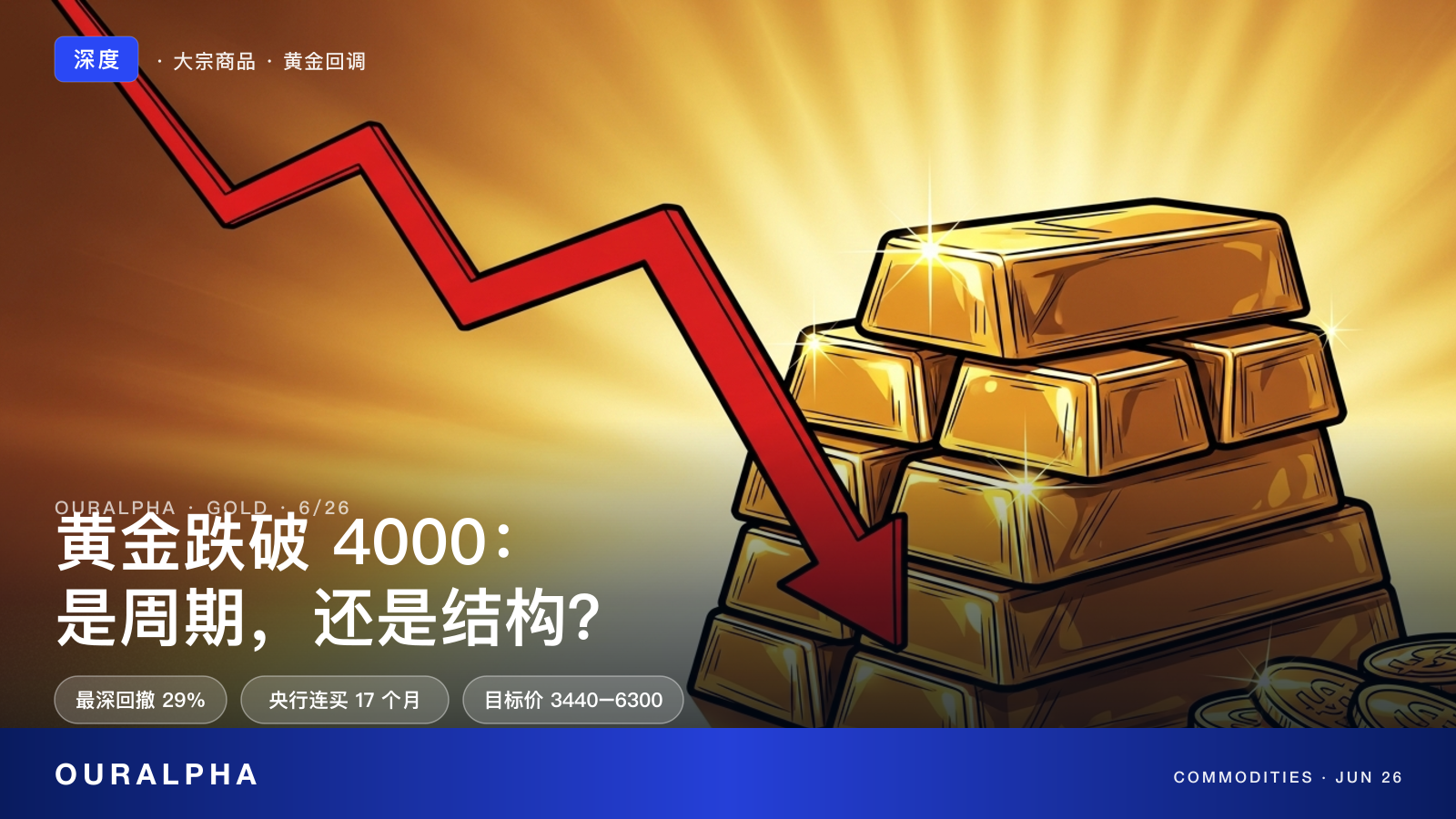
Gold Breaks $4,000: Cyclical Correction or Structural Crack?

Spot gold broke $4,000 on June 24, dropping to $3,959 intraday — nearly 29% off January's $5,594 all-time high. The three forces behind the selloff are all cyclical; the structural central bank bid — 17 consecutive months, ~850 tonnes per year — hasn't moved.

Gold price breaks $4,000 with 29% drawdown from all-time high — cyclical correction or structural breakdown analysis — gold bars and downward arrow — OurAlpha
What gold sold off was investor hands. Not central bank feet.

During New York trading on June 24, spot gold broke through $4,000, touching an intraday low of $3,959 — the first time since November 2025. Although gold managed to claw back above $4,000 over the following two sessions on the back of an "in-line" inflation print (hovering around $4,010 as of June 26), the curve that had surged to $5,594 in late January was now down nearly 29% from its all-time high.

Silver sold off even harder, briefly breaking below $60 and hitting lows near $58. Social media lit up with calls that "the gold bull market is over."

Let's frame the right question first: does $4,000 breaking signal the end of a three-year bull run, or is this a long-overdue, violent cyclical correction? Those sound similar — but they point to completely opposite conclusions for your portfolio.

This article works through one central question: cycle or structure.

01
Breaking $4,000: What Did This Selloff Actually Break?

Let's trace the path gold has traveled. On January 28, gold hit its all-time high of $5,594, when the loudest voices in the market were calling for $6,000. What followed was five months of choppy consolidation at elevated levels, with $4,000 holding as support in both March and June. Then this week, on Wednesday, it closed below that line for the first time — the first daily close under $4,000 in seven months.

Why does this level matter? Technically, once a repeatedly tested support breaks, it tends to flip from "floor" to "ceiling" — longs' cost basis becomes trapped sellers' exit target. More troubling: the 50-day and 200-day moving averages are converging, and markets have started talking about a potential "death cross." That's not fundamentals — but it amplifies sentiment.

Chart 1 | Gold's Wild Ride (USD/oz)
Jan 2026 All-Time High
5,594
Early June 2026
4,113
Jun 24 Intraday Low
3,959
Jun 26 Current Price (Back Above $4,000)
~4,010
~29% drawdown from the January all-time high. Bar lengths scaled proportionally to price. Data: Spot Gold (XAU), as of June 25, 2026.

Silver's steeper decline doesn't signal that the precious-metals thesis is broken — it reflects silver's higher beta. Silver is both a safe-haven metal and an industrial commodity, meaning risk-sentiment reversals hit it with amplified two-way swings. Reading silver's selloff as a collapse in the precious-metals narrative is a misread.

02
Three Forces: Why Now?

Price doesn't break a key level by accident. This week's selloff is the product of three forces converging in the same window.

The first — and most critical — is the Fed's pivot. Many investors still have gold's story pegged to "the Fed is cutting rates" — but that narrative has reversed. At its June 17 meeting, the Fed held rates at 3.50%–3.75% for the fourth consecutive time. The real signal was in the dot plot: the year-end rate median was revised up from 3.4% in March to 3.8%, with 9 of 19 officials projecting at least one more hike this year and 6 calling for at least two. The word "cut" has been erased from the rate outlook.

Underlying all of this: inflation. The meeting revised the 2026 PCE inflation forecast from 2.7% all the way up to 3.6%, and core PCE to 3.3%. Then May PCE (released June 25) came in at 4.1% YoY — the highest since April 2023 — with core PCE at 3.4% YoY, the highest since October 2023. Both matched consensus, which is precisely why gold didn't crater further and instead staged a brief rebound. Rate futures (CME FedWatch) are now pricing a ~63% probability of a September hike (it peaked near 68% just before the meeting), with roughly 80% odds of at least one hike by year-end (December).

For gold, this is the worst possible combination. Gold pays nothing; its biggest competitor is real rates. When markets shift from "waiting for cuts" to "bracing for hikes," real rates and the dollar rise in tandem — the dollar index hit a 13-month high this week — and the opportunity cost of holding gold jumps directly. This isn't sentiment; it's pricing mechanics.

The second force is the geopolitical premium unwinding. Over recent months, U.S.-Israel-Iran tensions had baked a "war premium" into gold. This week, as a temporary U.S.-Iran peace framework emerged, the Strait of Hormuz reopened, and oil prices dropped to four-month lows, that premium is being rapidly squeezed out. History shows it every time: safe-haven buying arrives fast and leaves faster. Once tensions cool, those positions are the first to be unwound.

The third force is dollar strength siphoning demand. A stronger dollar makes dollar-priced gold more expensive for buyers in other currencies, passively compressing demand. All three forces — real rates, a fading war premium, a strong dollar — point the same direction. This explains "why now." But note: every one of these forces is cyclical.

Chart 2 | The Fed's Hawkish Pivot in Three Months
Dark bars = March forecast; gold bars = June forecast. The further right each bar extends, the more bearish for gold.
2026 PCE Inflation Forecast
Mar 2.7%
Jun 3.6%
2026 Core PCE Forecast
Mar 2.7%
Jun 3.3%
Year-End Rate Median (Dot Plot)
Mar 3.4%
Jun 3.8%
Data: Federal Reserve June 2026 SEP Summary of Economic Projections / Dot Plot, June 17, 2026.
03
Central Banks' Foothold: Is the Bull's Foundation Still Intact?

Now for the other side of the scale. If investor buying is rate-sensitive and quick to exit, what has actually underpinned this three-year bull run is a steadier, heavier foot — central banks.

WGC data delivers a key fact: in Q1 2026, global central banks net bought roughly 244 tonnes of gold, up 3% YoY and above Q4 2025's 208 tonnes — the fastest single-quarter buying pace in 12 months. More importantly, this marks 17 consecutive months of net buying — covering precisely the stretch when gold traded at all-time highs. Central banks did not stop buying because gold was "too expensive."

Chart 3 | Central Bank Annual Net Gold Purchases (tonnes)
2022 was the watershed: annual purchases have since doubled — and stayed there.
Pre-2022 Annual Avg
~450
Full Year 2025
863
Full Year 2026 · WGC Forecast
~850
Data: World Gold Council (WGC) Gold Demand Trends Q1 2026, published April 2026.

The buyer list tells its own story. Poland led Q1 with +31 tonnes (targeting a 700-tonne reserve), Uzbekistan added 25 tonnes, and Kazakhstan 12 tonnes. China's total reserves have risen to roughly 2,313 tonnes, with monthly buying accelerating from around 1 tonne/month early in the year to 5 tonnes in March and 8 tonnes in April. Also worth noting: Guatemala, Indonesia, Uganda, Malaysia, and South Korea — long absent from gold markets — are returning or entering for the first time. A WGC official called it "phenomenal."

Why are central banks worldwide piling into gold at this exact moment? The answer isn't in the price — it's in the moment Russia's foreign reserves were frozen in 2022. That event sent every non-Western central bank a signal: dollar assets held within the Western financial system are not unconditionally safe. Gold — politically neutral, requiring no counterparty — became the natural anchor for de-dollarization and reserve diversification. In WGC's 2025 survey, 95% of respondent central banks expected global gold reserves to rise over the next 12 months, 43% planned to increase their own holdings, and not one planned to reduce.

That said, we need to be honest about the other side: this foot isn't monolithic. In Q1, Turkey sold 60 tonnes outright in March, and Russia was also a net seller — fiscal and FX pressures from high oil prices force some nations to tap gold as a "liquidity reserve." But these sales are tactical and emergency-driven, not a strategic reversal. The logic for buying (de-dollarization) is structural and long-term; the logic for selling (needing dollars) is cyclical and temporary. The two are not in the same league.

04
Wall Street Divided: Even the Big Banks Can't Agree

If direction is unclear, check whether the institutions are aligned — they aren't either. Several banks cut targets during this pullback: Goldman from $5,400 to $4,900, Deutsche Bank slashed from $6,000 to $4,800, and ING lowered its Q3/Q4 average price targets to $4,300 and $4,600 respectively. But even after those cuts, the vast majority of targets remain well above spot.

Chart 4 | Gold Price Targets by Institution (USD/oz)
Red dashed line = current price ~$4,010. Most institutions remain above spot.
Technical Bears
3,440
Morgan Stanley
4,400
Reuters Poll Median
4,746
Deutsche Bank
4,800
Goldman Sachs
4,900
JPMorgan
6,000
Wells Fargo
6,300
Data: Public 2026 price targets/year-end forecasts from each institution, as of June 2026. Bars scaled proportionally to price.

The most important takeaway from this chart isn't "who's right" — it's that the divergence stems from the same single variable: whether the Fed will actually enter a rate-hiking cycle. The technical bears targeting $3,440 and the Wells Fargo bulls targeting $6,300 are betting on opposite faces of the same coin. JPMorgan even named the biggest bear case explicitly: if the U.S. economy stays strong, employment holds, but inflation keeps accelerating and forces the Fed into a genuine hiking cycle, Western investor ETF flows could flip from inflows to sustained outflows — delivering real, lasting pressure on gold.

In other words, Wall Street's disagreement is fundamentally a disagreement about one macro scenario — the exact question this article comes down to.

05
Cycle or Structure: Is This Bull Market Over?

Pull the previous four sections together and the answer takes shape.

The three forces that drove this breakdown — a hawkish Fed, a fading geopolitical premium, a surging dollar — are all cyclical. They will shift with the next inflation print, the next FOMC meeting, the next geopolitical event. Real rates won't climb forever; the war premium has largely been priced out; the dollar has its own cycle. These are "investor hands" — rate-sensitive and quick to exit.

The foundation supporting this bull run — 17 consecutive months of central bank buying at nearly 850 tonnes annually, the structural global demand for a politically neutral reserve asset, persistently elevated sovereign debt, and the real-world failure of the 60/40 hedge — is all structural. It doesn't vanish because gold fell a few hundred dollars in a week. These are "central bank feet" — price-insensitive, slow but steady.

Our read: this looks far more like a violent but normal cyclical correction within a structural bull market than an end to the bull itself. A 29% drawdown from $5,594 is within "normal correction" territory for an asset with this kind of run — and one that was widely anticipated.

But there is one variable that could flip this call —
whether inflation forces a genuine rate-hiking cycle.

That is the only scenario that could simultaneously undercut both the "cycle" and "structure" legs: sustained high inflation forcing consecutive Fed rate hikes would keep real rates elevated long-term, not just suppressing gold but potentially triggering sustained outflows from gold ETFs as Western investors exit — exactly the "low-probability, high-impact" risk JPMorgan flagged. Whether it materializes depends on the next few months of PCE data, employment, and oil prices. Nobody can answer that with certainty today.

For investors, this means two things. First, don't treat this pullback as a bull market obituary — structural buyers are still in the game and the foundation hasn't shifted. Second, don't rush to "buy the dip" either, because the cyclical headwinds (strong dollar + elevated rates) haven't cleared. The $4,000 level — just barely reclaimed and still fiercely contested — along with the potential death cross, will continue capping near-term rallies. The real indicator to watch isn't the gold price itself; it's inflation data and Fed language — that's the referee deciding whether this bull market is at halftime or the final whistle has blown.

What gold sold off was investor hands.
Not central bank feet.
This article is original research from OurAlpha, provided for informational and research purposes only, and does not constitute investment advice. Data drawn from the World Gold Council, the Federal Reserve's SEP, publicly available investment bank research, and public market prices, as of June 26, 2026. Precious metals prices are highly volatile. Investing involves risk. Please exercise independent judgment.

This content is for informational purposes only and does not constitute investment advice, trading advice, or any guarantee of returns.

Stay ahead of the market — never miss a deep dive

Follow OurAlpha for AI-driven US equity research and market insight, every day.