
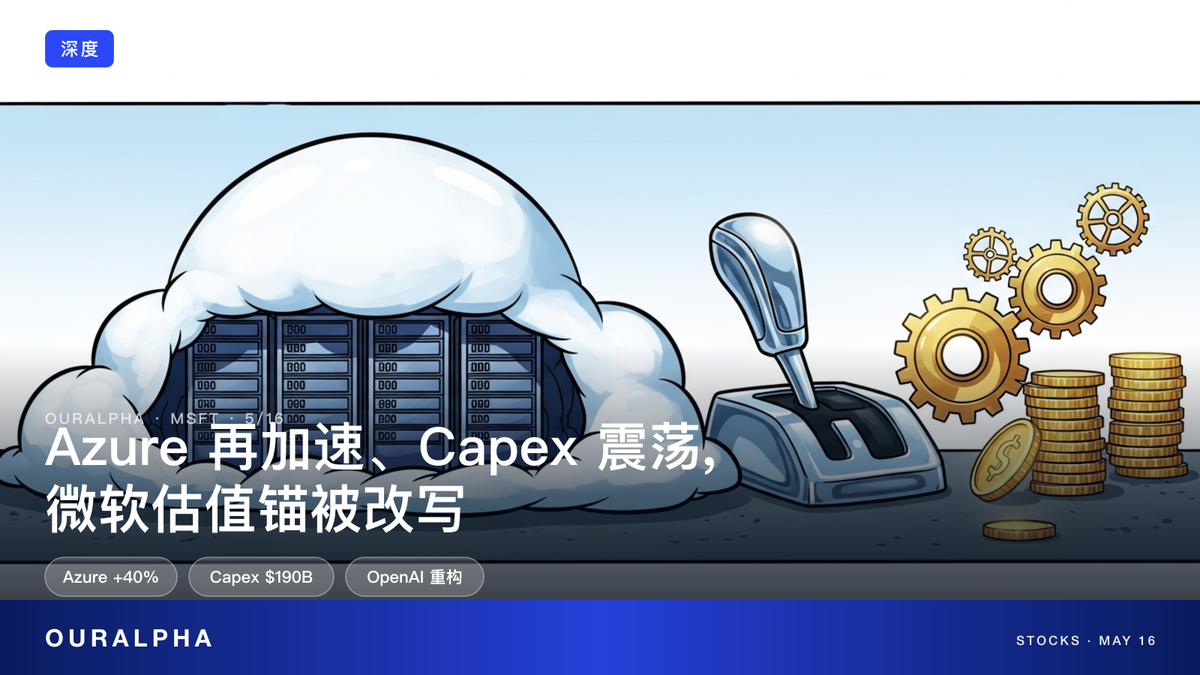
微软换挡:Azure +40% 第五季加速、$190B Capex 震荡与 OpenAI 大重构——估值锚正在被改写
微软 Q3 FY26 后的全维度复盘:Azure & other cloud services +40%(CC +39%)第五季加速、AI run-rate $37B、Copilot 2000 万付费坐席、Maia 200 自研芯片、OpenAI 重构(27% economic interest + 2032 IP license 非独家 + Azure-first)、Calendar 2026 ~$190B Capex 如何重写估值框架。附 OurAlpha 5 维评分、$569 目标价反推与未来 3 季度 5 个可执行指标。

TL;DR · 一句话叙事
微软($MSFT)2026 年 5 月的故事,已经从"OpenAI 独家代理 + Azure AI 受益"切换成"企业 AI 操作系统 + 重资本云基础设施"的重新定价。Q3 FY26 财报(2026/4/29 公布)本身很强——但市场当日打掉 -4~5%,定价压力不在增长本身,在增长的资本代价。
- Q3 FY26 营收 $82.9B(+18% YoY / CC +15%)、EPS $4.27(+23%),营收和 EPS 都超市场共识($81.4B / $4.06)[Microsoft IR]
- Microsoft Cloud 营收 $54.5B(+29% / CC +25%);Azure and other cloud services 增速 +40%(CC +39%)——这是 Azure 单季增速连续多个季度上行后的水平[Microsoft IR]
- Microsoft AI business annual revenue run-rate 突破 $37B,+123% YoY——管理层口径,非审计分部,未给出完整拆分公式[Microsoft 官方 X]
- Microsoft 365 Copilot paid seats 超过 2000 万;Accenture 超 74 万 seats;超过 50,000 seats 的客户数同比翻 4 倍[Microsoft IR]
- Commercial RPO 增至 $627B(+99% YoY)——含 OpenAI 长期算力合同,该数字受长期 AI/cloud contracts 显著影响,市场需要区分 OpenAI 相关合同与普通商业 backlog 的质量[Microsoft IR]
- Microsoft-OpenAI 新协议(2025/10/28 + 2026/4/27 两轮):MSFT 获得 OpenAI Group PBC 约 27% economic interest(按 $500B 估值约 $135B,非可直接并表资产);微软对 OpenAI IP 的 license 固定至 2032 年,但从独家变为非独家;微软仍是 OpenAI 的 primary cloud partner,OpenAI 产品默认 Azure-first,除非微软不能或选择不支持[OpenAI 官方]
- OpenAI 收入分成方向需要区分:微软官方表示微软不再向 OpenAI 支付收入分成;据 Reuters 报道,OpenAI 仍向微软支付 20% revenue share 至 2030,但总额设置未披露 cap[Reuters]
- Maia 200 ASIC 已正式发布(2026/1/26):TSMC 3nm、216GB HBM3e、>10 PFLOPS FP4,Iowa(US Central)已部署,下一站 Phoenix;面向下一代大模型推理 workloads;MSFT 自报性能/$ 较 Maia 100 提升 30%(厂商自报基准,非 MLPerf)[Microsoft Blog]
- Calendar 2026 capex 指引约 $190B(+61% YoY vs 2025)——注意:这是日历年口径,跨 FY26 H2 + FY27 H1,不等于 FY26 全年财年 capex;管理层称其中约 $25B 来自组件价格上涨;Q3 FY26 单季 capex $31.9B,Q4 FY26 指引 >$40B[CNBC]
- 市场定价:股价 $421.92(截至 2026/5/15 收盘)、市值 $3.13T、Forward P/E 约 22x;StockAnalysis 口径:37 位分析师覆盖、consensus Strong Buy、平均目标价 $569.46、区间 $415–$680[Stock Analysis]
这次重构对微软不是单边利空——它压低了独家分发溢价,但也降低了 OpenAI 单点合同的尾部风险:原先围绕 AGI 触发条款的合同不确定性被弱化,IP license 固定到 2032 年,27% economic interest 把 OpenAI 估值上行的好处锁进财务结构。
接下来三个季度,市场真正要看的不再是 Azure 单季是否漂亮——而是 Copilot 坐席和 ARPU 能否继续上台阶、Maia 系列是否能在 Azure inference workloads 中形成可观占比并降低单位推理成本、$190B calendar 2026 capex 是否能转化为可见的自由现金流回报、以及 OpenAI 多云之后 Azure-first 优先权的实际"含金量"。任一条变弱,"AI 操作系统"叙事就会被打折。
OurAlpha 评分
| 维度 | 评分 | 说明 |
|---|---|---|
| 基本面强度 | 8.5/10 | Azure & other cloud services +40%、AI run-rate +123%、Copilot 20M seats,增长质量强 |
| 披露透明度 | 6.5/10 | AI run-rate、Copilot ARR、Azure AI 贡献、Maia 200 成本优势都缺少独立细拆 |
| 资本效率可见度 | 6/10 | calendar 2026 ~$190B capex 是最大变量,对应 ROIC 尚未被充分证明 |
| 估值吸引力 | 7.5/10 | 22x forward P/E 不贵,但 EPS 路径受折旧节奏与组件涨价影响 |
| 叙事稳定性 | 7/10 | 从"OpenAI 独家代理"切到"enterprise AI OS",叙事更大但也更复杂 |
综合 7.1/10——适合作为 Mag 7 核心长仓研究对象,但不适用"OpenAI 独家代理"旧框架估值。
一、Q3 FY26 财报:再次 beat,但市场被 capex 击中
微软 Q3 FY26(季度截至 2026/3/31)数据[Microsoft IR]:
| 项目 | Q3 FY26 | YoY | vs Street 共识 |
|---|---|---|---|
| 总营收 | $82.9B | +18%(CC +15%) | beat($81.4B) |
| 运营利润 | $38.4B | +20%(CC +16%) | — |
| 净利润(GAAP) | $31.78B | +23% | — |
| 摊薄 EPS(GAAP) | $4.27 | +23% | beat($4.06) |
| Microsoft Cloud 营收 | $54.5B | +29%(CC +25%) | — |
| Azure & other cloud | — | +40%(CC +39%) | 略 beat |
| AI run-rate(管理层口径) | >$37B | +123% | — |
Q4 FY26 指引[Investing.com 电话会 transcript]:
- 总营收 $86.7B–$87.8B(+13~15%)
- Intelligent Cloud $37.95–38.25B(+27~28%)
- Productivity & BP $37.0–37.3B(+12~13%)
- More Personal Computing $11.75–12.25B
- Azure CC 增速继续指引 +39~40%(基本"维持目前速度")
三个 segment 拆分:
| Segment | 营收 | YoY | 含义 |
|---|---|---|---|
| Productivity & Business Processes | $35.0B | +17%(CC +13%) | M365 Copilot 涨价 + 坐席扩张是主要驱动 |
| Intelligent Cloud | $34.7B | +30%(CC +28%) | Azure 引擎全力 ramp |
| More Personal Computing | $13.2B | −1%(CC −3%) | Windows OEM 弱、Xbox hardware −33% |
Intelligent Cloud cost of revenue +47%(CC +44%)[Alphastreet]——这就是 capex / 折旧的传导。营收增速 +30%、cost of revenue +47%——长期看,Intelligent Cloud 毛利率会被结构性压扁。这是 5/16 这一周最被卖方反复讨论的数字。
OurAlpha 视角:营收 / EPS / Azure 全面 beat,但市场给的反应是 4/30 收盘 −4~5%[24/7 Wall St.]——核心就是 capex shock(详见第六节)。这是个重要信号:MSFT 在被市场切换估值框架——从"AI 受益者"切到"AI 重资本基础设施公司"。
二、Azure +40% 与 AI 披露口径的变化
Q3 FY26 数据:Azure and other cloud services 增速 +40%(CC +39%)[Microsoft IR]。注意这是 Microsoft 公开口径——Azure 单一产品并不被微软单独报告,而是与 other cloud services 合并。
近几个季度增速节奏(CC 口径,按公开财报):
| 季度 | Azure & other cloud services CC 增速 |
|---|---|
| 之前几个季度 | 持续高 20% 区间逐步上行 |
| Q3 FY26 | +39% |
| Q4 FY26 指引 | +39~40% |
无论以哪一季为锚,这都是超大云中相当强的增速。Hood 在电话会再次提到 2026 全年算力依然偏紧[Futurum 分析]。
值得注意的披露口径变化:过去几个季度微软更常披露"AI services contributed X points to Azure growth"这类百分点拆分。Q3 FY26 这一季叙事重心转向 $37B AI run-rate。这个变化未必是负面,但会降低投资人对"Azure AI vs 非 AI"增长拆分的可见度。
关于 $37B AI run-rate 的口径说明:这是微软管理层口径的 AI annualized revenue run-rate,根据管理层描述大致涵盖 Azure AI 客户、frontier model company workloads、以及 Microsoft 第一方 AI 应用与服务等,但微软没有给出完整审计分部拆解[Microsoft 官方 X]。它不应被当作独立业务分部收入,投资人需要警惕"run-rate 数字增长但毛利质量"的口径与可比性问题。
Azure 算力供需现状:
- 依然 capacity-constrained——Hood 在电话会再次提到 2026 全年算力都偏紧[Futurum 分析]
- Q3 净新增 ~1 GW 数据中心容量,管理层称 2 年内全球数据中心物理足迹翻倍[Global Datacenter Hub]
- Q1 FY26 单季数据中心租赁支出 $11.1B[DCD]——capex 之外的 OpEx 数字,说明 Azure 在以"自建 + 租赁"双轨抢占容量
OurAlpha 视角:Azure 故事的硬数字仍在——+40% / CC +39% + capacity-constrained 是"需求超供给"的典型信号。披露口径的微调更像微软在"$37B run-rate 已成主叙事抓手"之后的统一表达,但短期内会让"Azure AI vs 非 AI"边界更模糊,估值锚需要重画。
三、Copilot:2000 万付费坐席背后的真实结构
官方披露的关键数据[Microsoft IR][Microsoft 官方 X]:
- Microsoft 365 Copilot 付费坐席超过 2000 万
- Accenture 超过 74 万 seats(最大单笔)
- 超过 50,000 seats 的客户数同比翻 4 倍
- 多家大型企业(Bayer / Johnson & Johnson / Mercedes-Benz / Roche 等)部署规模显著
GitHub Copilot(最近一次官方更新为 Q2 FY26 / 2026 年 1 月)[Motley Fool]:
- 付费订阅约 470 万(+75% YoY)
- 2026/6/1 起转为按 token 用量计费[GitHub Blog]——商业模式切换至 usage-based,未来 ARR 与实际用量绑定
关于 Copilot ARR 的口径说明:Copilot 单独 ARR 没有被微软单独披露——折在 $37B AI run-rate 里。如果以 $30/user/month list price 粗算,2000 万 seats 对应 $7.2B annualized list-value;但考虑企业批量折扣、bundle、分阶段启用与实际 seat utilization,实际 ARR 可能明显低于 list-value。
$7.2B annualized list-value 经过通常的 50–70% 企业 ASP 折扣后,作者估算的实际 ARR 可能落在 $3.5–5.5B 区间。这是 OurAlpha 的情景估算,不应被理解为微软披露收入,也不应等同审计分部数字。
Copilot 的真正信号:
- 大客户部署正在扩大:50,000+ seats 客户数翻 4 倍 + Accenture 单家 74 万——企业部署进入"全员级"阶段
- 2000 万 → 5000 万是下一个量级:FY27 中能否到 4000 万、何时到 5000 万定价点,是 ARPU 与坐席数双轮驱动的关键观察点
- 5/1 发布的 Agent 365 GA($15/user/月)[Microsoft Security Blog]——这是 Copilot 之上的下一层 SKU,让企业用户可以编排 AI agent;AWS Bedrock / Google Cloud 注册表同步在 preview——MSFT 主动把 Agent 365 做成跨云产品
- M365 E7 SKU $99/user/月[SAMexpert]——5 月新发布的顶级 SKU,是 ARPU 上行的关键
OurAlpha 视角:Copilot 是 MSFT 这轮 AI 周期里"应用层最确定"的资产。问题不在能不能涨,而在"AI run-rate 不分解"会让市场对 Copilot 单独估值的能力受限——一旦市场要把它当作单独的 SaaS 业务估值(类似 ServiceNow 的 P/S),需要更多披露。这是未来 2-3 个财报季管理层会面对的压力。
四、OpenAI 关系大重构:从"独家分发"到"primary cloud + Azure-first + 非独家 IP + capped revenue share"
这是 2026 年 MSFT 故事最大的结构性变化。两个关键时点:
2025/10/28(OpenAI 重构)[CNBC]:
- OpenAI 拆为 OpenAI Group PBC(for-profit)+ OpenAI Foundation(nonprofit)
- 基于 $500B OpenAI 估值,MSFT 获得 OpenAI Group PBC 约 27% economic interest(按估值折算约 $135B——注意:这是按估值折算的 economic interest,不是普通意义上可直接并表的股权资产,也不应被理解为现金等价物)[Tom's Hardware]
- Foundation 持 26%、员工+投资人 47%
2026/4/27(第二轮修订)[OpenAI 官方]:
- IP license 固定到 2032 年,且从独家变为非独家
- 新协议弱化/移除了围绕 AGI 触发的合同不确定性。此前市场担心一旦 OpenAI 宣称实现 AGI,微软的访问权、分成与合作边界可能发生重大变化;新协议把微软对 OpenAI 模型与产品的 IP license 固定到 2032 年——但该 license 变为非独家[The Decoder]
- Azure 独家分发失效,OpenAI 可通过任何云服务商向客户提供产品;但微软仍是 OpenAI 的 primary cloud partner——根据微软官方表述,"OpenAI products will ship first on Azure, unless Microsoft cannot and chooses not to support the necessary capabilities"[Directions on Microsoft]
收入分成方向需要区分(这是最容易被读者误读的一段):
- 微软官方表述:Microsoft will no longer pay a revenue share to OpenAI——即微软不再向 OpenAI 支付收入分成[OpenAI 官方]
- Reuters 报道:OpenAI 向 Microsoft 支付的 20% revenue share 保留至 2030 年,但总额设置 undisclosed cap——cap 触发后该义务消失[Reuters]
触发事件:2026/2 AWS-OpenAI 大单[Nerd Level Tech]:
- AWS 投资 OpenAI 高达 $50B
- AWS 成为 OpenAI "Frontier" enterprise 平台的独家第三方云
- 这是 MSFT-OpenAI 独家性失效后的第一个具体落地案例
MSFT 的反向动作——接盘 OpenAI 放弃的 Stargate 资产:
- Stargate Norway:OpenAI/Oracle 退出后 MSFT 接手;MSFT 从 Nscale 租 3 万颗 NVIDIA Vera Rubin 芯片,5 年合同,目标 10 万 GPU 总规模;建立在之前 MSFT $6.2B 承诺基础上[Bloomberg]
- Stargate Texas:Oracle/OpenAI 放弃后 MSFT 接手[Bloomberg]
- 据媒体报道,OpenAI 对其长期基础设施支出计划进行了显著下修/重排(早期市场估算到 2030 累计 $1T+ 量级;最新报道口径下修至 $600B 量级)[CNBC]——这是 MSFT 接盘部分 Stargate 资产的背景
4/2 MSFT 发布 3 个自研 foundation model[TechCrunch]——这是 MSFT 正式从"OpenAI 代理"转为"模型独立提供方"的明确信号。
OurAlpha 视角:这次重构对微软不是单边利空——它压低了独家分发溢价,但同时降低了 OpenAI 单点合同的尾部风险:
- **27% economic interest(按 $500B 估值约值 $135B)**比"无限期独家性"更具长期 IRR——OpenAI 估值再涨一倍,MSFT 直接对应的 economic interest 价值也跟涨;但这不是可直接并表的经营资产
- 弱化 AGI 触发不确定性:旧合同下 AGI 触发对微软访问权、分成与合作边界都构成 tail risk;新协议把 IP license 固定到 2032,把这一风险显著降低(但 license 变为非独家)
- Azure-first 优先权对新模型首发:根据微软官方表述,OpenAI 产品仍会先上 Azure,除非微软不能或选择不支持——这保留了"AI 主干道"地位,但需要微软主动行使
- 收入分成方向重塑:微软不再向 OpenAI 支付分成;OpenAI 仍向微软支付 20%(capped 至 2030)——双方都接受的"清算路径"
反向风险:
- OpenAI 现在可以在 AWS 上和 MSFT 直接竞争同类企业客户——AWS 拿 OpenAI、MSFT 也卖 OpenAI,企业可能选 AWS 因为更便宜
- Azure-first 仍是优先权而非独家权:如果 Azure 容量跟不上,OpenAI 可以合规地走 AWS——"含金量"取决于微软算力供给与商业意愿
- 独家分发溢价被削弱:原本"OpenAI = Azure"的简单估值故事终结,市场需要新的估值锚
五、Maia 200:MSFT 的 ASIC 反击战
Maia 200[Microsoft Blog] 是 MSFT 第二代自研 AI inference 芯片,2026/1/26 正式发布:
| 维度 | Maia 200(MSFT 官方) |
|---|---|
| 制程 | TSMC 3nm,140B+ 晶体管 |
| 内存 | 216GB HBM3e @ 7 TB/s,272MB SRAM |
| 算力 | >10 PFLOPS FP4,>5 PFLOPS FP8 |
| TDP | 750W |
| 部署 | Iowa(US Central)已 live,Phoenix(US West 3)next |
| 工作负载 | 面向下一代大模型推理 workloads |
MSFT 自报性能(厂商 presentation 口径,未经独立第三方 benchmark 验证)[Microsoft EMEA Source]:
- 比 Maia 100 性能/$ 提升 30%——这是 MSFT 自己 fleet 内的代际对比
- FP4 算力约为 AWS Trainium 3 的 3 倍(MSFT 自报)[Tom's Hardware]
- FP8 算力高于 Google TPU v7(Ironwood)(MSFT 自报)
注意:上述对外厂商对比是 MSFT 单方面 presentation 数据,没有 MLPerf 类独立基准跑分,对应不同精度 / 系统级 / 单芯片口径——这些数字适合说明微软的 ASIC 野心,不适合直接证明 Maia 200 已经全面领先 Trainium / TPU。
Maia 200 的产业意义:
- ASIC 反击战:MSFT 是 Mag 7 里最依赖 NVDA 的客户之一(参考 NVDA 深度的 ASIC 围城分析)。Maia 200 是 MSFT 减少 NVDA 依赖的核心抓手
- 推理战场:Maia 200 定位明确为 inference accelerator——不挑战 NVDA 的训练市场,主攻 inference 这一 ASIC 的天然池子
- 垂直整合的闭环信号:如果下一代大模型推理在 Maia 200 上 ramp 起来,意味着 MSFT 已经走通了"模型 - 芯片 - 数据中心"垂直整合的第一个真实闭环
- Phoenix 之后是全球部署:Iowa + Phoenix 是开局,2027 之后预期欧洲 + 亚太——长期会显著影响 NVDA 在 Azure 数据中心的 GPU 采购比例
OurAlpha 视角:Maia 200 不是"取代 NVDA"——而是让 MSFT 在 NVDA 议价桌上获得筹码。短期看,2026 capex 里 ~2/3 仍然是 GPU 采购;中期看,Maia 系列能否在 Azure inference workloads 中形成可观占比、并真正降低单位推理成本,是判断 MSFT 资本效率的关键。这里 Maia 占 Azure inference 池"20-30%"的具体百分比属于情景假设(微软未披露 inference 池口径),但方向意味着 NVDA 在 MSFT 这一大客户的 ASP 议价空间会被压缩——这是 NVDA 客户集中度风险的具体兑现路径之一。
六、Capex 指引重新定价:calendar 2026 ~$190B 是怎么打爆估值的
Calendar 2026 capex 指引约 $190B(+61% YoY vs 2025)[CNBC]——这是 4/29 电话会上 Hood 给出的数字。
口径说明(非常重要):$190B 是 calendar year 2026(日历年)口径,不等同于 FY26 全年资本开支——微软财年以 6 月 30 日结束,所以 $190B 实际上跨 FY26 H2(2026/1–6)+ FY27 H1(2026/7–12)。本文及任何对比都按"calendar 2026"理解。
已披露的具体数字:
- Q3 FY26 单季 capex $31.9B
- Q4 FY26 capex 指引 > $40B
- vs Street 共识 ~$154.6B → 高出 ~$35B[Global Datacenter Hub]
Capex 增量拆解(管理层口径):
- ~$25B 来自 memory / 组件价格上涨——不是新增容量,而是同样容量花更多钱(HBM3e/HBM4 紧缺、TSMC 3nm 加价等)
- 剩余 ~$10B 来自实际扩容
- 总 capex 约 2/3 投入 GPU/CPU 硅芯片,剩 1/3 是 shell / 土地 / 电力 / 制冷
为什么 Q3 财报当天 MSFT 跌 -4~5%[24/7 Wall St.]:
- 未来折旧压力(粗略估算):如果按 5-7 年折旧周期摊销,$190B 的 AI infrastructure investment 会在 FY27-FY30 形成持续的折旧压力。但不能简单把 $190B / 6 = $32B 视为某一年的新增折旧——因为 capex 是滚动投入、资产类别不同(土地、shell、设备、GPU、网络、租赁)、投产节奏与折旧年限均有差异
- 市场对 "AI ROIC" 开始追问:2024-2025 市场愿意"信仰 capex";2026 起开始追问"每花 $1 capex 拿回多少营收"。Microsoft 的回答:"Azure +40% + AI run-rate $37B"——但管理层没有给出对应的 ROIC 数字
- 资本回报受影响:Q3 单季股东资本回报(股息 + 回购)$10.2B[Microsoft Source]——以这个速度年化约 $40B,远小于 calendar 2026 capex $190B
一个非标准但直观的观察指标——"资本回报 / capex"(注意:这不是华尔街标准财务指标,是 OurAlpha 自创的对比口径,仅用于直观对比 capital allocation 的方向变化):
- FY25 资本回报 ~$36B、capex ~$80B → 比例 ~45%
- FY26 资本回报 ~$40B(估算)、calendar 2026 capex ~$190B → 比例跌到 ~21%
这是 MSFT 这轮 AI 周期的"硬币背面"——前面是 Azure +40% 的故事,背面是"现金流大部分被重新投入而非返还股东"。这种切换会让一部分红利型 / GARP 投资人重新评估持仓。
OurAlpha 视角:calendar 2026 ~$190B capex 本身不是问题——MSFT 的现金生成能力可以撑住。真正问题在于 ROIC 兑现节奏:
- 乐观情景:Azure +40% 维持 + Copilot 加速向 5000 万坐席 + Maia 系列降低 inference 单位成本——FY28 EPS 仍可保持高增速
- 悲观情景:Azure 进入基数效应放缓 / OpenAI 多云分散增长 / 折旧吞掉 EPS——FY28 EPS 增速可能掉到中低双位数
5/20 NVDA 财报、7 月底 Q4 FY26 财报、10 月底 Q1 FY27 财报——这三个事件每一个都会调整市场对"calendar 2026 capex 的回报"的预期。
七、估值与 Price In:$569 共识、22x Forward P/E、$3.13T 市值
当前数据(截至 2026/5/15 收盘)[Stock Analysis]:
| 项目 | 数值 |
|---|---|
| 股价 | $421.92(截至 2026/5/15 收盘) |
| 市值 | $3.13T |
| Forward P/E | 约 22x |
| Trailing P/E | 24.39x |
| 股息率 | 0.86% |
| 52 周区间 | $356.28 – $555.45 |
| 分析师覆盖 | 37(StockAnalysis 口径) |
| 共识评级 | Strong Buy |
| 平均目标价 | $569.46(+35%) |
| 中位目标价 | $575 |
| 最高 / 最低 | $680 / $415 |
| FY26 营收共识 | $335.36B(+19%) |
| FY26 EPS 共识 | $17.06(+25%) |
MSFT 在 Mag 7 估值光谱里的位置:
- 按 StockAnalysis 当前估值口径,MSFT forward P/E 约 22x,低于过去几年市场常给微软的高 20x 区间,也低于部分高增长 Mag 7 标的(不同数据平台 forward EPS 口径不同,需注意可比性)
- +35% 目标价空间 + Strong Buy 共识——市场情绪显著乐观于当前价格
共识里已经被定价的故事:
- Azure 增速继续 +35-40% 到 FY27
- Copilot 坐席继续翻倍
- OpenAI 重构后的 27% 股权 + Azure-first 优先权可以保住模型首发
- Maia 200 顺利 ramp,2027 起对 NVDA 议价
- $190B capex 在 FY28-FY29 兑现成 ROIC 上行
还没被定价的反向风险(每一个都能 derate 估值 10%+):
- Azure 增速进入"加速 - 维持 - 减速"曲线的拐点(5 季加速之后必然有放缓)
- Copilot 单坐席 ARPU 在企业批量折扣后实际不及预期
- OpenAI 在 AWS / Google 上和 Azure 直接价格竞争,把 enterprise OpenAI ASP 打下来
- Maia 200 量产 / 良率不及预期,NVDA 议价空间没打开
- 美国 / 欧盟反垄断调查针对 Microsoft-OpenAI 关系或 Copilot bundle
- $190B capex 在 2027 进一步上调(市场对 ROIC 容忍度阈值会被打穿)
OurAlpha 视角:Forward P/E 约 22x 对一家Azure CC +39% + 27% OpenAI economic interest + Copilot 2000 万 seats 的公司,估值并不夸张。问题不在估值倍数本身,在于 EPS 路径:
- 如果 FY27 EPS 跟随 FY26 节奏继续上行,$569 共识目标价相对容易兑现
- 如果折旧 / 组件价格继续压制 EPS 增速,估值倍数会被压回 18-20x 区间
OurAlpha 简化反推(非卖方共识模型):22x × $25 FY28 EPS(共识乐观情景)≈ $550;如果 FY28 EPS 只到 $22(折旧拖累情景),那么估值要 26x 才能撑 $570——这就要市场愿意给 MSFT 一个"AI 操作系统"溢价倍数。这是 OurAlpha 的简化反推,不是卖方目标价的统一计算方式。
八、下一个 3 季度:5 个会改写估值的关键指标
5 个可执行指标:
- Q4 FY26 财报(7 月底):Azure & other cloud services CC 增速能否守住 +39%——指引是 +39~40%,任何 +38% 以下都会被视为"加速结束"
- Copilot 坐席披露节奏——3000 万 / 4000 万哪个季度兑现 + 是否给出 ARPU / ARR 拆分,是定价 Copilot 业务的关键
- OpenAI 重构后的 Azure-first 履约含金量:OpenAI 下一代旗舰模型是否仍在 Azure 首发?任何 OpenAI 把新模型同步首发到 AWS Bedrock / Google Cloud 都会实质性削弱 Azure-first 价值
- Maia 系列在 Azure inference workloads 中的占比与单位推理成本变化——Iowa + Phoenix 之后 ramp 节奏是 2026 H2 / 2027 H1 关键观察;MSFT 是否公开披露相关比例本身就是信号
- Calendar 2027 capex 指引——市场最敏感的数字。继续大幅上调会再打一波估值;明显收缩会被视为"AI 周期降温"也会打估值。只有"温和上行 + 配套 ROIC 信号"才会被视为正面
九、反向风险:什么情况会让这个判断翻车
- 估值切换风险:从"AI 受益者"切到"AI 重资本基础设施公司"——后者估值倍数天然低于前者,过渡期波动放大
- OpenAI 关系进一步松动:4/27 修订只是中间态;2028-2030 区间若 OpenAI 完全独立 IPO,MSFT 的"模型供应优势"会进入清算路径
- Copilot ARPU 兑现不足:2000 万坐席的列表价 vs 实际折扣后 ARPU 之间有较大解释空间
- Maia 200 量产瓶颈:TSMC 3nm 产能与 HBM3e 供应都偏紧;任何良率 / 交付问题都会延迟 NVDA 议价时机
- 超大厂集体减速:Big Five capex 在 2027 任何一家明确收紧,整个 AI 板块估值会被重估
- 反垄断风险:Microsoft-OpenAI 关系 + Copilot bundle 持续受美国 / 欧盟监管关注;任何调查升级都会成为短期催化空头
- More Personal Computing 持续疲软:Q3 −1%——Windows OEM / Xbox Hardware 走弱,虽然占比小(16%),但反映消费侧 AI PC 升级周期没有兑现
- AI 安全监管落地:5/5 MSFT + Google + xAI 同意把未发布模型给美国政府预审[CNN]——短期是 PR 利好,长期会对模型发布节奏产生约束
十、押注三件事:现在买 MSFT 等于在买什么
买 MSFT 不再是"买 OpenAI 独家代理"。现在买 MSFT,本质是在押注三件事:
- Azure 仍是 AI 操作系统的主入口——即使 OpenAI 走向多云,Azure 凭借 enterprise stickiness + Copilot bundle + Microsoft 365 base 仍能保住"AI 应用层标准 OS"地位
- Copilot + Agent 365 + M365 E7 的 ARPU 上行——单用户 / 单坐席收入未来 3 年从 ~$30/月走向 ~$80/月(含 Agent 365 + E7 + Copilot),这是最干净的成长引擎
- 27% OpenAI PBC economic interest 的二次估值上行——OpenAI 估值 $500B → $1T+ 路径若成立,MSFT 这部分 economic interest 价值 $135B → $270B 是单纯的"非业务性"价值释放(注意:这是 economic interest 不是可直接并表的经营资产)
如果你相信这三条 = 现在 $421 是合理偏便宜的介入点; 如果你对第一条(Azure 主入口)开始动摇 = 仓位应该降低; 如果你对第二条(Copilot ARPU)开始动摇 = MSFT 估值会回到 18-20x。
MSFT 是 Mag 7 里"故事最完整"的那个——它同时是云、模型、应用、Agent、芯片、操作系统、硬件、游戏的合集。Q3 FY26 财报告诉市场两件事:基本面仍然加速、但估值框架正在切换。
胜负看 ARPU + ROIC。
A 类:官方披露——Microsoft IR、10-Q、官方产品页、SEC 文件、OpenAI 官方公告。例:Q3 FY26 营收 $82.9B、Azure +40% CC +39%、Copilot 付费坐席 2000 万、Maia 200 specs(216GB HBM3e / 10+ PFLOPS FP4)、OpenAI 27% 股权 + 2032 IP 到期。
B 类:管理层电话会口径——Nadella / Hood 在 earnings call 上的发言。例:AI run-rate $37B、Calendar 2026 capex ~$190B、Q4 FY26 Azure 指引 +39~40%、Accenture 74 万 Copilot 坐席、Azure 容量仍紧。
C 类:主流媒体 / 卖方报道——CNBC、Bloomberg、Reuters、24/7 Wall St 等。例:Stock Q3 financial day drop -4~5%、Stargate Norway/Texas MSFT 接盘、AWS-OpenAI $50B 交易细节、Maia 200 自报 vs Trainium 3 / TPU v7 性能对比。
D 类:情景假设——OurAlpha 对 Copilot ARPU、Azure 增速曲线、OpenAI 估值上行、Maia 200 inference 池占比的推演。例:Copilot 实际 ARR ~$40-55 亿、FY28 EPS +12-25% 的情景区间、Maia 200 在 Azure inference 池 2027-28 跑到 20-30%。
文中涉及 AI run-rate 内部构成、Copilot 单独 ARR、Maia 200 跨厂商性能对比、OpenAI 估值二次上行、capex 折旧路径的内容,均不应视为 Microsoft 官方指引。
关于数据口径的额外说明
- 股价与估值:$421.92 / Forward P/E 22.12x 截至 2026-05-15 美股收盘,会随市场实时变化
- AI run-rate $37B 是管理层口径,含 Azure AI + OpenAI 收入分成 + Copilot + GitHub/Dynamics AI;无公开方法论文档
- Copilot 单独 ARR 没有审计分部数据——文中估算 $40-55 亿基于卖方对企业批量折扣的假设
- 27% OpenAI 股权账面价值 $135B 是 $500B 估值下的对应金额;MSFT 10-Q 用 equity / cost method 入账,不是按 $135B 直接列示
- $190B capex 是 calendar 2026 口径(含 FY26 H2 + FY27 H1),不等于 FY26 全年 capex
- Maia 200 自报性能对比(vs Trainium 3 / TPU v7)来自 MSFT 单方面 presentation,无独立第三方基准
- 文章中所有"OurAlpha 视角 / 观点 / 情景估算"段落 = 编辑判断,非投资建议
Sources
- Microsoft Q3 FY26 Earnings Release — Microsoft IR
- Microsoft Cloud and AI Strength Fuels Q3 Results — Microsoft Source
- AI Run-Rate $37B + Copilot 20M Seats — Microsoft Official X
- Azure Hits 40% Growth, AI Business $37B Run-Rate — Alphastreet
- Microsoft Q3 FY26 Earnings Call Transcript — Investing.com
- Microsoft FY26 Q3 Results Explained (RPO $627B) — LicenseQ
- Microsoft Q3 FY26 Earnings: $190B Capex — CNBC
- Microsoft Falls 5% Despite Q3 Beat — 24/7 Wall St.
- Microsoft Q3 FY2026 The $190B Capex Breakdown — Global Datacenter Hub
- Microsoft Spent $11.1B on Data Center Leases in Q1 FY26 — DCD
- Microsoft Cloud Growth with Capacity Still Tight — Futurum Group
- Copilot Reaches 20 Million Paid Enterprise Seats — Let's Data Science
- GitHub Copilot Paid Subscribers ~4.7M — Motley Fool
- GitHub Copilot Moves to Usage-Based Billing June 2026 — GitHub Blog
- Microsoft Agent 365 Now Generally Available — Microsoft Security Blog
- Microsoft 365 E7 SKU $99 May 2026 — SAMexpert
- Next Phase of Microsoft Partnership (2026/4/27 Amendment) — OpenAI
- OpenAI Restructured to For-Profit, MSFT 27% — CNBC
- OpenAI PBC Restructure, MSFT 27% Stake $135B — Tom's Hardware
- OpenAI-Microsoft Deal: No More Exclusivity, No More AGI Clause — The Decoder
- Microsoft-OpenAI Amend Their Agreement Again — Directions on Microsoft
- What Microsoft's 10-Q Says About OpenAI (Rev Share Cap) — OM.co
- AWS-OpenAI $50B Deal Trigger — Nerd Level Tech
- Microsoft Takes Over Norway OpenAI Data Center Capacity — Bloomberg
- Microsoft to Rent Texas Data Center Dropped by Oracle/OpenAI — Bloomberg
- OpenAI Infra Spend Cut from $1.4T to $600B — CNBC
- Microsoft Three New Foundation Models — TechCrunch
- Maia 200 AI Accelerator for Inference — Microsoft Blog
- Microsoft Maia 200 Specs and Benchmarks — Tom's Hardware
- Maia 200 +30% Perf/Dollar vs Maia 100 — Microsoft EMEA Source
- MSFT/Google/xAI Government Pre-Test Agreement — CNN
- MSFT Forecast and Analyst Price Targets — Stock Analysis
本文内容仅作信息分享,不构成任何投资建议、交易建议或收益承诺。