Bank of America Reverses Course, Now Sees Three Fed Rate Hikes in 2026
Bank of America reversed course in a June 22 note, calling for three Fed rate hikes in 2026 — September, October, and December, each 25bp — pushing rates to 4.25%–4.50%. Sticky inflation, resilient jobs, and rising energy prices drove the pivot.

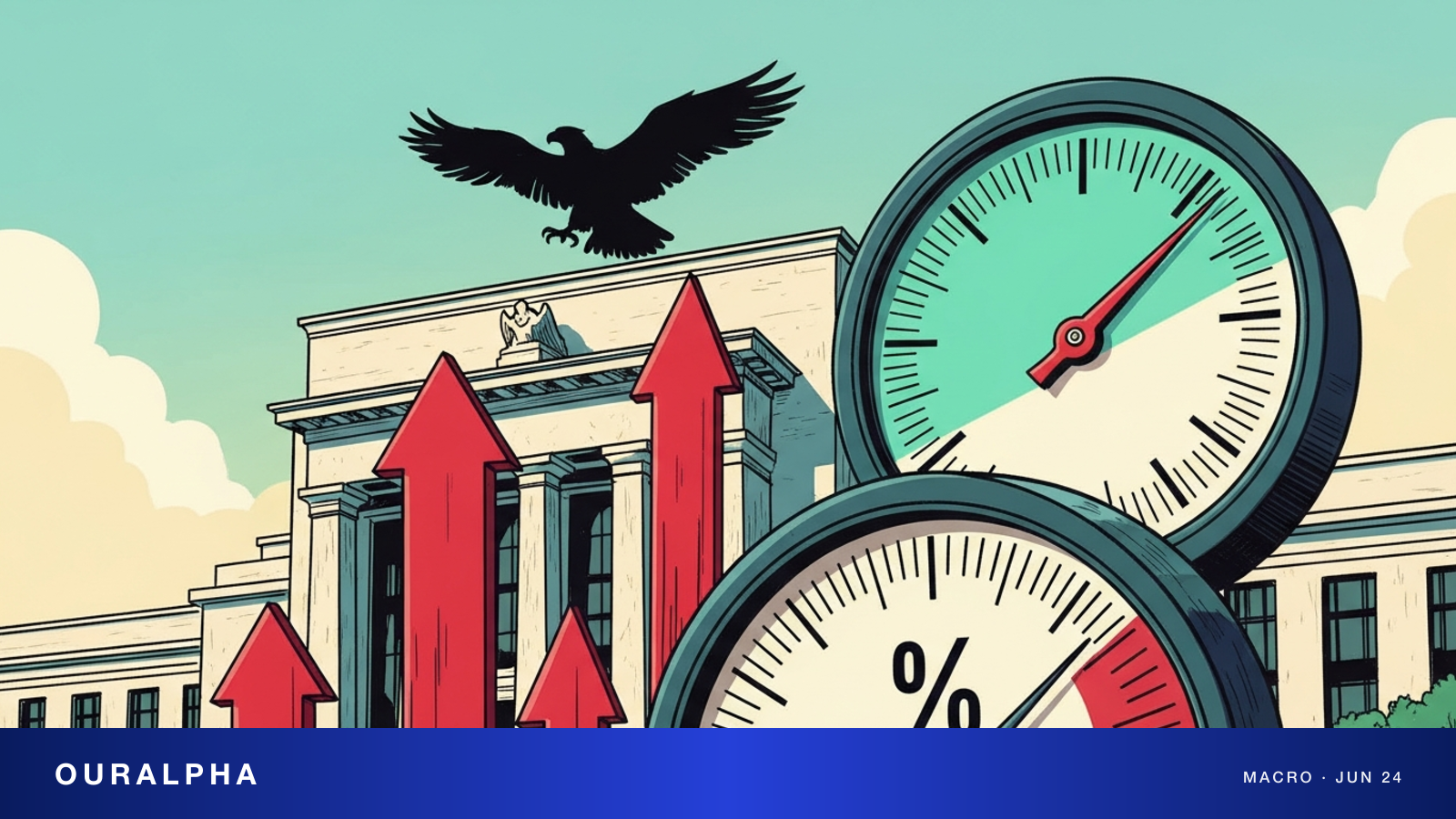
Bank of America (BofA) sharply reversed its prior stance in a June 22 note, forecasting three Fed rate hikes this year instead of a hold. Key takeaways:
- BofA expects 25bp hikes in September, October, and December, lifting the federal funds rate from the current 3.50%–3.75% to 4.25%–4.50%.
- Just last week, BofA's base case was a full-year hold — making this a clear hawkish reversal.
- The rationale: stronger-than-expected job growth, sticky inflation, and rising energy prices.
- BofA projects core PCE to run at 3.5% annualized, partly reflecting "one-time" contributions from tariffs.
- The call is among the most hawkish on Wall Street, well ahead of current market pricing.
Bank of America (BofA) revised its Federal Reserve policy outlook in a note published Monday, June 22. BofA economists now expect three rate hikes this year — 25 basis points each in September, October, and December — pushing the federal funds rate from its current 3.50%–3.75% range to 4.25%–4.50%.1 According to CNBC, roughly a week earlier BofA's base case was still a full-year hold, making the shift a clear directional reversal.1
BofA's Forecast in Detail
BofA's projected path amounts to three consecutive 25bp moves — 75 basis points of cumulative tightening:
- September: +25bp
- October: +25bp
- December: +25bp
- Terminal target range after all three moves: 4.25%–4.50%
The note was authored by BofA economist Aditya Bhave. As reported by CNBC, Bhave wrote that the Fed's inflation problem has become "unambiguously worse" — a line widely cited across financial media.1 To be clear, the hike schedule is BofA's forecast — not a decision the Fed has made.
Why BofA Reversed Course
Per the BofA note and Fortune's reporting, the hawkish turn rests on several factors:2
- Job growth has strengthened this year, with labor data proving more resilient than previously expected
- Inflation remains sticky: shelter disinflation "has largely run its course," while other core services prices remain stubborn
- Energy prices have risen — Fortune notes that geopolitical conflict has pushed oil higher
- Tariffs and ongoing supply shocks continue to exert upward pressure on prices
On the inflation front, Fortune reports that BofA projects core PCE could reach 3.5% annualized — roughly 70 basis points above year-ago levels — though the bank acknowledges the figure includes "one-time" contributions from tariffs.2
Warsh's Signals and Market Pricing
Fortune reports that new Fed Chair Kevin Warsh recently struck what media described as a hawkish tone. Warsh acknowledged that monetary policy is "somewhat restrictive" but argued the stance is "not uniformly so," and he did not push back on the prospect of rate hikes.2 CNBC also noted that Bhave highlighted Warsh's repeated emphasis on restoring price stability.1
CME FedWatch data show rate-hike odds for the second half have risen markedly:
- September hike probability: ~72.8%
- October hike probability: ~80.6%
- December hike probability: ~87.9%
Financial media reports that two weeks ago markets priced in roughly one 25bp hike for the full year; bets on a December move have since risen sharply.3 Even so, BofA's three-hike call remains one of the most hawkish on Wall Street — more aggressive than the path currently implied by markets.
Dissenting Views
Not everyone sees hikes as imminent. Fortune reports that Chen Zhao, Chief Global Strategist at Alpine Macro, believes "the probability of actual tightening remains very low."2 Zhao's reasoning: oil prices could retreat, small businesses are under strain, AI is lifting productivity, and wage growth is trending softer.2
In the bond market, Fortune reports that the 10-year Treasury yield rose roughly 4.6 basis points to 4.497% on June 23; Brent crude fell about 4% the same day to $77.29 a barrel.2 The market remains divided on the Fed's path — BofA's three-hike forecast is one bank's call, and the ultimate outcome will depend on incoming jobs and inflation prints, as well as the Fed's own deliberations.
Sources
- CNBC — Bank of America sees 3 Fed hikes in 2026, inflation 'unambiguously worse'
- Fortune — The Fed is fed up with inflation and will bring down the hammer with a series of rate hikes this year, BofA says
- Bitcoin.com News — Bank of America: Fed's Inflation Problem 'Unambiguously Worse' as It Forecasts 3 Rate Hikes in 2026
- Yahoo Finance — 3 Fed Rate Hikes Now on Bank of America's 2026 Radar
This content is for informational purposes only and does not constitute investment advice, trading advice, or any guarantee of returns.