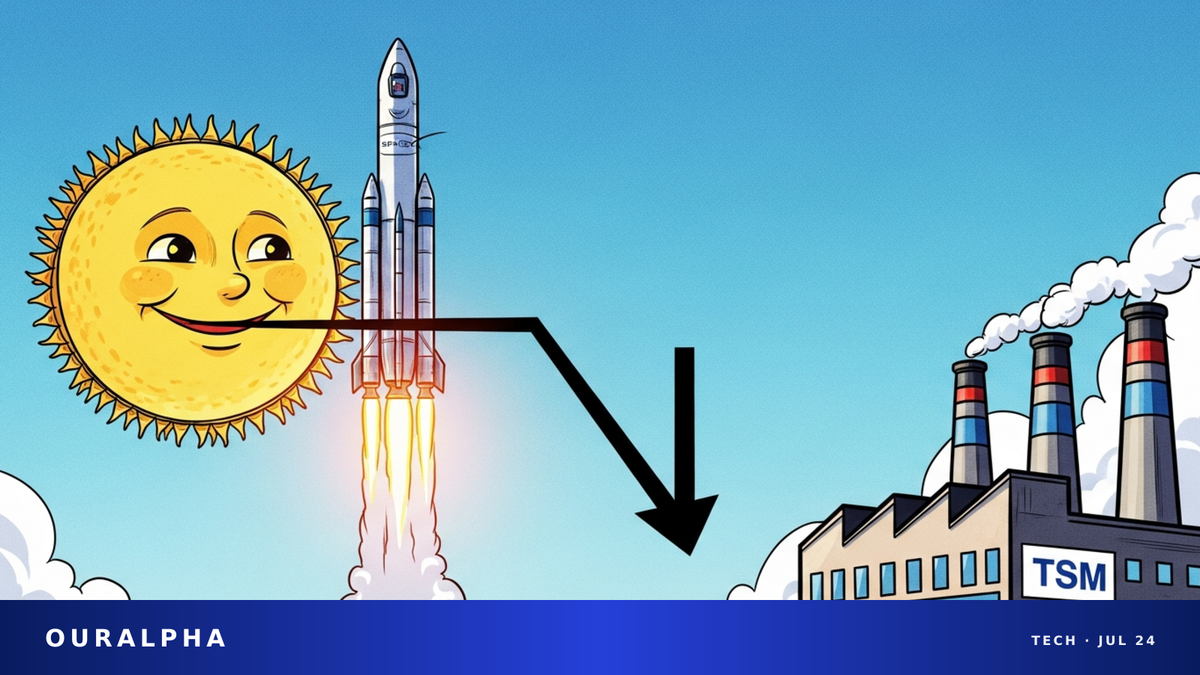
Credo Downgraded: Can SpaceX Tailwinds Offset the Risk of Overpriced Frontier AI Customers?

Seeking Alpha cuts Credo Technology Group to Hold, warning that its premium valuation already prices in the SpaceX win and that demand from high-flying U.S. AI startups carries real downside risk.

Credo downgrade SpaceX tailwinds US frontier AI valuation risk
Credo’s dual narrative of SpaceX orders and AI clients faces a valuation reckoning.

Network chip designer Credo Technology Group (CRDO) has been downgraded to Hold by a Seeking Alpha analyst, who argues that the stock’s rich valuation already reflects the SpaceX win and that demand from overvalued U.S. frontier AI startups is a real risk.

  • As of ~12:30 p.m. ET on July 24, Credo (CRDO) traded at $411.37, down 1.01% from the prior close of $415.58.
  • Seeking Alpha analyst downgraded Credo from Buy to Hold, saying the current price already prices in near-term growth expectations.
  • The analyst notes SpaceX’s Starlink project is a strong tailwind, but the premium valuations of U.S. frontier AI clients (e.g., Cerebras, Groq) pose a risk.
  • Credo’s stock has surged over the past year, partly reflecting its partnership potential with SpaceX and its AI networking business.
  • The analyst believes Credo’s position in high-speed data-center interconnects (e.g., AECs) is solid, but competition and customer concentration remain concerns.

Network chip designer Credo Technology Group (CRDO) has been downgraded to Hold by a Seeking Alpha analyst, who argues that the stock’s rich valuation already reflects the SpaceX win and that demand from overvalued U.S. frontier AI startups is a real risk. As of ~12:30 p.m. ET on July 24, Credo (CRDO) traded at $411.37, down 1.01% from the prior close of $415.58.[Seeking Alpha]

SpaceX Order and Frontier AI Client Narrative

In a recent report, the Seeking Alpha analyst noted that Credo is riding two growth engines: SpaceX’s Starlink satellite internet project, which provides a strong tailwind, and the networking needs of U.S. frontier AI startups like Cerebras and Groq. These clients’ demand for high-speed, low-latency network chips is fueling Credo’s business in data-center interconnects such as active electrical cables (AECs).[Seeking Alpha]

However, the analyst also warned that these frontier AI clients themselves carry the risk of excessive valuation premiums. If their funding environment or commercial deployment falls short, Credo’s order stability could take a hit. Furthermore, Credo’s high customer concentration—relying on a few big clients—amplifies earnings volatility.[Seeking Alpha]

Valuation Pressure and Downgrade Logic

The core reason for the downgrade is valuation. The analyst believes Credo’s current stock price already fully reflects the SpaceX order and AI networking growth expectations—and may have even priced in years of future upside. The report states: “While Credo’s technology and customer relationships are impressive, the current valuation lacks a margin of safety.”[Seeking Alpha]

The analyst further explained that Credo’s P/E and P/S ratios are among the highest in the industry, and market expectations for future growth may be overly optimistic. Given the cyclical nature of the semiconductor industry and the uncertainty around AI capex pacing, the risk/reward for a Buy rating is no longer attractive.[Seeking Alpha]

‘DHQ’ Stocks and Credo’s Market Position

A separate Seeking Alpha article took a broader view, exploring the investment logic behind “DHQ” (Digital High Quality) stocks like Credo, SpaceX (private), and Amazon (AMZN). It argued that these companies represent core assets in the digital infrastructure space with high long-term growth certainty.[Seeking Alpha]

But the article also cautioned that even DHQ stocks need to align valuation with fundamentals. Credo, as a high-speed network chip specialist, has unique advantages in frontier areas like AI data centers and satellite communications, but the market has already priced in a lot. Investors need to weigh its technological moat against the current valuation.[Seeking Alpha]

Competition and Outlook

In the high-speed network chip market, Credo faces competition from giants like Broadcom (AVGO) and Marvell (MRVL), which are also aggressively building AI data-center interconnect solutions. Credo’s edge lies in its proprietary SerDes technology and AEC products, but the battle for market share will continue.[Seeking Alpha]

The analyst believes Credo’s long-term growth thesis remains intact, but the stock may face near-term valuation compression. The market will be watching its upcoming earnings closely to see if results can justify the high expectations. Additionally, the pace of SpaceX Starlink deployment and the capex plans of frontier AI clients will be key swing factors for Credo’s future.[Seeking Alpha]

This content is for informational purposes only and does not constitute investment advice, trading advice, or any guarantee of returns.

Keep Reading

Magnificent Seven Lose $797 Billion in a Day — Apple Stands Alone as the Anti-Capex Safe Haven

Magnificent Seven Lose $797 Billion in a Day — Apple Stands Alone as the Anti-Capex Safe Haven

A tech selloff sparked by earnings from Tesla and Alphabet peaked during Thursday’s session, sending the Magnificent Seven index down 4.8% in a single day and erasing roughly $767 billion in market value — the worst one-day drop since the tariff shock of April 2025. But by Friday’s session, Apple (AAPL) had bounced back, becoming the market’s go-to “anti-capex” trade.

  • The Magnificent Seven index fell as much as 4.8% on Thursday, wiping out roughly $767 billion in market cap (Yahoo Finance
Read full story →

Stay ahead of the market — never miss a deep dive

Follow OurAlpha for AI-driven US equity research and market insight, every day.