Fed Minutes Reveal Rare Split: Hawk and Dove Camps in Near-Deadlock

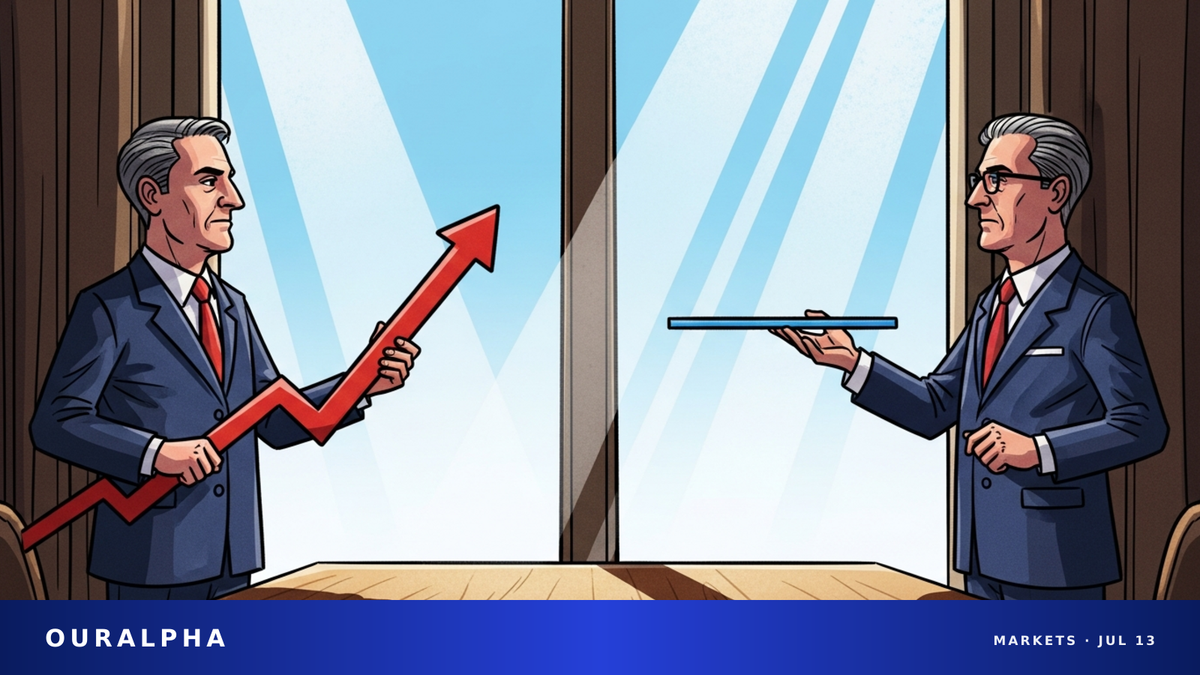
The Fed’s June meeting minutes show a rare, evenly matched split between officials who favor holding rates steady and those pushing for hikes. Markets may be overpricing the risk of near-term tightening.

Fed split hawk dove meeting minutes
The Fed's hawk and dove camps are in near-deadlock, leaving markets uncertain on the next move.

The Fed’s June meeting minutes revealed a rare, evenly matched split among policymakers on the inflation outlook and the rate path: one camp favored holding rates steady, while the other argued for hikes. Markets may be overpricing the risk of near-term tightening.

  • The June 16-17 FOMC minutes showed that the number of participants expecting the policy rate to remain unchanged or edge lower by year-end was “roughly as large” as those expecting it to be higher.[Commerzbank via Bitget]
  • The word “many” was used to describe the size of both camps, implying they are roughly equal in size.[Commerzbank via Bitget]
  • Under an adverse scenario where inflation persists and broadens, most Fed officials would be prepared to raise rates; under a favorable scenario where inflation eases, most would be comfortable holding rates steady or eventually cutting.[Reuters]
  • New York Fed President John Williams said the minutes “captured the collective reaction function,” even though that wasn't their design.[Reuters]
  • EY-Parthenon chief economist Gregory Daco noted the minutes mark a shift in Fed communication under Chair Kevin Warsh from broad risk-management language to explicit scenario-based policymaking.[Reuters]
  • Commerzbank expects no rate hikes in the coming months, with the fed funds rate staying at 3.75% until early 2027 before a cut to 3.50%.[Commerzbank via Bitget]

The Fed’s June meeting minutes laid bare a deep internal divide over inflation risks and the rate path. The minutes showed that the number of participants expecting the policy rate to remain unchanged or edge lower by year-end was “roughly as large” as those expecting it to be higher.[Commerzbank via Bitget] This rare deadlock has left markets in a fog of uncertainty over the Fed’s next move. As of the close on July 10, 2026, Goldman Sachs (GS) traded at $1,055.18, down 0.07% (-$0.79) from the prior close of $1,055.97. The stock opened at $1,063.21, hit a high of $1,067.17 and a low of $1,048. With markets closed for the weekend, the stock remains at that closing price with no real-time movement.

The Deadlock and the Scenario-Based Framework

The June 16-17 FOMC meeting minutes, described by economists as “milquetoast,” nonetheless clearly reflected Fed officials’ heightened vigilance on inflation.[Reuters] The minutes revealed “notable differences of opinion” in the discussion of the monetary policy outlook.[Commerzbank via Bitget] For many participants, the most likely scenario was for the policy rate to remain unchanged or be slightly lower by year-end; for many others, the rate would be higher. The word “many” was used to describe both groups, implying they are roughly equal in size.[Commerzbank via Bitget]

EY-Parthenon chief economist Gregory Daco commented shortly after the minutes were released: “The minutes provide the clearest articulation yet of the Fed’s reaction function under Chair Warsh, marking a shift from broad risk-management language to explicit scenario-based policymaking.”[Reuters] In a follow-up comment to Reuters, he added: “What struck me is that this scenario discussion wasn’t framed as a risk-management strategy. Instead, it was designed to show the consensus on the reaction function across different scenarios, even if the two camps are evenly matched.”[Reuters]

Inflation Risk and Hike Options: Policy Responses Under Two Scenarios

The core of the minutes revolved around a discussion of different scenarios and their likely policy responses. The clearest signal: under an adverse scenario where inflation persists and broadens, most Fed officials would be prepared to raise rates; under a favorable scenario where inflation eases, most would be comfortable holding rates steady or eventually cutting.[Reuters]

New York Fed President John Williams said at a conference on July 10: “I think [the minutes] show the richness of these scenarios.” He added: “Some parts of the inflation outlook could be a bit more benign, like on tariffs, or on energy prices, depending on how things develop. But there are other scenarios where inflation is more persistent and stays elevated, which would require tighter monetary policy. I think that’s the right way to think about it.”[Reuters]

Compared to the April 28-29 meeting minutes, the tone in June shifted markedly. In the April minutes, “a few” participants thought rate cuts would be appropriate once there was clear evidence that the disinflation process was firmly back on track or that the labor market showed more pronounced signs of weakness. “Most” participants, however, thought that if inflation remained above the 2% target, “some degree of policy tightening might become appropriate.”[Reuters] Reuters analysis noted this means the rate-cut camp is shrinking, and policymakers are showing greater openness to rate hikes.[Reuters]

Market Take: Hike Pricing May Be Overdone

Commerzbank analysts Dr. Christoph Balz and Bernd Weidensteiner wrote in a July 10 report that recent softer U.S. inflation data, the FOMC’s internal balance, and the fed funds rate projections (staying at 3.75% until early 2027 before a cut to 3.50%) all support the view that “the market is overpricing further tightening and the next major move will be a rate cut.”[Commerzbank via Bitget] They stated: “We continue to expect no rate hikes from the Fed in the coming months.”[Commerzbank via Bitget]

However, Reuters’ coverage highlighted a different interpretation. The “dot plot” released after the June meeting showed that policymakers now see a much higher probability of rate hikes than cuts.[Reuters] But the minutes themselves struggled to clearly reflect that outlook, describing two apparently overlapping groups: in a scenario where inflation is about to ease, “most” participants thought “almost all” would support holding rates steady or cutting; in a scenario where inflation remains elevated, “most” participants thought “almost all” would support tightening.[Reuters]

Warsh’s Communication Shift and External Views

The concise style of the minutes also sparked discussion about the influence of new Fed Chair Kevin Warsh. Reuters noted that several economists observed the absence of the risk-management section that had been a fixture of the minutes under Jerome Powell.[Reuters] Warsh had previously advised market participants to assess Fed policy based on economic data rather than over-analyzing Fed officials’ comments.[Commerzbank via Bitget]

Meanwhile, geopolitical factors added another layer of uncertainty to the inflation outlook. Reuters reported that renewed tensions in the Middle East have put a spotlight on the upcoming batch of price data reports.[Reuters] Jason Pride, head of investment strategy and research at Glenmede, said on CNBC that the market is “getting desensitized to geopolitical conflict.”[CNBC] The comment suggests that despite the Middle East tensions, the market may have already partially priced in their potential impact.

This content is for informational purposes only and does not constitute investment advice, trading advice, or any guarantee of returns.

Keep Reading

SpaceX-Tesla Merger Won’t Save TSLA Investors, Analysts Warn

SpaceX-Tesla Merger Won’t Save TSLA Investors, Analysts Warn

SpaceX stock has tumbled 25% since its June IPO, its debt is trading like junk, and Tesla (TSLA) closed at $407.76 before the weekend. Top analysts warn that even a merger between the two companies won’t save Tesla investors.

  • SpaceX (SPCX) shares have fallen 25% since the June IPO, wiping $1.8 trillion off its market cap[Forbes
  • SpaceX’s Baa1/BBB+/BBB-rated bonds are now trading like junk[Forbes
  • Starlink revenue hit $11.387 billion in 2025 with $4.423 billion in
Read full story →

Stay ahead of the market — never miss a deep dive

Follow OurAlpha for AI-driven US equity research and market insight, every day.