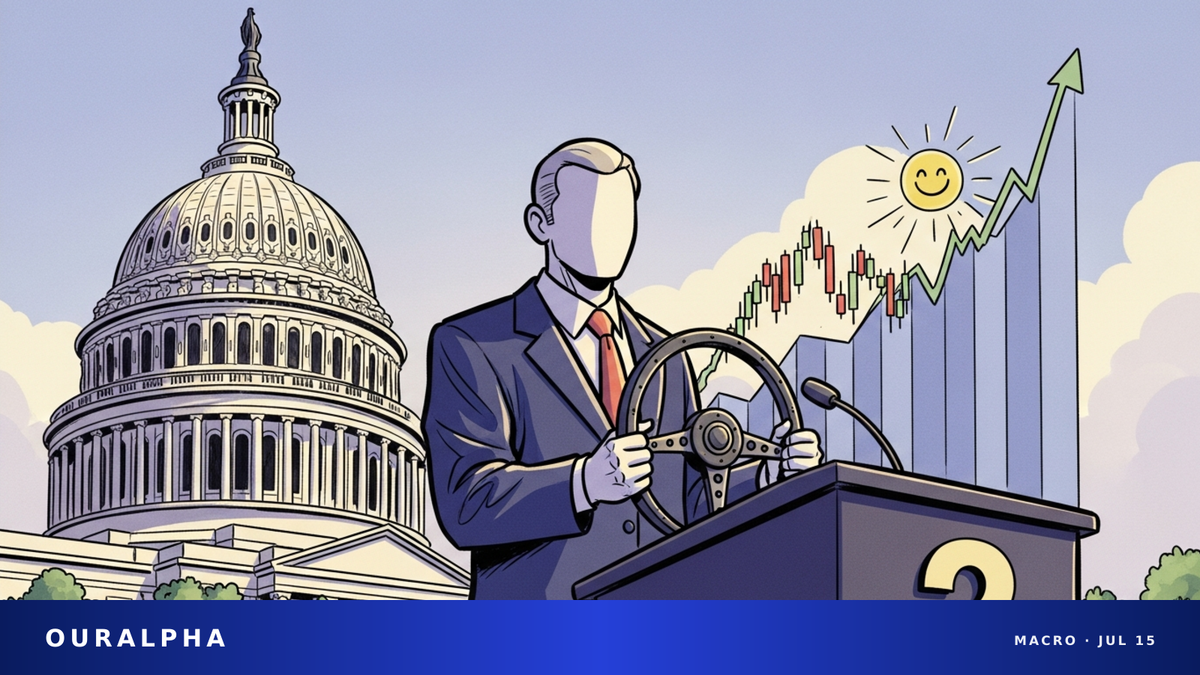
Fed Chair Warsh’s Capitol Hill Debut: Inflation Fight Not Over, Rate Path a Mystery

Fed Chair Kevin Warsh told Congress Tuesday that June’s CPI improvement doesn’t mean “mission accomplished” on inflation, and refused to tip the Fed’s hand on rate moves. Markets slashed July hike odds to 17% as oil prices climbed on escalating Middle East tensions.

Federal Reserve Chairman Kevin Warsh testifies before Congress on inflation and interest rate policy
Warsh’s first Capitol Hill testimony: Inflation improving but not defeated, rate path remains a puzzle.

Federal Reserve Chair Kevin Warsh told Congress Tuesday he’s still committed to crushing inflation, but refused to tip the Fed’s hand on rate moves, calling June’s CPI improvement “a data point” — not “mission accomplished.” As of 7:15 a.m. ET Wednesday, U.S. equity futures were modestly mixed as markets digested his remarks and the uncertainty from escalating Middle East tensions.

  • June CPI fell to 3.5% year-over-year from May’s 4.2%; core CPI dropped to 2.6% from 2.9%, both below expectations.
  • Warsh called the inflation data “a data point,” refused to over-interpret it, and said “63 months of above-target inflation is an unfair burden on the American people.”
  • Market odds for a July rate hike collapsed to 17% from 42% a day earlier, though September remains in play.
  • Brent crude rebounded above $84/barrel; WTI near $79/barrel as the Middle East conflict keeps energy prices elevated.
  • Warsh announced five new Fed working groups to review monetary policy communication, the balance sheet, economic data, productivity and employment, and the inflation framework.
  • The S&P 500 rose 0.5% Tuesday, the Nasdaq gained 1.1%, but the Dow edged down 0.1% as IBM plunged 25%.

Federal Reserve Chair Kevin Warsh made his first appearance before Congress as the central bank’s chief Tuesday, delivering the semiannual Monetary Policy Report to the House Financial Services Committee. Warsh stressed that despite June’s notable inflation cooldown, the Fed has “zero tolerance for persistently elevated inflation” and vowed to bring it back to the 2% target. He also sidestepped any hint of the future rate path, saying the Fed should not pre-commit to a direction before its meetings.[CNN] As of 7:15 a.m. ET Wednesday, U.S. equity futures were modestly mixed as markets weighed his remarks and the geopolitical risks from the Middle East.

Inflation Improving, But Not ‘Mission Accomplished’

Warsh struck a cautious tone on the June CPI data during the hearing. The Bureau of Labor Statistics reported that headline CPI slowed sharply to 3.5% year-over-year from May’s 4.2%, while core CPI (excluding food and energy) fell to 2.6% from 2.9% — both below economist forecasts.[CNN] Yet Warsh made clear: “I’m not going to over-interpret or cherry-pick data. Some people might look at this morning’s numbers and say ‘Oh, mission accomplished, all good.’ That’s not my view.”[Axios]

In his opening statement, Warsh reiterated that the Fed has “no tolerance for persistently elevated inflation” and said “63 months of above-target inflation is an unfair burden on American families and businesses, and we intend to eliminate that burden.”[Yahoo Finance] He added that the Fed will remain independent of political influence and promised to communicate any changes to its balance sheet policy well in advance.[CNN]

Rate Path a Mystery: Warsh Breaks With ‘Forward Guidance’ Tradition

Warsh’s most striking move in the hearing was his refusal to offer any clues on the future rate path. He explicitly said the Fed should stop pre-committing to a rate direction before its meetings, arguing: “If we give a forecast for what we’ll do in two weeks, we’ll be tempted to look for information that supports our preconceived view and reject information that doesn’t. That’s not how we want to operate.”[Axios]

That stance marks a sharp break from the post-financial-crisis tradition of “forward guidance,” where Fed officials routinely signaled the likely policy direction through speeches and meeting minutes. Warsh’s silence leaves markets to parse other officials for clues. Fed Governor Christopher Waller said Monday that while inflation could fall to 2% without further tightening, there is still a “credible possibility” that data stays elevated or re-accelerates, in which case “tighter monetary policy would be warranted.”[Axios] New York Fed President John Williams last week gave a more specific benchmark: if the Fed’s preferred core inflation gauge consistently exceeds a 0.2% month-over-month pace, policy would need to respond.[Axios]

Markets reacted swiftly. According to CME FedWatch data, traders slashed the implied probability of a July rate hike to 17% from 42% a day earlier, though September remains priced in.[CNN] Warsh himself declined to comment on how the CPI data affected his outlook, calling it merely “a data point.”[Axios]

Middle East Conflict Pushes Oil Higher, Adds Inflation Uncertainty

Warsh’s testimony came as Middle East geopolitical tensions escalated. According to Reuters, the U.S. and Iran traded strikes over the weekend, with Tehran claiming it had closed the Strait of Hormuz while President Trump insisted the waterway remained open to commercial traffic.[Fortune] Iran’s Islamic Revolutionary Guard Corps (IRGC) reportedly attacked U.S. bases in Bahrain, Kuwait and Jordan, while U.S. Central Command (CENTCOM) said it acted after Iran struck another commercial vessel.[Fortune]

Oil prices have climbed steadily. As of Tuesday, Brent crude had rebounded to $84.35/barrel, with WTI near $78.70/barrel — both well above the pre-conflict level of just under $70/barrel.[CNN] Goldman Sachs said in a Sunday report that rising oil prices are creating a knock-on effect on inflation expectations, which in turn influences the path of the Fed’s benchmark rate.[Fortune] Deutsche Bank’s Jim Reid described the conflict as “sharply escalating.”[Fortune]

Warsh acknowledged during the hearing that the Middle East situation is one of the risks to the inflation outlook. At his post-June-meeting press conference, he had said energy price volatility is a key focus for the Fed.[CNN] Analysts note that if oil stays elevated, June’s inflation improvement could prove temporary, adding another layer of uncertainty to the Fed’s policy path.

Fed Reform and Independence: Warsh’s Five Working Groups and Political Pressure

Warsh laid out his reform plans for the Fed in detail. He announced five working groups to study: communication, balance sheet policy, economic data, productivity and employment, and the inflation framework.[CNN] These groups will first report to the 19 members of the Federal Open Market Committee (FOMC), after which Warsh himself will release the findings to the public.[CNN] On the balance sheet, Warsh promised any policy changes would be “previewed, explained, debated” with markets well in advance, and would not be implemented without sufficient notice.[CNN]

Warsh was also pressed repeatedly on the Fed’s political independence. When Rep. Nydia Velázquez (D-NY) asked if he works for President Trump, Warsh replied: “We are an independent central bank.” He added: “We are honored to remain independent. Outside the four walls of the Fed, there is no doubt a lot of politics.”[CNN] The comment came against the backdrop of Trump’s earlier public support for Warsh as Fed chair, which had fueled market concerns that Warsh might bow to White House political pressure.[Reuters]

Warsh also touched on the economic impact of artificial intelligence (AI). He noted that the AI-related investment boom is creating some inflationary pressure, but so far the technology has not led to job losses — instead, it “has made workers more productive — and I say ‘a little,’ because I think productivity is still ahead of us.”[Axios]

Market Reaction: Stocks Mixed, Oil and Geopolitical Risk Dominate Sentiment

U.S. stocks ended mixed Tuesday. The S&P 500 rose 0.5%, the Nasdaq Composite gained 1.1%, and the Russell 2000 added 0.4%. The Dow Jones Industrial Average fell 65 points, or 0.1%, dragged down by a 25% plunge in IBM — its worst single-day performance on record.[CNN]

Energy was the sector in focus. Oil prices rose Tuesday, with Brent crude settling at $84.35/barrel and WTI at $78.70/barrel, both up about 1% from the prior session.[CNN] The gains extended a multi-day rally following the escalation of the U.S.-Iran conflict over the weekend. Futures markets indicate crude prices are expected to keep rising in the coming months and to hold around $72/barrel by year-end.[Fortune]

Warsh is scheduled to testify before the Senate Banking Committee on Wednesday, where markets will be watching closely for any additional clues on the rate path or the Middle East situation.[CNN]

This content is for informational purposes only and does not constitute investment advice, trading advice, or any guarantee of returns.

Keep Reading

Eli Lilly’s Retevmo Wins Full FDA Approval, Expanded to More Lung Cancer Patients

Eli Lilly’s Retevmo Wins Full FDA Approval, Expanded to More Lung Cancer Patients

The FDA has granted full approval to Eli Lilly’s (LLY) RET inhibitor Retevmo (selpercatinib) for adults with RET fusion-positive locally advanced or metastatic non-small cell lung cancer (NSCLC), expanding the label beyond the accelerated approval. As of the July 14 close, Lilly shares were at $1,152.54, down 2.48% from the prior close of $1,181.87, with an intraday low of $1,140.74. U.S. markets were closed for a holiday on July 15, so no real-time price changes are

Read full story →

Stay ahead of the market — never miss a deep dive

Follow OurAlpha for AI-driven US equity research and market insight, every day.