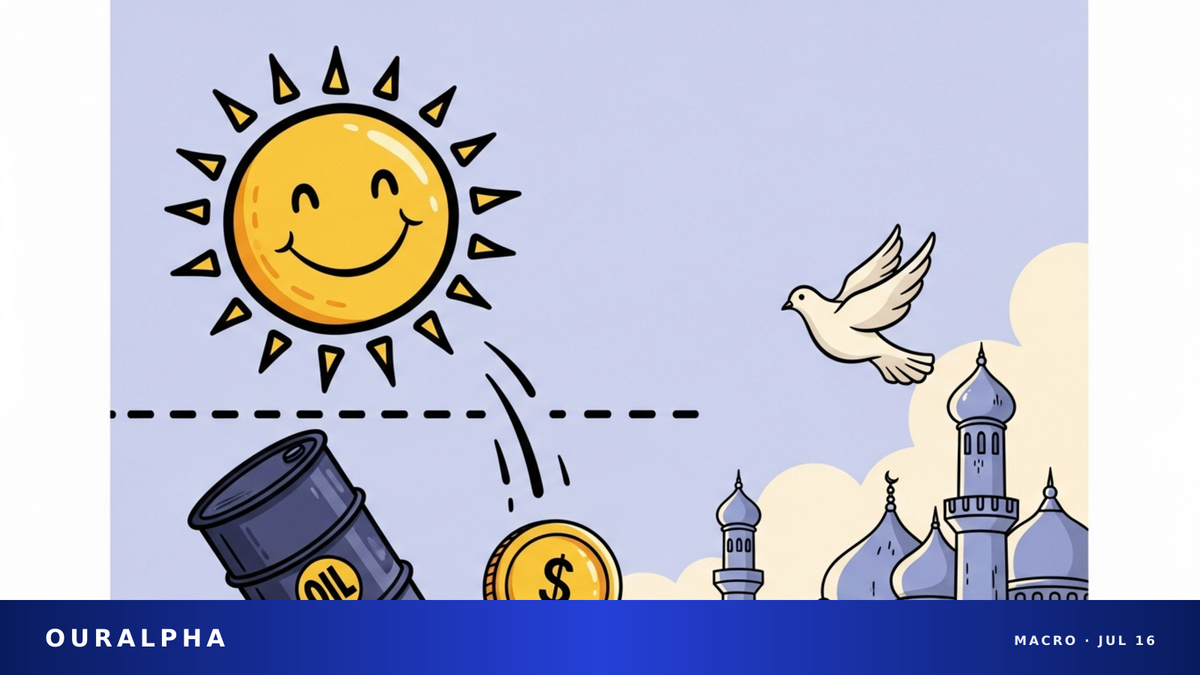
Gold Breaks Below $4,000 as Mideast Conflict Intensifies and Oil Surges
Gold slid below $4,000 as escalating Middle East conflict and surging oil prices reignited inflation fears, overshadowing the metal's traditional safe-haven appeal.
Gold extended its slide on Thursday, briefly dipping below the psychologically key $4,000-an-ounce mark, as escalating Middle East conflict and surging oil prices revived inflation fears and overshadowed the metal's traditional safe-haven appeal.
- Spot gold was trading at $4,034.42 an ounce as of 4:30 a.m. ET, down 0.6% on the day.
- U.S. gold futures for August delivery fell 0.3% to $4,039.90 an ounce.
- With no signs of de-escalation in the Middle East, the market's optimism over easing inflation has been wiped out, and the oil spike is stoking fears of further rate hikes.
- Gold had already fallen 0.5% on Wednesday and tumbled 1.4% on July 13.
- Analysts note that geopolitical risk is putting a double squeeze on gold by pushing up both oil prices and the dollar.
- Market expectations for a September rate hike from the Federal Reserve are rising, with the CME FedWatch tool now pricing in roughly a 69% probability.
Gold prices fell in Asian trading on Thursday as the escalating Middle East conflict quickly erased recent optimism over easing inflation, with surging oil prices fueling fears that the Federal Reserve may be forced to hike rates again. As of 4:30 a.m. ET, spot gold was at $4,034.42 an ounce, down 0.6% from the previous close, while U.S. gold futures for August delivery slipped 0.3% to $4,039.90 an ounce.[CNBC
Geopolitical Risk Caps Gold’s Haven Bid
Despite intensifying conflict in the Middle East, gold has not found the support traditional safe-haven logic would suggest. Instead, the market has shifted its focus to the conflict's impact on energy supply and the inflation outlook. CNBC reported that the lack of any sign of de-escalation is erasing recent optimism about cooling inflation and stoking fears that the oil surge could lead to rate hikes.[CNBC
A Kitco analysis noted that gold's decline is not an isolated event but is tightly linked to the oil spike, a stronger dollar, and rising rate expectations. The article cited analysts who argue the market no longer sees Gulf conflict as a reason to buy gold, but rather as a reason to buy crude. Higher oil means higher inflation, a more hawkish Fed, and a stronger dollar—a chain reaction that is the core driver of gold's slide.[KITCO
Oil Surge and Rate-Hike Fears Form a Double Squeeze
Gold has been under persistent pressure this week. It fell 0.5% on Wednesday as rising oil prices intensified inflation concerns and clouded the U.S. rate outlook.[CNBC Earlier, on July 13, spot gold tumbled 1.4% to $4,061.64 an ounce after intense missile and drone exchanges between the U.S. and Iran in the Persian Gulf, with Iran even hinting at a possible closure of the Strait of Hormuz, sending oil prices surging over 3% that day.[KITCO
"The renewed hostilities in the Gulf have rekindled market concerns about inflation and further Fed tightening, creating additional headwinds for gold through higher bond yields and a stronger dollar," said Ole Hansen, an analyst at Saxo Bank. He added that the Middle East situation and rising oil prices, combined with low liquidity during the summer holiday season, are key risks that could push gold out of its current $3,900–$4,200 range.[KITCO
Market expectations for a Fed rate hike are building. According to the CME FedWatch tool, traders are now pricing in roughly a 69% probability of a rate hike in September, up from 63% last week.[KITCO Higher rates increase the opportunity cost of holding non-yielding gold.
Inflation Data and the Fed’s Stance
Key U.S. inflation data was released earlier this week. The June CPI fell 0.4% month-over-month, the first monthly decline since 2020, with the annual rate dropping to 3.5% from May's 4.2%. The June PPI also came in weaker than expected, falling 0.3% month-over-month.[KITCO
Yet these seemingly positive inflation prints failed to lift gold. Fed Chair Kevin Warsh, testifying before Congress this week, reiterated the central bank's commitment to price stability and said policymakers have "zero tolerance" for persistently high inflation. While Warsh did not strike a more hawkish tone, the market is still bracing for a September hike.[KITCO
Kitco analyst Gary Wagner noted that while inflation data is cooling, the oil surge is keeping inflation expectations elevated, which limits both the dollar's downside and gold's upside. "The market is caught in a tug-of-war between domestic disinflation data and foreign inflationary supply shocks," he wrote.[KITCO
Technical Levels and Institutional Outlook
Technically, gold remains in a downtrend channel that began with the correction earlier this year. Kitco analysis points to resistance near $4,077 an ounce, the 100-period moving average. A sustained break above that level could open the path to $4,140 and even $4,200. On the downside, a break below the $4,000 psychological level would expose deeper support at $3,962 and $3,950.[KITCO
Gold is now roughly 27% below its all-time high of $5,589.38 an ounce, set on January 28. The metal posted its worst quarterly performance in over a decade during the second quarter.[KITCO
Despite near-term headwinds, most institutions remain constructive on gold's long-term outlook. J.P. Morgan has a year-end target of $6,000 an ounce, driven primarily by record central bank buying led by China, India, Turkey, and Poland.[KITCO
Among other precious metals, spot silver fell 2.4% on Thursday to $58.4181 an ounce, platinum slipped 0.5% to $1,619.98, and palladium dropped 0.8% to $1,266.10.[KITCO
Sources
- CNBC — Gold falls as Mideast escalation dims hopes of easing inflation
- KITCO — Gold extends decline as Middle East tensions bolster higher-for-longer rate view
- CNBC — Gold recovers from two-week low ahead of US inflation figures
- CNBC — Gold slips as oil rally keeps inflation, rate outlook on investors' radar
- KITCO — Gold Edges Higher as Cooler Inflation Data Meets Dollar Weakness, but Iran Risk Keeps Bulls in Check
This content is for informational purposes only and does not constitute investment advice, trading advice, or any guarantee of returns.