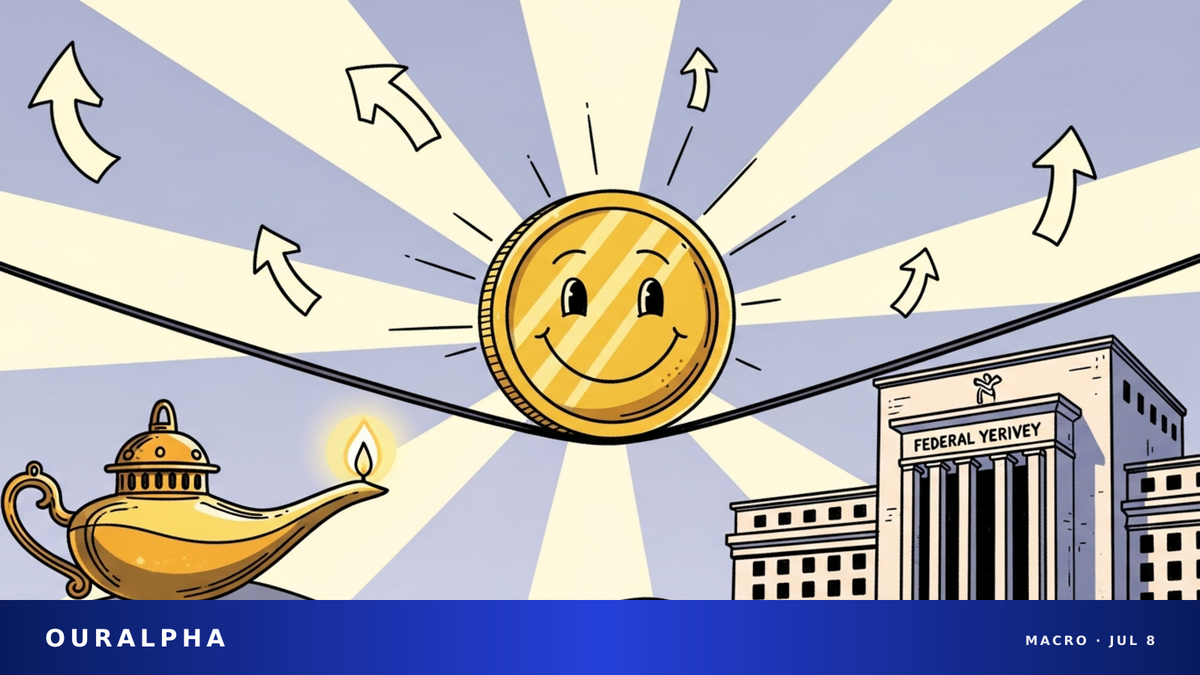
Gold Whipsaws as Iran Strikes and Hawkish Fed Minutes Loom

Gold prices swung between gains and losses Wednesday as investors weighed fresh U.S. military strikes on Iran against the release of the Fed’s June meeting minutes. Spot gold last traded at $4,125.59 an ounce.

Gold prices whipsaw as U.S. strikes Iran and Fed minutes loom
Geopolitical risk and monetary policy expectations collide, fueling gold volatility.

Gold prices swung between gains and losses Wednesday as investors digested fresh U.S. military strikes on Iran and awaited the release of the Federal Reserve’s June meeting minutes for clues on the rate path.

  • Spot gold (XAU=) last traded at $4,125.59 an ounce, up 0.5% on the session[CNBC].
  • On Tuesday, spot gold fell 0.6% to settle at $4,138.32 an ounce, off a two-week high[CNBC].
  • The U.S. launched a "series of powerful strikes" on Iran late Tuesday in retaliation for Iranian attacks on three commercial vessels in the Strait of Hormuz[CNBC].
  • West Texas Intermediate crude for August delivery rose 2.1% to $71.87 a barrel in Asian trading; Brent crude for September gained 1.9% to $75.53[CNBC].
  • The Fed will release the minutes from its June FOMC meeting at 2 p.m. ET Wednesday, with markets expecting a hawkish tone[CNBC].
  • U.S. stock futures were narrowly mixed in premarket trading Wednesday: Dow futures down 53 points, S&P 500 futures flat, and Nasdaq 100 futures up 0.3%[CNBC].

Gold prices seesawed Wednesday, with spot gold last at $4,125.59 an ounce, up 0.5% on the session[CNBC]. The metal had fallen 0.6% on Tuesday to $4,138.32, retreating from a two-week high as investors awaited the Fed’s June meeting minutes to gauge the policy direction of new Chairman Kevin Warsh[CNBC]. Analysts noted that the U.S. strikes on Iran boosted crude and the dollar, stoking fears of higher inflation and interest rates that weighed on gold[CNBC].

U.S. Launches ‘Powerful Strikes’ on Iran, Strait of Hormuz Tensions Spike

The U.S. Central Command announced late Tuesday that American forces had launched a "series of powerful strikes" on Iran in retaliation for Iranian attacks on three commercial vessels transiting the Strait of Hormuz earlier that day[CNBC]. The move followed the Treasury Department’s revocation of a sanctions waiver that had allowed Iran to sell oil globally[CNBC]. The military warned that Tehran would face a "heavy price" for actions against commercial shipping[CNBC].

Oil prices surged on the news. WTI crude for August delivery jumped 2.1% to $71.87 a barrel in Asian trading, while Brent crude for September rose 1.9% to $75.53[CNBC]. Prices had eased on Monday after OPEC+ announced seven members would boost output by 188,000 barrels per day in August and shipping activity in the Strait of Hormuz partially resumed, with Brent at $71.72 and WTI at $68.40[KITCO]. The new strikes have revived the geopolitical risk premium.

Fed Minutes in Focus, Markets Brace for Hawkish Tone

Investor attention is now squarely on the Fed. The central bank will release the minutes from its June FOMC meeting at 2 p.m. ET Wednesday. This is the first policy meeting under new Chairman Kevin Warsh, where the committee held the federal funds rate steady at 3.50%-3.75% but maintained a hawkish bias, noting inflation remains above the 2% target and that energy-related supply shocks continue to push prices higher[KITCO]. The statement also hinted that further rate hikes may be needed if inflation pressures persist[CNBC].

"The FOMC minutes will be a wildcard because Warsh was very vague in his recent press conference," said Adam Crisafulli, founder of Vital Knowledge, in a note. "Normally, [former Chairman Jerome] Powell would give a pretty thorough rundown of the meeting discussion, but Warsh didn't, so the minutes, which could be hawkish, might contain some surprises."[CNBC]

StoneX market analysis head Rhona O'Connell described the U.S. labor market as "mixed," pointing to weaker nonfarm payrolls, a falling unemployment rate, and hiring constraints at small businesses that have made rate markets more cautious about further tightening. She noted that interest rate swaps price in a 34% probability of a rate hike in the fourth quarter[KITCO].

Global Markets Under Pressure, Asia-Pacific Stocks Fall

Escalating Middle East tensions weighed on global markets. Asia-Pacific stocks were broadly lower Wednesday: Japan’s Nikkei 225 fell 0.55%, South Korea’s Kospi dropped 0.72%, and Australia’s S&P/ASX 200 slid 1.36%[CNBC].

U.S. stock futures were narrowly mixed in premarket trading. Dow Jones Industrial Average futures fell 53 points, S&P 500 futures were flat, and Nasdaq 100 futures edged up 0.3%[CNBC]. In regular trading Tuesday, investors rotated out of AI-related stocks as rising oil prices dampened sentiment. The Dow fell over 100 points after hitting an intraday record high; the S&P 500 lost 0.5%; and the Nasdaq Composite dropped 1.2%, led lower by chip stocks[CNBC].

This content is for informational purposes only and does not constitute investment advice, trading advice, or any guarantee of returns.

Keep Reading

Gold Wavers as US-Iran Strikes Lift Oil, Markets Await Fed Minutes

Gold Wavers as US-Iran Strikes Lift Oil, Markets Await Fed Minutes

International gold prices swung between gains and losses on Wednesday (July 8) as investors weighed escalating Middle East tensions after the US launched fresh strikes on Iran, while awaiting the release of the Fed’s June meeting minutes. Oil prices rose on the Strait of Hormuz conflict, stoking inflation expectations and lifting the dollar, which weighed on gold.

  • Spot gold was last at $4,125.59/oz, up 0.5% on the day.[CNBC]
  • On Tuesday (July 7), spot gold fell 0.6% to settle
Read full story →

Stay ahead of the market — never miss a deep dive

Follow OurAlpha for AI-driven US equity research and market insight, every day.