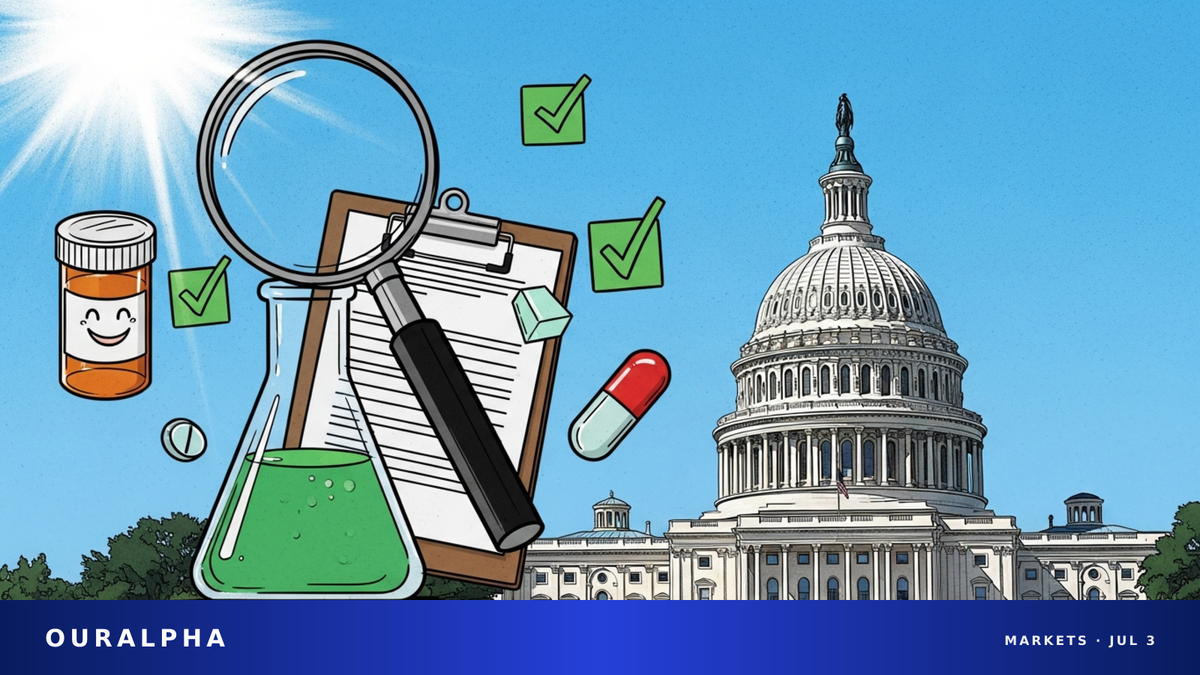
US House Probes Merck, AbbVie China Trials; Eli Lilly, Pfizer, BMS Also Questioned

The House China committee demands five pharma giants explain the ethics and security of their Chinese drug trials, including any military-linked sites or Xinjiang operations. Eli Lilly shares rose 1.40% on the news.

US House committee investigates Merck, AbbVie, Eli Lilly, Pfizer, and BMS over Chinese clinical trials
The House Select Committee on China sent letters to five major drugmakers, focusing on ethical and security risks in their Chinese clinical trials.

The House Select Committee on China this week sent letters to several major drugmakers demanding details on the ethical and security risks of their Chinese clinical trials, reigniting fears of a US-China biotech decoupling. As of after-hours trading on July 2, Eli Lilly (LLY) closed at $1,208.39, up 1.40% from the prior close.

  • Committee Chairman John Moolenaar sent letters to Merck, AbbVie, and others, demanding responses by July 17.
  • The letters ask whether trials involved sites linked to the People's Liberation Army or were located in Xinjiang.
  • Beyond Merck and AbbVie, Eli Lilly, Pfizer, and Bristol Myers Squibb also received similar letters.
  • The letters note that China, through regulatory reforms and state subsidies, has become the world's "cheapest and fastest" location for early-stage human drug trials.
  • The letters do not allege wrongdoing but warn that conducting research in China "exposes U.S. companies to ethical and security risks."
  • This follows President Trump's signing of the Biosecurity Act, which restricts U.S. entities from contracting with "biotech companies of concern" in China.

The House Select Committee on China this week launched a national security investigation into big pharma's Chinese clinical trials, sending letters to the CEOs of Merck, AbbVie, Eli Lilly, Pfizer, and Bristol Myers Squibb demanding detailed disclosures.[Reuters] As of after-hours trading on July 2, Eli Lilly (LLY) stood at $1,208.39, up 1.40% (+$16.65) from the prior close of $1,191.74, with an intraday high of $1,232 and a low of $1,180.3.[Reuters]

Letters Focus on Ethics and Security

According to an exclusive Reuters report, the letters, signed by Chairman John Moolenaar (R-MI), ask drugmakers whether their Chinese trials involved sites linked to the People's Liberation Army or were conducted in Xinjiang—a region under international scrutiny for its treatment of Uyghurs and other Turkic Muslim minorities.[pharmaphorum] The letters also demand assurances that trial subjects "participated voluntarily and gave informed consent."[pharmaphorum]

"Through regulatory reforms, state subsidies, and—at best—questionable ethical practices, China has transformed itself into the world's cheapest and fastest location for early-stage human drug trials," the letters state.[pharmaphorum] While not alleging wrongdoing, the letters make clear that conducting research in China "exposes U.S. companies to ethical and security risks."[pharmaphorum] Companies have until July 17 to respond.[pharmaphorum]

US-China Biotech Tensions Escalate

This investigation is the latest push by the U.S. government to curb biotech cooperation with China. As BioSpace reports, President Trump last year signed the Biosecurity Act, which restricts U.S. entities from contracting with "biotech companies of concern" deemed national security threats.[BioSpace] The final version was softened from the initial proposal, giving U.S. drugmakers until 2032 to sever ties with Chinese biotech firms.[BioSpace]

BioSpace's analysis highlights a fundamental divide: pharma companies view China as a valuable source of innovation and pipeline replenishment, while the government focuses on biosecurity risks.[BioSpace] This split leads to divergent strategies—the government favors restricting US-China biotech ties, while the industry calls for systemic incentives to boost domestic innovation.[BioSpace]

US Accelerates Domestic Manufacturing

Alongside heightened scrutiny, the U.S. is also moving to strengthen domestic drug manufacturing. According to pharmaphorum, the FDA last week launched a pilot program called "PreCheck" to streamline approval of new manufacturing facilities, with Eli Lilly and Regeneron among the first seven companies selected.[pharmaphorum]

The program is part of a broader push to bring more drug production onshore. The FDA says PreCheck aims to "boost U.S. global competitiveness, strengthen domestic drug manufacturing, and enhance the resilience of the U.S. drug supply chain."[pharmaphorum] Lilly's pilot site is its active pharmaceutical ingredient (API) plant in Lebanon, Indiana, where the company recently announced an additional $4.5 billion investment on top of the $27 billion plan announced last year.[pharmaphorum]

Separately, the Department of Health and Human Services (HHS) last week unveiled "Operation Trailblazer," a plan to accelerate drug development by reducing unnecessary delays in research, boosting clinical trial participation, and strengthening domestic research capacity.[pharmaphorum]

Market Reaction and Industry Impact

As of after-hours trading on July 2, Eli Lilly shares closed at $1,208.39, up 1.40% on the day. The market's full reaction to the investigation remains to be seen. Analysts note that while the probe could heighten fears of a US-China biotech decoupling, the near-term impact on big pharma is likely limited, as most Chinese trials are early-stage and companies have already begun shifting some production back to the U.S.

Notably, this investigation is not an isolated event. According to BioSpace, Moolenaar and Rep. Debbie Dingell (D-MI) earlier this month co-introduced the Biotech Investment National Security Act, further tightening restrictions on US-China biotech cooperation.[BioSpace]

This content is for informational purposes only and does not constitute investment advice, trading advice, or any guarantee of returns.

Keep Reading

UnitedHealth Beats Q1 Estimates, But Stock Edges Down 0.28% After Hours

UnitedHealth Beats Q1 Estimates, But Stock Edges Down 0.28% After Hours

UnitedHealth Group (UNH) beat Wall Street’s Q1 2026 revenue and profit estimates, but the market barely reacted — shares edged down 0.28% in after-hours trading as of 5:30 PM ET on July 2.

  • Revenue: $100.8B, up 12% YoY, above the $99.5B consensus.
  • Adjusted EPS: $7.24, topping the $7.10 estimate.
  • Medical Loss Ratio (MLR): 82.4%, better than the 82.8% expected — a sign of tighter cost control.
  • Operating cash flow: ~$8.5B, up 15% YoY.
  • FY 2026 adjusted EPS
Read full story →

Stay ahead of the market — never miss a deep dive

Follow OurAlpha for AI-driven US equity research and market insight, every day.