Korea's KOSPI Crashed Nearly 10% — Why Did the Memory Chip Selloff Hit US Stocks?
South Korea's KOSPI crashed nearly 10% on June 23, with memory chip giants leading the rout. The selloff spread to Wall Street by the close — the SOX fell 7.9%, while Micron, Western Digital, and SanDisk all dropped double digits intraday.

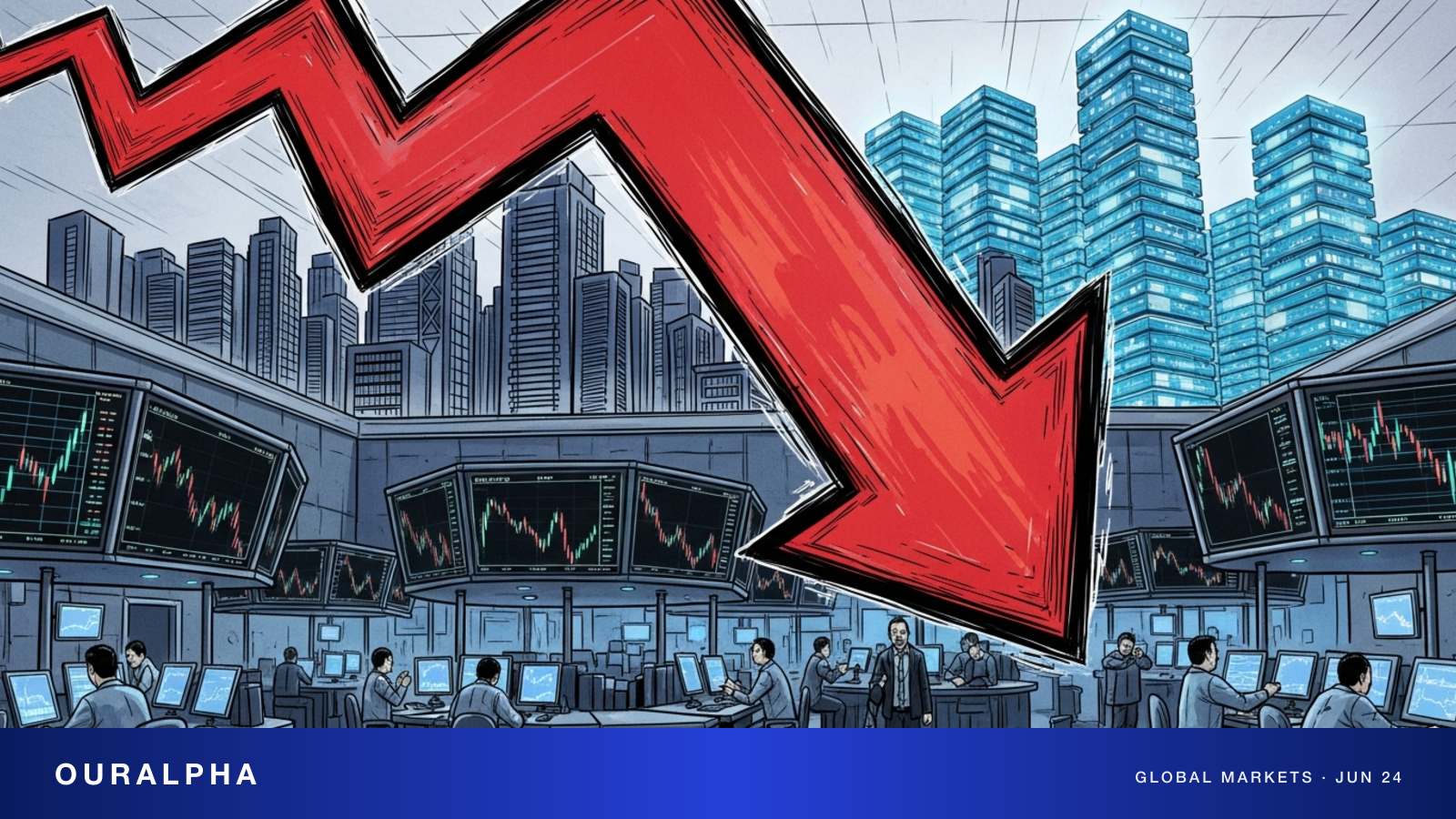
During the Asian session on June 23, South Korea's KOSPI triggered circuit breakers twice and closed down nearly 10%, with memory chip giants leading the rout — a selloff that quickly spread to US semiconductor stocks.
- Per Korean media, the KOSPI closed down ~10% below the 9,000 threshold at 8,203.84 — its lowest close since June 12; SK Hynix and Samsung Electronics each fell ~12%.
- Per Reuters, the Philadelphia Semiconductor Index (SOX) closed down 7.9% and the S&P 500 Information Technology sector closed down 3.7%.
- Per Reuters, Nvidia (NVDA) closed down 4.1%; Intel (INTC), Marvell (MRVL), and AMD closed down between 5.8% and 9.4%.
- Per 24/7 Wall St., SanDisk (SNDK) fell ~11% intraday; Micron (MU) and Western Digital (WDC) fell ~10% intraday; the Roundhill Memory ETF (DRAM) fell ~14%.
- Per Reuters, market concerns centered on debt-funded AI capex at hyperscalers and rising expectations of a more hawkish Fed.
South Korean equities cratered on June 23. Per IndexBox and Korea's Digital Today, the KOSPI triggered circuit breakers twice intraday, closed below the 9,000 threshold at 8,203.84 — a single-day loss of nearly 10% and the lowest close since June 12.[IndexBox] The selloff, centered on memory chip stocks, quickly spread to US markets when they opened.
Asian Session: Two Chip Giants Lead the Market Down
The core of the decline was the two memory chip heavyweights that dominate KOSPI's index weighting.
- Per TradingKey, SK Hynix and Samsung Electronics each fell ~12%; Japan's Kioxia dropped more than 15%.[TradingKey]
- Per Bloomberg, Samsung and SK Hynix together account for roughly half of KOSPI's market cap and had driven most of the index's 2026 gains.[Bloomberg]
- Per IndexBox, the exchange triggered circuit breakers twice, halting trade; an afternoon suspension lasted roughly 20 minutes, and the selloff deepened once trading resumed.[IndexBox]
A note on the numbers: KOSPI's exact closing decline varies by source. Some Korean and Asian outlets report a close of ~10% at 8,203.84; others cite ~8% at the point circuit breakers were triggered intraday. This article uses the Korean local media closing figure and flags the discrepancy for readers.
An SK Hynix Production Report Pulls the Trigger
Per TradingKey citing market reports, additional pressure on SK Hynix came from reports that the company was slowing its HBM4 (High Bandwidth Memory, 4th generation) expansion and shifting capacity toward conventional DRAM.
- Per that report, conventional DRAM's operating margin had recently exceeded HBM's due to supply tightness; some Korean analysts estimated the gap at more than 15 percentage points.[TradingKey]
- Per TradingView citing Moneycontrol, the market attributed part of the drop to "South Korea's hottest AI trade unraveling" — a reversal in the bullish narrative around AI memory demand.[TradingView/Moneycontrol]
These are media-cited market reports and analyst estimates, not company-audited disclosures. Neither SK Hynix nor Samsung had publicly confirmed specific capacity adjustments as of publication.
US Intraday: Memory Stocks Take a Beating
The Asian selloff extended into the US session, with memory-related names among the worst performers on the day.
- Per 24/7 Wall St., SanDisk (SNDK) fell ~11% intraday; Micron (MU) and Western Digital (WDC) each fell ~10% intraday.[24/7 Wall St.]
- Per the same report, the Roundhill Memory ETF (DRAM) fell ~14%.[24/7 Wall St.]
A note on timing: the double-digit moves above are intraday figures. The SOX index and Nvidia figures in the next section are closing figures — these are not snapshots from the same point in the session.
US Close: Semiconductors Drag the Broad Market
Per Reuters, all three major US indexes closed lower, with semiconductors the heaviest drag.
- The Philadelphia Semiconductor Index (SOX) closed down 7.9%; the S&P 500 Information Technology sector closed down 3.7%.[Reuters via Yahoo Finance]
- Nvidia (NVDA) closed down 4.1%; Intel (INTC), Marvell (MRVL), and AMD closed down between 5.8% and 9.4%.[Reuters via Yahoo Finance]
- Per Reuters, the S&P 500 and Nasdaq Composite closed at their lowest levels in more than a week.[Reuters via Yahoo Finance]
Reuters' Two Threads on What Drove the Selloff
Reuters offered two background narratives for the decline — both market storylines, not settled conclusions.
- The first: doubts about AI capex sustainability. Reuters cited analysts saying recent AI-related news "raises questions about all of this spending, capex, and semiconductor capacity expansion," with focus squarely on debt-funded AI investment at hyperscalers.[Reuters via Yahoo Finance]
- The second: a hawkish Fed repricing. Per Reuters citing LSEG data, traders' bets on another Fed rate hike before December rose — compared to two weeks earlier when markets largely priced in just one 25bp hike, current pricing has shifted toward a more aggressive path under new Fed Chair Kevin Warsh.[Reuters via Yahoo Finance]
The above is a summary of same-day media reports. All percentage moves are as reported in the cited sources and for the time periods specified therein. Discrepancies in KOSPI's exact closing decline across sources have been flagged in the text.
Sources
- IndexBox — Asian Stock Market Crash: KOSPI Leads Sharp Decline on Tech Selloff
- TradingKey — Korean Stocks Trigger Circuit Breakers Twice; SK Hynix and Samsung Plunge 12%
- Bloomberg — Kospi Index Slides With Samsung, SK Hynix Falling on Chip Concerns
- 24/7 Wall St. — SanDisk Plunges 11%, Micron and Western Digital Slide 10% as Korean Market Crash Hits Memory Chips
- Reuters via Yahoo Finance — Wall Street ends lower on semiconductor selloff as AI spending concerns mount
- TradingView / Moneycontrol — South Korea's hottest AI trade is unraveling
This content is for informational purposes only and does not constitute investment advice, trading advice, or any guarantee of returns.