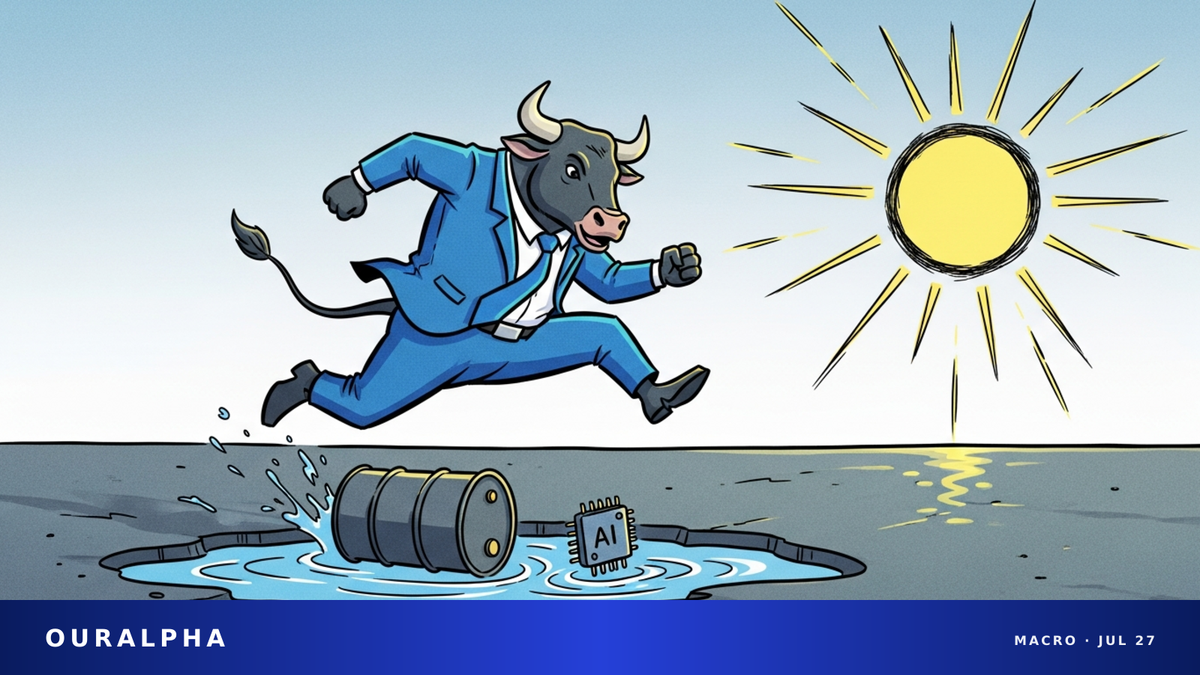
Oil Tops $100, AI Stocks Tumble in Wall Street’s Worst Day in a Month
Brent crude surged past $100 a barrel as Middle East tensions escalated, while Tesla and Google parent Alphabet cratered after earnings, sending the Nasdaq down 2.2% in the S&P 500’s worst session since late June.
Middle East tensions sent Brent crude back above $100 a barrel for the first time in two months, and a post-earnings rout in AI leaders dragged U.S. stocks to their worst single-day loss in a month on Thursday (July 23). Markets were still digesting the shock as of midnight ET (overnight session).
- Brent crude hit an intraday high of $102 a barrel Thursday, settling at $100.69 — a 7% single-day surge.
- The S&P 500 fell 1.2%, the Dow Jones Industrial Average dropped 506 points (roughly 1%), and the Nasdaq Composite tumbled 2.2%.
- Tesla (TSLA) cratered 14.5% after quarterly profit missed analyst estimates.
- Alphabet (GOOGL) slid 7.1% despite beating on revenue and profit, as the market focused on its higher AI capex guidance.
- The 10-year U.S. Treasury yield hovered around 4.6%, with the 30-year near 5.1%, reflecting sticky inflation expectations.
- The U.S. on July 24 slapped tariffs of 10% to 12.5% on 60 trading partners, covering 99% of U.S. imports.
Fighting in the Middle East spilled into Red Sea shipping lanes, sending Brent crude to an intraday high of $102 a barrel on Thursday (July 23) before it settled at $100.69 — a 7% daily gain and the highest level since May.[AP]The oil spike, combined with a post-earnings collapse in AI bellwethers, hammered all three major U.S. indexes: the S&P 500 fell 1.2%, the Dow dropped 506 points (roughly 1%), and the Nasdaq Composite led the rout with a 2.2% slide.[AP]It was the worst single-day performance since late June. U.S. equity futures edged higher Friday (July 24), though markets were in the overnight session with no live quotes at press time.
Red Sea Tanker Attacks Spark Oil Surge, Middle East Becomes Market’s Biggest Wild Card
The catalyst for Thursday’s crude spike was an attack on two Saudi oil tankers in the Red Sea, threatening another key maritime route for Middle Eastern crude just as the Strait of Hormuz had already been disrupted by the conflict.[AP]Brent crude was around $72 a barrel before the Iran war erupted in late February; it has now rallied roughly 40% from that level. President Trump later threatened “major military punishment” against Iran-backed Houthi rebels in Yemen if they continue attacking vessels.[AP]The surge in oil directly raises corporate costs and eats into consumer purchasing power. The average U.S. gasoline price has climbed to $4.09 a gallon (AAA data), up from $3.93 a month ago, though still below the May peak near $4.56.[AP]
AI Earnings: A Mixed Bag, But Capex Fears Crush Stocks
The other major shock came from Big Tech earnings. Tesla (TSLA) shares plunged 14.5% after the electric-vehicle maker’s latest quarterly profit fell short of Wall Street estimates.[AP]As one of the largest components in the S&P 500, Tesla’s drop weighed heavily on the index. Google parent Alphabet (GOOGL) also slid 7.1% despite reporting revenue and profit that beat expectations.[AP]Analysts said investors were fixated on Alphabet’s upward revision to its AI capex forecast, worrying that the massive spending won’t generate near-term returns.[AP]The double blow dragged down the entire tech sector and reignited fears of an AI investment bubble.
Asian Markets Catch the Fallout, Dollar-Yen Hits 40-Year High
Thursday’s U.S. sell-off quickly spread to Asia. Asian stocks broadly slumped on Friday (July 24): South Korea’s Kospi tumbled 5.9%, with Samsung Electronics down 8% and SK Hynix off 7.4%; Japan’s Nikkei 225 fell 3.1%, and SoftBank Group (heavily invested in AI) cratered 7.5%; Hong Kong’s Hang Seng Index dropped 1.3%, and the Shanghai Composite lost 1.2%; Australia’s S&P/ASX 200 fell 1%.[AP]Meanwhile, the dollar surged to 163.83 yen, the highest level in 40 years (last seen in 1986).[AP]The euro was roughly flat at $1.1378. In Asian trading Friday, U.S. WTI crude edged 0.5% lower to $91.71 a barrel, while Brent slipped 0.3% to $100.40.[AP]
Bond Market Flashes Inflation Warning, Investors Flee Traditional Fixed Income
The oil spike intensified fears of a rebound in inflation. The 10-year U.S. Treasury yield hovered around 4.6%, with the 30-year near 5.1%, signaling that investors expect inflation to remain sticky and demand a higher premium for locking up money long-term.[Reuters]The Federal Reserve held its policy rate steady at 3.50%-3.75% at its most recent meeting.[Reuters]MarketWatch noted that the yield curve is sending Fed Chair Kevin Warsh a clear warning: the market is “extremely worried” about inflation and questioning whether the Fed will back up its hawkish rhetoric with action.[MarketWatch]Against this backdrop, some U.S. investors are rethinking the role of bonds in their portfolios. According to Reuters, wealth manager Osaic recently cut its fixed-income allocation in a classic 60/40 portfolio from 40% to 31%, and added a 6% commodities allocation for the first time in 15 years.[Reuters]“Bonds only act as insurance in a portfolio when inflation is low,” said Phil Blancato, Osaic’s chief market strategist.[Reuters]Morningstar data show that while fixed-income fund assets climbed to $7.9 trillion as of May 31, their share of total portfolio assets has fallen from 25.7% in 2016 to 20.3% — down another 4.8 percentage points from 2025 and the lowest month-end concentration since May 2008.[Reuters]
Trump Tariffs Escalate Again, Global Trade Under Fresh Pressure
On top of the Middle East turmoil and AI stock rout, the market faced a new wave of trade friction. The Trump administration on Thursday announced tariffs of 10% to 12.5% on imports from 60 trading partners, covering 99% of U.S. imports, citing those countries’ failure to fully enforce a ban on goods made with forced labor.[AP]The move came just as temporary tariffs were set to expire Friday — measures the president had put in place after a Supreme Court setback on tariff authority.[AP]The European Central Bank held its key interest rate steady at its meeting Thursday.[AP]Analysts warned that higher inflation could push the Fed and other central banks to raise rates further, slowing the economy and pressuring stocks and other assets.[AP]
Sources
- Reuters — US investors rethink bonds' role as inflation reshapes portfolios
- Barron's — Intel, SpaceX, Verizon, Oracle, SAP, Tenet, Amex, and More Stocks That Explain Today’s Market
- AP — Shares skid in Asia in sell-off of AI-related shares as Brent oil tops $100 per barrel
- MarketWatch — The Treasury market is sending Fed Chair Kevin Warsh a clear warning about rates
- AP — Shares skid in Asia in sell-off of AI-related shares as Brent oil tops $100 per barrel
This content is for informational purposes only and does not constitute investment advice, trading advice, or any guarantee of returns.