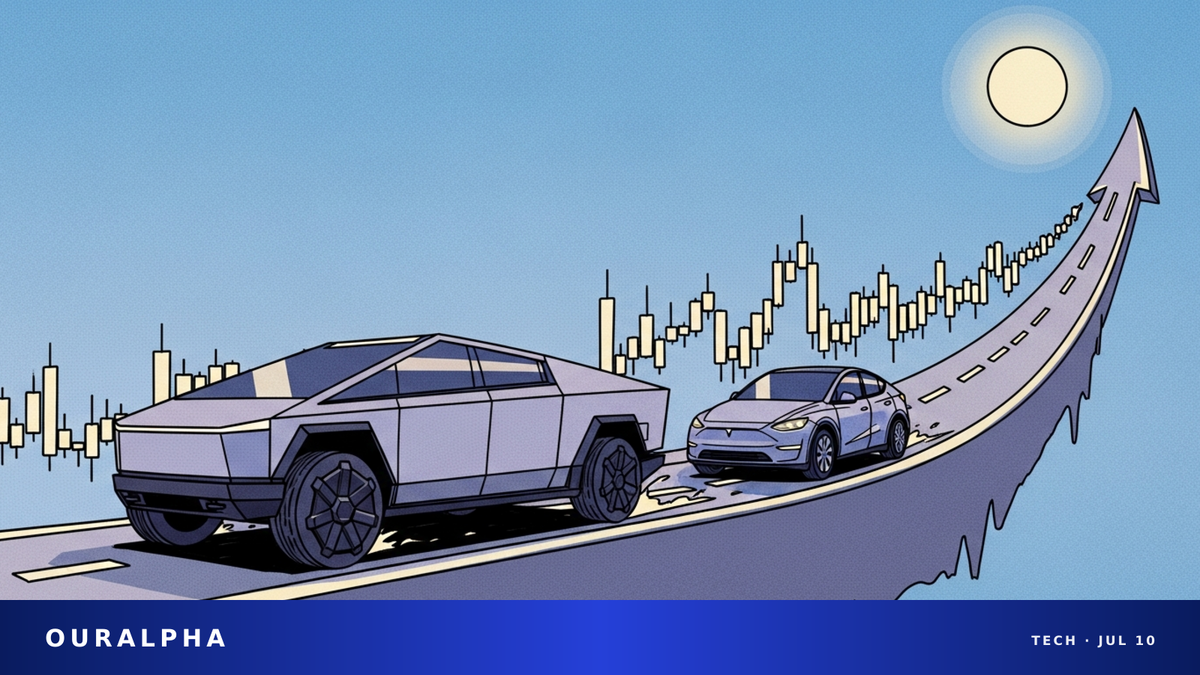
Tesla Earnings Preview: Why Wall Street Is Betting on a Blowout Quarter

Tesla shares surged 3% ahead of Q2 earnings as Wall Street bets on AI and energy-fueled profit growth. But sky-high expectations could be a double-edged sword.

Tesla earnings preview Wall Street betting on blowout quarter stock price up
Tesla shares rallied ahead of earnings season as investors bet on a strong Q2 report driven by AI and energy tailwinds.

As Q2 earnings season kicks into high gear, all eyes are on Tesla (TSLA). As of 4:00 PM ET on July 9, shares closed at $406.13, up 3.06% from the prior session. A growing chorus of analysts and institutions expects Tesla to deliver a "blowout" quarter, fueled by AI infrastructure spending and a resilient economy. But the market is also on edge — when expectations run this hot, even a minor miss can spark volatility.

  • As of 4:00 PM ET on July 9 (after-hours), Tesla (TSLA) traded at $406.13, up 3.06% (+$12.07) from the prior close of $394.06. The stock hit an intraday high of $407.86 and a low of $390.86.
  • FactSet data shows Wall Street analysts expect S&P 500 companies to post 22.5% EPS growth in Q2; Bloomberg's forecast is even higher at 25% year-over-year, driven by the AI boom and steady economic growth.
  • LSEG IBES data indicates S&P 500 Q2 earnings are expected to grow 23.4% year-over-year, well above the 15.2% forecast at the start of the year.
  • The S&P 500 Information Technology sector (including Nvidia, Apple, and others) is expected to see Q2 earnings surge 62% year-over-year; the Energy sector, boosted by surging oil prices amid the Iran conflict, is forecast to grow roughly 115%.
  • The S&P 500 is up 9% year-to-date in 2026, while forward earnings estimates have risen 21% over the same period — earnings growth is outpacing the index's rally.
  • The S&P 500's forward P/E has fallen to 20.1x from 22.2x at the end of 2025, as earnings growth has helped absorb some of the valuation pressure.

As Q2 earnings season approaches, expectations for Tesla (TSLA) are heating up. A growing number of analysts and institutions believe that massive AI infrastructure investment and resilient consumer spending will drive a "blowout" quarter for the EV maker. Yet Wall Street is also on guard — when the bar is set this high, even a small disappointment can rattle markets.

As of 4:00 PM ET on July 9, Tesla shares closed at $406.13, up 3.06% (+$12.07) from the prior close of $394.06. The stock hit an intraday high of $407.86 and a low of $390.86, opening at $395.50.[Reuters]

Sky-High Expectations: Profit Growth at a Four-Year High

Wall Street's Q2 earnings expectations have climbed to multi-year highs. According to Axios, citing FactSet, analysts forecast 22.5% EPS growth for S&P 500 companies; Bloomberg's estimate is even higher at 25% year-over-year, fueled by the AI boom and steady economic growth.[Axios]

LSEG IBES data further shows S&P 500 Q2 earnings are expected to grow 23.4% year-over-year, sharply above the 15.2% forecast at the start of the year.[KITCO]

That growth rate is the highest analysts have projected for blue-chip earnings since 2021. Axios notes that the 2021 surge was partly due to the market "digesting" the terrible data from the pandemic-ravaged year.[Axios]

Tech and Energy: The Twin Engines Driving Growth

The main drivers of earnings growth are two sectors: technology and energy. The S&P 500 Information Technology sector (which includes Nvidia, Apple, and leading chip stocks like Micron) is expected to post 62% year-over-year earnings growth in Q2.[Axios]

The Energy sector's outlook is even more dramatic. Driven by surging oil prices amid the Iran conflict, S&P 500 Energy sector earnings are expected to grow roughly 121% in Q2.[Axios]

KITCO, citing LSEG IBES data, pegs the Energy sector's earnings growth at roughly 115%.[KITCO]

In contrast, the Healthcare sector's EPS is expected to contract by 9%.[Axios]

The 'SpaceX Effect' and the Valuation Debate

The valuation of SpaceX, another company led by Tesla CEO Elon Musk, has also become a market focus. Barron's reports that Wall Street is sharply divided on SpaceX's worth. The average analyst price target is around $240, implying a valuation of roughly $3.2 trillion — more than Microsoft, Amazon, or even Tesla itself.[Barron's — How SpaceX Stock Can Hit $900]

Barron's also notes that SpaceX stock fell 6.8% on Tuesday, July 7, after being added to the Nasdaq 100 index.[Barron's — What Is SpaceX Really Worth?]

Although SpaceX and Tesla are separate publicly traded companies, Musk serves as CEO of both. The market broadly believes that volatility in SpaceX's valuation could indirectly affect investor sentiment toward Tesla.

Risk Alert: High Expectations Are a Double-Edged Sword

While elevated earnings expectations provide fundamental support for the market, several analysts warn that they can also be a double-edged sword.

Reuters quotes Chris Fasciano, chief market strategist at Commonwealth Financial Network: "Earnings growth and rising expectations are good for investors because they do push the market higher. But it undoubtedly raises the bar."[Reuters]

Joe Mazzola, head of trading and derivatives strategy at Charles Schwab, said: "We're going into Q2 with higher expectations. Because expectations have already been raised, we could see a bit more volatility during the Q2 earnings season."[KITCO]

Yardeni Research noted in a report this week: "The risk is that the exceptionally strong Q1 results led analysts to raise their expectations too much for the remaining three quarters."[KITCO]

Capital Economics analysts wrote in a note to clients last week: "AI-related stock markets may be approaching a point where earnings expectations and capex assumptions become unsustainable," and a pullback in these areas could "trigger a broad market correction."[Axios]

Earnings Season Calendar and Market Outlook

Q2 earnings season officially kicks off on Tuesday, July 14, with JPMorgan reporting first. Goldman Sachs, Netflix, Johnson & Johnson, and other major names will follow.[KITCO]

For Tesla, the exact earnings date has not been finalized, but it typically reports mid-season. The market will be closely watching vehicle deliveries, gross margins, progress on Full Self-Driving (FSD), and updates on AI-related initiatives like the Dojo supercomputer.

The S&P 500 is up 9% year-to-date in 2026, while forward earnings estimates have grown 21% over the same period — earnings growth is outpacing the index's rally. Mark Hackett, chief market strategist at Nationwide, noted: "The market is this strong, but earnings growth is even stronger — that is very, very rare."[KITCO]

The stronger earnings outlook has helped absorb some of the market's valuation. The S&P 500's forward P/E has fallen to 20.1x from 22.2x at the end of 2025.[KITCO]

This content is for informational purposes only and does not constitute investment advice, trading advice, or any guarantee of returns.

Keep Reading

Micron’s $250 Billion Spending Plan Has BofA Saying ‘Time to Buy’

Micron’s $250 Billion Spending Plan Has BofA Saying ‘Time to Buy’

Micron Technology (MU) saw its stock pull back after a record-breaking earnings report, but Bank of America is calling the dip a buy after the company unveiled a massive $250 billion long-term investment plan. As of after-hours trading on July 9, Micron shares were at $991.64, up 4.52% from the prior close of $948.80.

  • Micron announced a multi-year, $250 billion capital expenditure plan on July 9 to expand capacity.[Barron's]
  • BofA Global Research analysts argue that despite the massive investment plan, the
Read full story →

Stay ahead of the market — never miss a deep dive

Follow OurAlpha for AI-driven US equity research and market insight, every day.