Uber Dips 3% After Product Chief Explains Why It Won’t Be a ‘Super App’
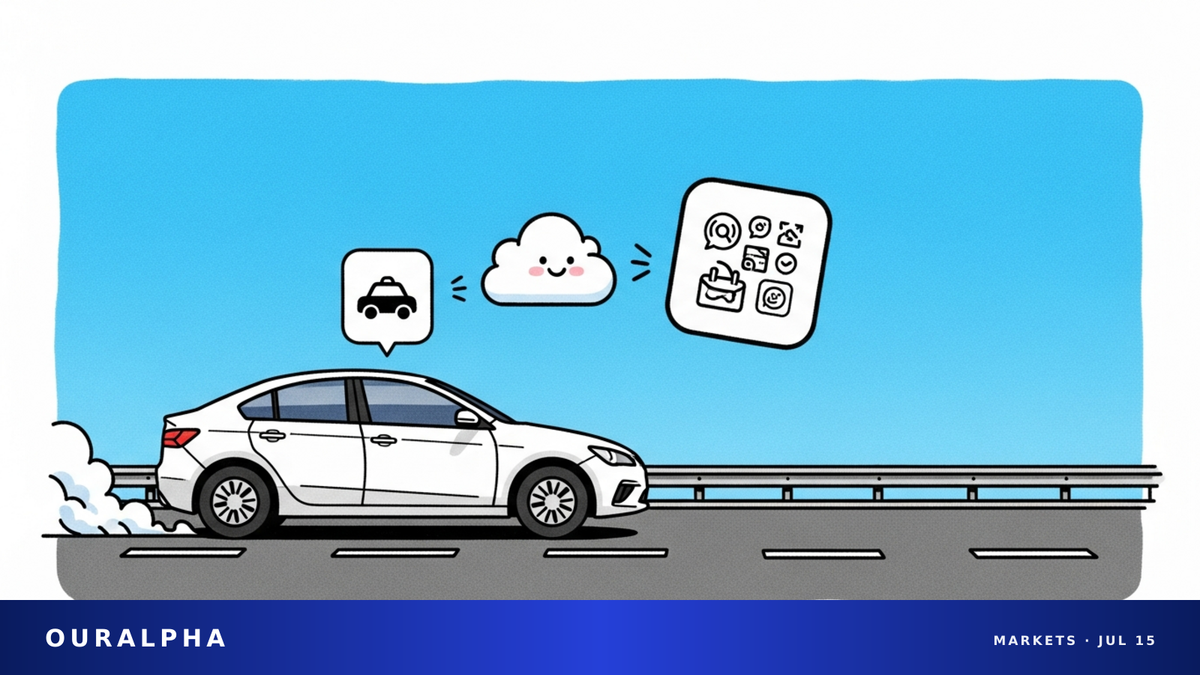
Uber’s product chief says the company won’t chase the super-app model of Asia’s Grab, instead focusing on mobility, delivery, and travel. The stock slipped 2.94% in after-hours trading following the interview.
Uber (UBER) shares slipped in after-hours trading after its product chief laid out the company’s strategic boundaries: no ambition to become a “super app” like Asia’s Grab, but a sharp focus on mobility, delivery, and travel. As of 4:30 p.m. ET on July 14, Uber was trading at $72.08, down 2.94% from its prior close of $74.26.
- Chief Product Officer Sachin Kansal said Uber doesn’t want to be an “everything for everyone” app, instead concentrating on complementary services around its core businesses.[TechCrunch]
- Uber’s app now features Expedia-powered hotel booking, European boat rentals, and a “shop for me” service.[TechCrunch]
- 1.5 billion Uber trips each year happen outside a user’s home city, positioning travel as the company’s “third pillar.”[TechCrunch]
- Uber’s AV Labs unit, just six months old, is deploying a sensor-equipped fleet to collect autonomous-driving data at scale — seen as a hedge against partners like Waymo.[TechCrunch]
- Uber has launched a debit card (Uber Pro) and data-labeling side hustles for drivers, but has no plans to build its own buy-now-pay-later or traditional banking services.[Zamin.uz]
Uber (UBER) fell in after-hours trading on July 14, closing at $72.08 as of 4:30 p.m. ET, down 2.94% from its prior close of $74.26. During the regular session, the stock opened at $73.56, hit a high of $74.20, and touched a low of $71.24. The decline came after Chief Product Officer Sachin Kansal, in a recent interview with TechCrunch, detailed Uber’s strategic choice: not to chase the super-app model of Asia’s Grab, but to focus on its three core pillars of mobility, delivery, and travel. The report, published July 13, appeared to weigh on sentiment in the following day’s after-hours session.
Travel Becomes Third Pillar, Hotel Booking Goes Live With Expedia
Kansal revealed that Uber has quietly expanded its service boundaries over the past year. Users can now not only hail a ride or order food delivery through the app, but also book hotels via Expedia, rent boats in Europe, and use a “shop for me” service to buy items from local stores.[TechCrunch] According to Kansal, 1.5 billion Uber trips each year originate outside a user’s home city, leading the company to position travel as its “third pillar” after mobility and delivery.[TechCrunch] “We hear from many users that they no longer use hotel room service — they just open Uber Eats to order food,” Kansal said.[TechCrunch]
Financial Services Boundary: Tools for Drivers, Not a Bank
Uber is taking a cautious approach to financial services. It has rolled out the Uber Pro debit card for drivers and delivery workers, allowing them to manage earnings instantly, and offers digital tasks like data labeling as an extra income source.[Zamin.uz] However, Kansal made clear Uber has no intention of taking on the full role of a traditional bank. For example, when it comes to buy-now-pay-later systems, the company prefers to work with industry partners rather than build its own product.[Zamin.uz] “We’re not trying to be everything for everyone,” Kansal emphasized, “but to improve the quality of services that complement our core business.”[TechCrunch]
AV Labs: Autonomous Driving Data Play and a Delicate Dance With Waymo
Uber’s autonomous-vehicle strategy is drawing particular attention. Six months ago, the company set up AV Labs, which operates a fleet equipped with special sensors. Its primary mission is not to carry passengers but to collect the massive amounts of data needed for autonomous-driving technology.[TechCrunch] TechCrunch notes that while Uber maintains partnerships with AV leaders like Waymo and holds equity stakes in some of them, owning its own data set allows it to remain independent in the market.[TechCrunch] The report describes this as a kind of hedge — Uber competes directly with some partners, and controlling the data layer gives it leverage and optionality.[TechCrunch] Kansal said AI-improved systems from this effort could eventually lift service quality to a new level.[Zamin.uz]
Market Reaction and Industry Backdrop
Uber’s after-hours decline reflects the market’s initial read on these strategic clarifications. Meanwhile, the ride-hailing industry is undergoing multiple shifts. According to CNBC, drone-delivery company Zipline recently hired former executives from Tesla, Uber Eats, and Waymo to scale its U.S. operations; the company now completes a delivery every 30 seconds and has surpassed 2.5 million commercial deliveries.[CNBC] Separately, Damilola Olokesusi, founder of African shared-mobility company Shuttlers, recently shared her journey of raising over $5 million and completing more than 10 million trips.[Business Insider Africa] These developments underscore a broader industry evolution from simple ride-hailing toward a more comprehensive mobility-services ecosystem.
Sources
- TechCrunch — Uber’s product chief on hotels, robotaxis, and why the company doesn’t want to be “everything for everyone”
- Zamin.uz — Uber Strategy: Why the company does not want to become an "everything app"
- CNBC — Zipline adds ex-Tesla, Uber, Waymo execs to make drone delivery mainstream across U.S.
- Business Insider Africa — Meet the founder who raised over $5 million to build one of Africa's leading shared mobility companies
This content is for informational purposes only and does not constitute investment advice, trading advice, or any guarantee of returns.