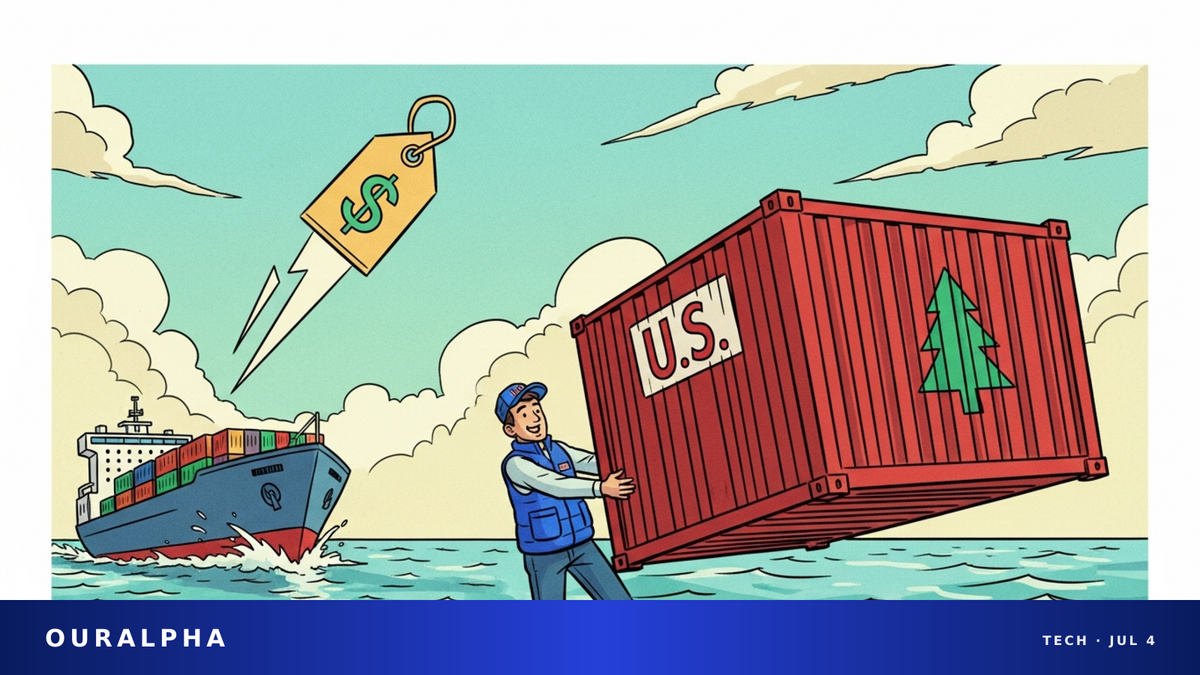
US Retailers Rush Christmas Stock Out of China Six Weeks Early, Sending Shipping Costs Soaring
US retailers are pulling Christmas orders from China forward by four to six weeks to dodge potential tariff hikes, driving a 35% surge in May imports and sending transpacific shipping costs up 25% YoY. Meanwhile, Best Buy and Kohl’s saw online traffic jump over 18% during Prime Day as…
To sidestep potential tariff hikes in the second half of the year, US retailers are pulling Christmas orders from China forward by four to six weeks, triggering a surge in May and June imports and driving up transpacific shipping costs. Meanwhile, during Amazon Prime Day, competitors including Walmart, Target, Best Buy, and Kohl’s all logged gains in online and in-store traffic, signaling a shift toward “promotion-driven” shopping. FedEx topped the logistics platform rankings.
- As of 2:00 AM ET on July 4 (markets closed for the weekend), Amazon (AMZN) was trading at $242.67, up 0.40% (+$0.97) from the prior close of $241.7.
- Retailers are pulling Chinese orders forward by four to six weeks; US imports from China surged 35% YoY in May.
- The spot rate for a 40-foot container from Shanghai to New York hit $7,149 on June 25, up 25% YoY.
- On Prime Day’s first day, Best Buy and Kohl’s online traffic rose 18.1% and 18.4%, respectively, above their baselines.
- 68% of US online shoppers abandon carts due to out-of-stock items; 66% do so when delivery falls short of expectations.
- FedEx ranked No. 1 in the Logistics & Shipping category of Newsweek’s “America’s Best Online Platforms.”
US retailers are accelerating the shipment of Christmas orders from China at an unprecedented pace to get ahead of potential tariff increases that could take effect later this year. According to Retail Gazette, shipping executives say retailers have moved orders forward by four to six weeks, with cargo volumes in May and June running above expectations as companies scramble to protect holiday inventory.[Retail Gazette This front-loading has pushed up container freight rates and tightened capacity on the US-China trade lane, adding a fresh layer of cost pressure for retailers already navigating a volatile trade environment.
Tariff Countdown Sparks Import Surge
President Trump’s visit to China last month helped maintain the current détente between the two countries, but retailers remain wary that tariffs could rise again in the coming months. The 10% across-the-board tariff on Chinese goods imposed in February expires on July 24, and the U.S. Trade Representative has proposed a 12.5% tariff on imports from China and other countries following an investigation into forced labor.[Retail Gazette
Maersk told Reuters that container space on the US-China route has tightened since mid-May due to stronger customer demand and earlier-than-usual seasonal bookings. Goods being shipped early include back-to-school items like stationery and clothing, with Christmas stockpiling adding to the push. Orders for jerseys, flags, souvenirs, and big-screen TVs tied to the World Cup, co-hosted by the US, Canada, and Mexico, are also boosting demand.[Retail Gazette
The Drewry World Container Index shows the spot rate for a 40-foot container from Shanghai to New York hit $7,149 on June 25, up 6% week-over-week and 25% YoY. The Shanghai-to-Los Angeles rate reached $5,750, up 12% week-over-week and 54% higher YoY.[Retail Gazette
The front-loading likely extended the surge in US imports from China into June—following a 35% spike in May, compared with an 11% gain in April and a contraction in March. However, industry executives warn that this growth could fade by late summer once goods have landed and higher tariffs begin to dampen demand.[Retail Gazette
Kyle Henderson, CEO of Vizion, said US demand remains below the three-year average and should be described as “normal to soft,” with higher freight rates also reflecting carriers’ capacity management rather than a broad consumer boom.[Retail Gazette
Prime Day Spillover Boosts Competitor Traffic
Amazon’s Prime Day (June 23–26) didn’t just set sales records for the e-commerce giant—it also benefited its rivals. According to Placer.ai research cited by Chain Store Age, Walmart, Target, Best Buy, and Kohl’s all recorded “meaningful” gains in online and in-store traffic during the event.[Chain Store Age
On the digital front, Best Buy and Kohl’s led on Prime Day’s first day (June 23), with visits up 18.1% and 18.4%, respectively, above their year-to-date daily baselines. Target followed with a 16.3% increase, while Walmart posted a more modest 4.7% gain.[Chain Store Age
Compared with the average daily level over the prior five weeks, Best Buy stood out the most, with visits up 12.3% on June 23 and maintaining double-digit growth in the following days. Target saw strong gains early in the week, while Walmart came in slightly below its recent baseline, and Kohl’s dipped to -3.9% on June 26 (Friday).[Chain Store Age
Placer.ai suggests that Best Buy’s overall strength in recent weeks offers the most useful read on the consumer. Electronics are big-ticket discretionary items, typically seen as purchases consumers postpone when under pressure. But the promotion-driven growth indicates that shoppers haven’t stopped spending big—they’re just tying those purchases to sales events.[Chain Store Age
On the in-store side, Placer.ai’s report noted: “The data suggests that consumer spending remains resilient but is increasingly promotion-driven, with shoppers waiting for major sales events before making purchases.”[Chain Store Age
Compared with Prime Day in July 2025, Target’s in-store traffic on the first day of Prime Day 2026 was up 10.3% YoY, with gains every day of the event. Kohl’s also exceeded its 2025 traffic levels for most of the period, while Walmart posted modest positive growth.[Chain Store Age
“The strong traffic trends seen by retailers that offered promotions during Prime Week underscore the current deal-focused mindset of consumers,” said R.J. Hottovy, head of analytical research at Placer.ai. “Traffic has been mixed so far in 2026 as consumers navigate macroeconomic uncertainty and higher gas prices, but Prime Week shows that when the right deals are on offer, shoppers will show up and buy.”[Chain Store Age
Out-of-Stock and Delivery Issues Drive Cart Abandonment
DHL’s “2026 E-commerce Trends Report” reveals the core preferences of US online shoppers. Nearly seven in ten (68%) US online shoppers abandon their carts because items are out of stock or unavailable—the top reason. 66% of respondents said they walk away when delivery services don’t meet expectations, and 62% do so due to unexpected tariffs or taxes.[Chain Store Age
The report notes that 93% of US shoppers identify themselves as “convenience shoppers,” prioritizing fast, free delivery and easy returns. This preference cuts across Gen Z, Millennials, Gen X, and Baby Boomers, leading DHL to call convenience the most unifying consumer behavior in the US. When asked what they most want to see in the next five years, 57% of respondents chose same-day or faster delivery and returns.[Chain Store Age
On AI, 64% of respondents said their biggest concern is privacy, trust, and security. Nearly half (46%) want AI-powered fraud detection in the future, and 40% want AI-based real-time inventory updates and arrival alerts. DHL sees these findings positioning AI as both a growth driver and a trust challenge for retailers.[Chain Store Age
On cross-border shopping, more than half (52%) of respondents avoid international purchases due to fraud concerns or lack of trust. However, among those who do shop cross-border, purchase volumes rose YoY in the three major markets: China (from 60% to 63%), the UK (from 25% to 28%), and Canada (from 18% to 23%).[Chain Store Age
“US shoppers know what they want: speed, transparency, and trust,” said Pablo Ciano, global CEO of DHL eCommerce. “The US is one of the most convenience-driven markets in the world, and retailers that close the expectation gap—especially in delivery, returns, and AI-powered shopping—will be the winners.”[Chain Store Age
FedEx Tops Logistics Platform Rankings
FedEx Corp. (NYSE: FDX) took the No. 1 spot in the Logistics & Shipping category of Newsweek’s annual “America’s Best Online Platforms” list. The recognition stems from the company’s commitment to ongoing strategic investment in digital infrastructure, aimed at delivering seamless, data-driven online tools for customers.[FedEx Newsroom
Newsweek’s “America’s Best Online Platforms” list evaluates thousands of US online platforms through a rigorous testing process that assesses mobile usability, traffic growth, technical performance, and an independent survey focused on impression, usage, and trust. FedEx said that as global trade and e-commerce continue to evolve, the company remains focused on delivering industry-leading digital solutions to simplify the shipping experience.[FedEx Newsroom
As of 2:00 AM ET on July 4 (markets closed for the weekend), FedEx (FDX) was trading at $313.89, up 0.24% (+$0.76) from the prior close of $313.13.[CNN
Sources
- Retail Gazette — US retailers rush Christmas stock out of China ahead of tariff threat
- Chain Store Age — Placer.ai: Prime Day boosts Walmart, Target, Best Buy, Kohl’s traffic
- Chain Store Age — Placer.ai: Prime Day boosts Walmart, Target, Best Buy, Kohl’s store traffic
- Chain Store Age — DHL: Here’s why online shoppers abandon carts
- FedEx Newsroom — FedEx Earns Top Spot for Logistics and Shipping on Newsweek’s America’s Best Online Platforms
This content is for informational purposes only and does not constitute investment advice, trading advice, or any guarantee of returns.