Dow Hits Record High Then Plunges 507 Points — Here's What the Fed Did to Spook Markets
The Dow set its third consecutive intraday record on June 17 before reversing sharply after the Fed's hawkish dot plot signaled rate hikes ahead. All three major indexes closed deep in the red.

TL;DR
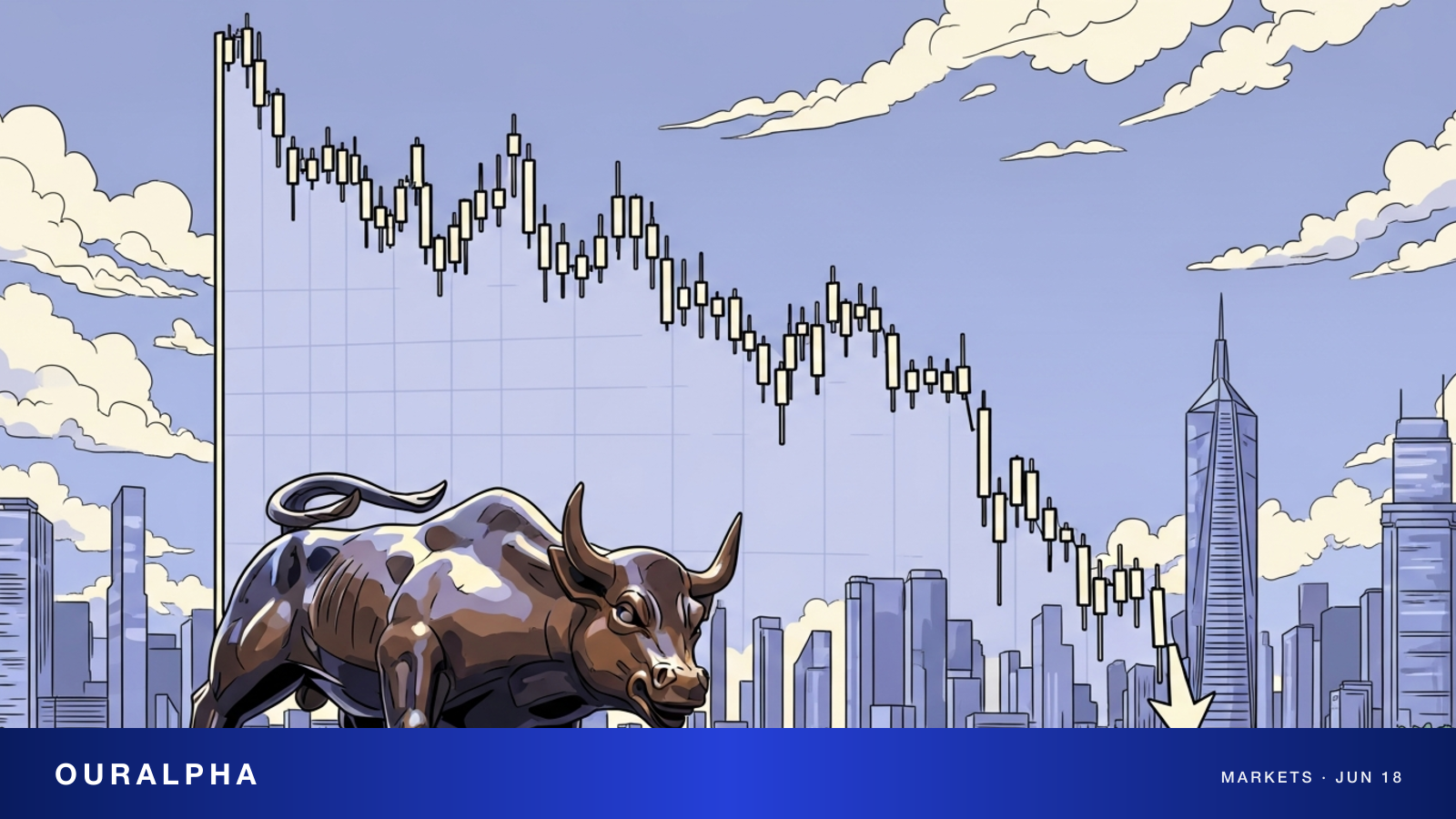
On June 17, the Dow Jones Industrial Average set an intraday record high for the third straight session — then reversed sharply after the Fed's economic projections came in more hawkish than expected. It was the forecasts, not the unchanged rate decision itself, that flipped sentiment.
- Dow closed down 507.12 points (-0.98%) at 51,492.55, after hitting an intraday all-time high
- S&P 500 fell 1.21% to 7,420.10; Nasdaq dropped 1.34% to 26,021.66
- Dot plot median year-end rate projection rose to 3.8% from 3.4% in March — shifting the implied next move from a cut to a hike
- 2026 PCE inflation median forecast jumped from 2.7% to 3.6%
- 10-year Treasury yield climbed back to roughly 4.45%
June 17 was a textbook "new high, then straight down" session for U.S. equities. The Dow Jones Industrial Average notched yet another intraday record — its third in as many days — before the Fed's afternoon rate decision and updated economic projections sent it into a sharp reversal. The index closed down 507.12 points, or 0.98%, at 51,492.55.[FXStreet]
The hold at 3.5%–3.75% was no surprise. What caught markets off guard — and snapped the rally — was the Summary of Economic Projections and dot plot, which the Street read as decidedly hawkish.[TheStreet]
From the 52,000 Milestone to a Painful Reversal
The prior session had been a genuine milestone. On Tuesday, June 16, the Dow closed above 52,000 for the first time in its history, touching an intraday high of 52,190. Falling oil prices eased inflation concerns and money rotated into industrials and cyclical blue chips to power the move.[TS2]
On June 17, the Dow extended that strength into the morning, setting another intraday record. Then the Fed decision dropped, sentiment flipped, and the index reversed hard. The S&P 500 and Nasdaq closed lower alongside it, falling 1.21% and 1.34% to 7,420.10 and 26,021.66, respectively.[TheStreet]
Hawkish Dot Plot: Inflation Forecast Revised Sharply Higher
The gut-punch came from the Fed's Summary of Economic Projections. The committee's median projection for the federal funds rate at end-2026 rose from 3.4% in March to roughly 3.8% — effectively flipping the implied next move from a cut to a hike, per FXStreet.[FXStreet]
Accompanying that shift: the committee's 2026 PCE inflation median forecast surged from 2.7% to 3.6%. With the Fed's preferred inflation gauge projected to run that far above target, a higher-for-longer — or outright tighter — path became the base case.[FXStreet]
The distribution of individual projections told the same story. According to CNBC's breakdown of the 19 committee members, 9 projected at least one rate hike this year, 8 saw rates on hold, and just 1 projected a cut — making "at least one more hike in 2026" the plurality view inside the FOMC.[CNBC]
Yields Surge, Stocks and Bonds Sell Off Together
Higher rate expectations fed straight through to Treasuries. The 10-year yield climbed back to roughly 4.43%–4.46% on June 17, per multiple data sources. Rising yields typically pressure richly valued growth stocks — which helps explain why the Nasdaq and tech names bore a disproportionate share of the day's losses.[Trading Economics]
There was a notable sector contrast at play. The industrials and cyclicals that carried the Dow to its 52,000 close the day before couldn't insulate the broader market once the hawkish signal hit. All three major indexes sold off in unison, and CNBC noted that Warsh's first meeting as Fed chair "set off a surge in bond yields" with stocks and bonds moving lower together.[CNBC]
What to Watch Next
- Inflation prints: With the Fed's 2026 PCE forecast now at 3.6%, incoming CPI and PCE readings will directly drive whether markets price in one hike — or more.
- 10-year yield trajectory: Whether the 10-year can hold above 4.45% will determine how much pressure stays on growth stock valuations.
- Sector rotation: Cyclicals and value have been outperforming. Watch whether the rotation out of high-multiple tech continues to have legs.
Sources
This content is for informational purposes only and does not constitute investment advice, trading advice, or any guarantee of returns.