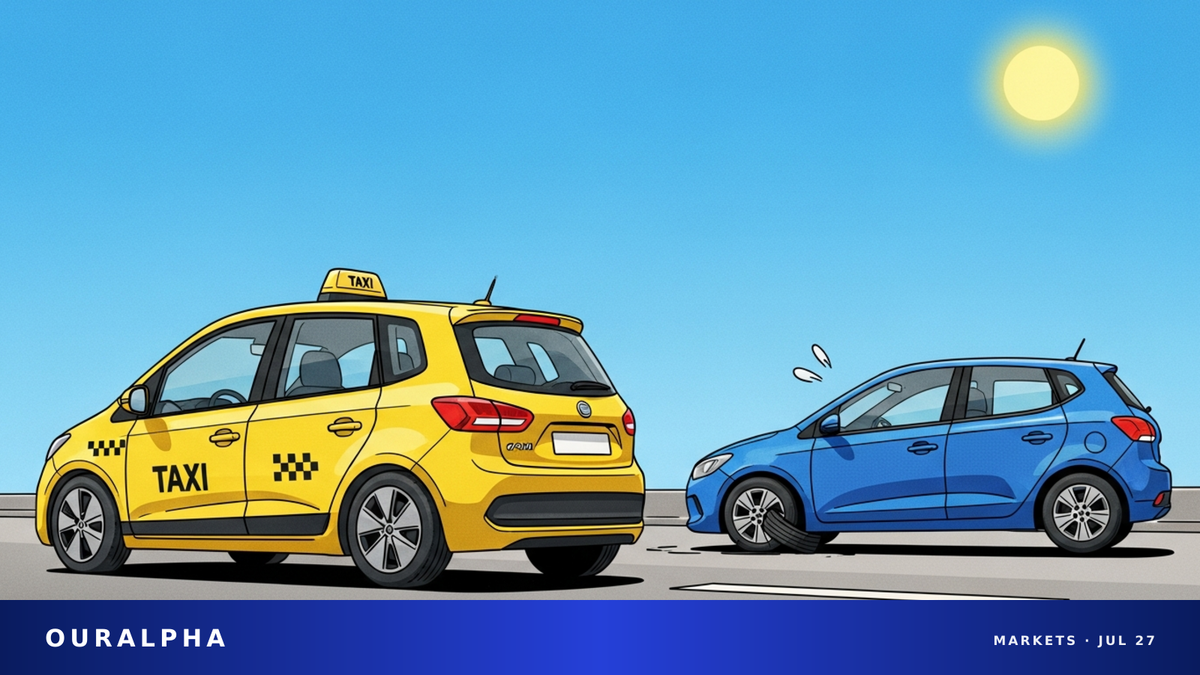
Waymo Weighs Exit From Uber Robotaxi Pact, Sending Shares Down 4%
Waymo is reportedly planning to end its robotaxi partnership with Uber, a move that sent Uber shares tumbling 4.31% on Friday. The split threatens to upend Uber’s autonomous-vehicle strategy.
Waymo, Alphabet’s self-driving unit, is reportedly considering ending its robotaxi partnership with Uber, sending the ride-hailing giant’s stock sharply lower on Friday. Uber (UBER) closed at $65.94 on July 24, 2026, down 4.31% from the prior session.
- Waymo has informed Uber it plans to operate independently in Austin and Atlanta via its own app starting January 2028.[Transport Topics]
- The existing partnership contract in Austin and Atlanta runs through May 2028.[Just Auto]
- The two companies had already ended their collaboration in Phoenix, where the agreement expired this May.[Just Auto]
- Uber has invested more than $10 billion in autonomous-vehicle partnerships since 2020.[Sahm Capital]
- Uber shares fell as much as 4.9% intraday on Friday, hitting a low of $65.56.[Transport Topics]
- Alphabet (GOOGL) shares edged up 0.58% on Friday.[StockTwits]
With U.S. markets closed for the holiday, Uber (UBER) shares are frozen at Friday’s close of $65.94. That session saw the stock tumble 4.31% from the prior day’s $68.91, touching an intraday low of $65.56 — a drop of nearly 5%.[Transport Topics] The catalyst was a Financial Times report that Alphabet’s Waymo is internally debating whether to end its robotaxi partnership with Uber.[Reuters]
Cracks From Phoenix to Austin and Atlanta
Waymo and Uber launched their partnership in May 2023, initially rolling out robotaxi service in Phoenix.[Just Auto] They later expanded to Austin, Texas, and Atlanta, Georgia. In those cities, Waymo’s autonomous vehicles were available exclusively through the Uber app, with Uber and partner Avomo handling fleet management.[Just Auto]
But the relationship is souring fast. According to the Financial Times, citing sources, Waymo has told Uber it plans to operate independently in Austin and Atlanta via its own app starting January 2028.[Transport Topics] Uber, for its part, expects to continue offering Waymo service in those cities until the contract expires in May 2028.[Just Auto] The partnership in Phoenix had already ended when the agreement expired this May.[Just Auto]
An Uber spokesperson said Waymo’s notice “effectively ends Waymo’s exclusivity in Austin and Atlanta” and allows Uber to “work with other autonomous technology providers in those cities,” adding that Uber is “ready for that.”[Transport Topics]
Growing Rifts Over Service, Safety, and Regulation
Reports indicate the two companies have been trading blame over service and safety issues in their partner cities, with tensions running high.[Just Auto] One source described the pair as “pursuing different goals.”[Just Auto]
Specifically, Waymo has complained that Uber mismanaged vehicle cleanliness and route planning in Austin and Atlanta. In May, dozens of Waymo cars got stuck in a dead-end street in Atlanta, with sources blaming Uber for the routing.[Just Auto] Uber, meanwhile, has griped about the financial terms of the deal and complained that Waymo vehicles stop operating in bad weather. After an incident last December in Austin where a Waymo car drove past a stopped school bus, Uber contacted Waymo to raise the issue.[Just Auto]
Beyond operational friction, the two diverge on regulatory policy for autonomous vehicles. Reports say they support different legislative paths for AVs.[Just Auto] Uber denies being “anti-autonomous or trying to slow its deployment,” arguing that a hybrid network — mixing autonomous and human-driven vehicles — can “get the technology to consumers faster while giving policymakers a practical framework to manage the transition.”[Just Auto]
Uber’s AV Strategy Under Pressure
A potential breakup would be a major blow to Uber’s autonomous-vehicle strategy. Since selling its in-house AV unit in 2020, Uber has relied on partnerships and investments to build its autonomous network.[Sahm Capital] According to Sahm Capital, Uber has invested more than $10 billion in AV partnerships since 2020.[Sahm Capital]
Uber had hoped to become the go-to aggregator for both autonomous and human-driven rides. But Waymo, the leading U.S. robotaxi provider, also competes directly with Uber in key markets like San Francisco and Los Angeles via its own app.[Transport Topics] Since launching on Uber’s app in Atlanta last June, Waymo hasn’t announced any new city launches through Uber, instead expanding independently to six additional cities beyond San Francisco and Los Angeles.[Transport Topics]
While Uber has announced partnerships with other AV companies — including plans in the U.S., Middle East, and Europe — Wall Street remains skeptical. According to Transport Topics, Uber shares are down nearly 20% year-to-date.[Transport Topics]
What’s Next for Waymo and Uber
In response to the reports, Waymo said in a statement: “We believe in a dynamic and collaborative autonomous ecosystem that supports innovation and gives riders the choice of how they want to experience the technology.”[Just Auto] Uber reiterated that it is not opposed to autonomous technology and stressed the value of a hybrid network model.[Just Auto]
Waymo hasn’t ruled out a complete split.[Just Auto] Under current plans, starting January 2028, Waymo would operate in Austin and Atlanta through both its own app and Uber’s — similar to its partnership with Lyft in Nashville.[Just Auto] Uber says it will be ready to bring in other AV providers by then.[Transport Topics]
Sources
- Just Auto — Waymo weighs ending Uber robotaxi partnership – report
- Reuters — Waymo explores ending Uber partnership, Financial Times reports
- Transport Topics — Waymo explores options to leave Uber robotaxi deal
- Sahm Capital — Uber Technologies (UBER) Is Down 9.0% After Waymo Seeks To End Robotaxi Partnership With Uber
- StockTwits — Uber Stock Slides Nearly 5% After Report Says Alphabet’s Waymo Could Walk Away From Their Robotaxi Deal
This content is for informational purposes only and does not constitute investment advice, trading advice, or any guarantee of returns.