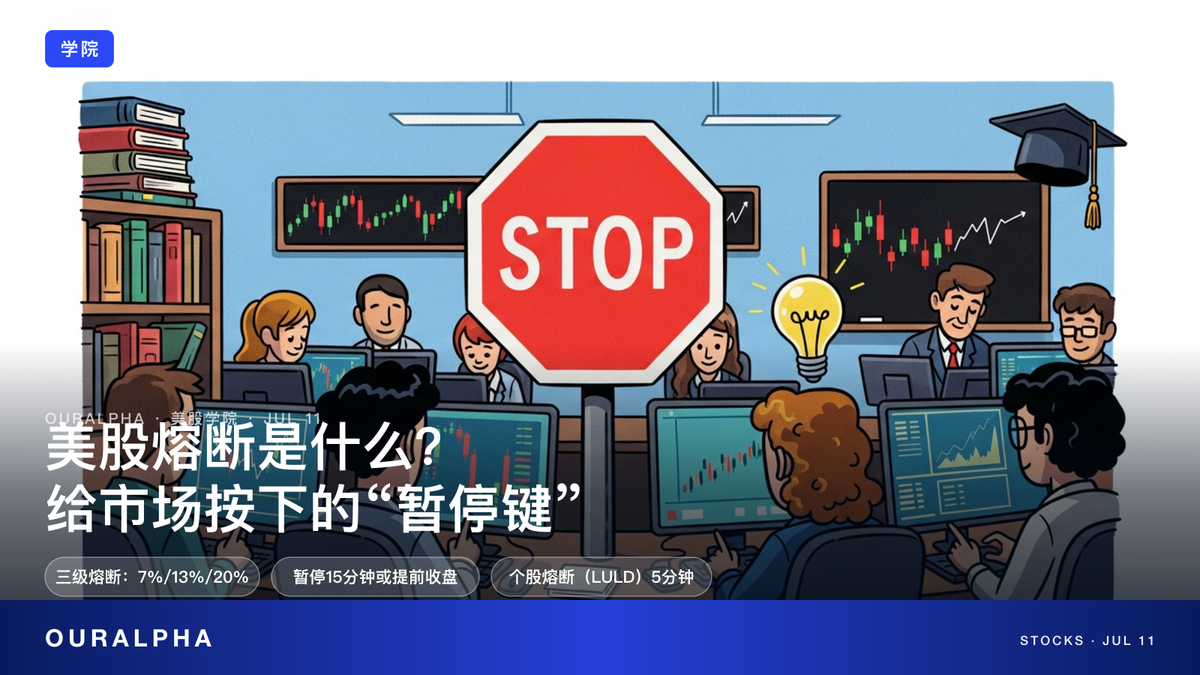
US Stock Market Circuit Breakers Explained: Three-Tier Rules vs. Single-Stock Circuit Breakers

A US stock market circuit breaker is not a shutdown, but a pause button. Understand the three-tier rules (7%/13%/20%) and the difference from single-stock circuit breakers (LULD) in 3 minutes.

US Stock Market Circuit Breakers Explained: Three-Tier Rules vs. Single-Stock Circuit Breakers
OURALPHA · ACADEMY

What Is a US Stock Market Circuit Breaker?
The 'Pause Button' for the Market

US Stock Academy · Understand Circuit Breakers in 3 Minutes

Every time the market drops sharply, you hear the word 'circuit breaker.'

Many people think a circuit breaker means the market is crashing and closing for good, but it's really just a 'pause button' for the market.

Today, we'll fully explain: What exactly is a US stock market circuit breaker?

TL;DR · IN SHORT

  • A circuit breaker is a pause button during a rapid market decline, not a shutdown.
  • Market-wide circuit breakers have three tiers: 7%, 13%, and 20%, based on the S&P 500.
  • Single-stock circuit breakers (LULD) and market-wide circuit breakers are two different systems.

KEY TERMS

Circuit Breaker: A protective rule that automatically pauses trading for a period when the market or a single stock price moves sharply in a very short time, to curb panic and cool down the market.

Market-Wide Circuit Breaker (MWCB): A mechanism that pauses trading across all US stock markets when the S&P 500 index falls by 7%, 13%, or 20% from the previous day's close.

Limit Up-Limit Down (LULD): A mechanism that sets price bands for individual stocks. If a stock's price touches the band and stays outside for more than a specified time, trading in that stock is paused for 5 minutes to prevent extreme volatility in a single stock.

CONTENTS

  1. What Does a US Stock Market Circuit Breaker Mean? Does the Market Close When It's Triggered?
  2. How Are the 7%, 13%, and 20% Levels for the Three-Tier Circuit Breaker Calculated?
  3. How Long Does Trading Pause After a Circuit Breaker? When Does It Resume?
  4. What's the Difference Between a Single-Stock Circuit Breaker (LULD) and a Market-Wide Circuit Breaker?
  5. Has the US Stock Market Actually Triggered a Circuit Breaker? When Was the Most Recent One?
  6. Are Circuit Breakers and Price Limits the Same Thing?
  7. Is There a Relationship Between Short Selling and Circuit Breakers?
  8. FAQ

What Does a US Stock Market Circuit Breaker Mean? Does the Market Close When It's Triggered?

Simply put, a circuit breaker is when the exchange automatically calls a 'time-out' when the market drops sharply in a very short time. Trading is paused for a period to let investors cool off and avoid panic selling that could lead to a market crash. Think of it like driving and hitting the brakes suddenly—the system automatically helps you brake to prevent a rollover. A circuit breaker is not about closing the market; it's about giving the market a chance to 'catch its breath,' allowing buyers and sellers to reassess information and avoid emotional decisions.

A circuit breaker is not a shutdown, just a pause. After the pause, trading resumes normally. Only when the most severe third-tier circuit breaker (a 20% drop) is triggered does the market close early for the day and not reopen[5]—we'll detail the pause durations and resumption rules in the next section. It's like a basketball game: if the score gap is too large, the referee may end the game early instead of waiting for the regular time to expire.

Circuit breakers originated from 'Black Monday' on October 19, 1987, when the Dow Jones Industrial Average plunged about 22.6%. After that, regulators introduced circuit breakers as a safeguard[8]. That crash made regulators realize the market needed a 'cooling mechanism' to prevent panic from spiraling out of control. Imagine if there were no circuit breakers—the market could snowball into a steeper decline. A circuit breaker acts like a barrier placed in the path of an avalanche, slowing the impact.

How Are the 7%, 13%, and 20% Levels for the Three-Tier Circuit Breaker Calculated?

The market-wide circuit breaker (MWCB) is based on the S&P 500 index's decline for the day, divided into three tiers: Level 1 at 7%, Level 2 at 13%, and Level 3 at 20%[2]. Note: These percentages are calculated relative to the S&P 500's closing price from the previous trading day, and the specific point levels change daily because the baseline changes[3]. It's like your height changes every day, so the difficulty of 'jumping to touch a high bar' also changes.

For example: If the S&P 500 closed at 5000 the previous day, then dropping to 4650 (a 7% drop) today would trigger a Level 1 circuit breaker; dropping further to 4350 (a 13% drop) triggers Level 2; dropping to 4000 (a 20% drop) triggers Level 3, ending trading for the day. To quickly estimate, use this formula: Trigger level = Previous day's close × (1 - percentage decline). For instance, if the previous close was 4800, the 7% trigger point is 4800 × 0.93 = 4464.

Remember this key point: The trigger levels change every day because they follow the previous day's closing price, not a fixed number. So you don't need to memorize specific point levels; just remember 'what percentage drop' to gauge whether the market is close to triggering a circuit breaker. It's like a weather forecast saying 'temperature drop of 10%'—the actual temperature depends on the day's baseline, not a rigid number.

How Long Does Trading Pause After a Circuit Breaker? When Does It Resume?

After a Level 1 (7%) or Level 2 (13%) circuit breaker is triggered, all market trading pauses for 15 minutes[4]. But there's an important time condition: if triggered before 3:25 PM ET, the pause is 15 minutes; if triggered 'at or after' 3:25 PM ET, no pause occurs and trading continues[4]. This is because near the close, a 15-minute pause could interfere with the normal closing process, so the rule sets a time boundary. Think of it like a basketball game: in the final minutes, the referee won't easily call a timeout to avoid affecting the game's outcome.

If a Level 3 (20%) circuit breaker is triggered, regardless of the time, trading stops immediately and does not resume for the day[5]. In other words, once it drops 20%, the market closes early for the day. This is like a soccer match where if one team leads by too much, the referee may terminate the game early without playing the remaining time.

Additionally, when a circuit breaker is triggered, all stocks traded under the NMS (National Market System) are paused together[6]. This means not just S&P 500 stocks, but all stocks listed on exchanges, including Nasdaq and NYSE, stop trading. It's like all traffic lights in a city turning red simultaneously—every vehicle must stop.

What's the Difference Between a Single-Stock Circuit Breaker (LULD) and a Market-Wide Circuit Breaker?

A market-wide circuit breaker is a 'big brake' for the entire stock market, while a single-stock circuit breaker (LULD) is a 'small brake' for an individual stock[9]. The market-wide circuit breaker affects all stocks; the single-stock circuit breaker only affects that one stock. Think of the market-wide circuit breaker as a power outage in the entire stadium, pausing all games; the single-stock circuit breaker is like a foul by one athlete, pausing only that athlete's game.

The rule for single-stock circuit breakers is: Each stock has a price band. If the stock price touches the band and does not return within the band within 15 seconds, trading in that stock is paused for 5 minutes[9]. The width of the price band depends on the stock price and the stock's tier (Tier 1 or Tier 2). For example, Tier 1 stocks (S&P 500, Russell 1000 components, etc.) have price band widths of 5% or 10%, etc.[10]. Specifically, price band widths can be 5%, 10%, 20%, or the lesser of $0.15 and 75%, depending on the stock price and tier. For instance, a Tier 1 stock priced at $100 might have a 5% price band, meaning $5 up or down; if the price suddenly drops below $95 and doesn't return above $95 within 15 seconds, a 5-minute pause is triggered.

Single-stock circuit breakers are only effective during regular trading hours (9:30 AM - 4:00 PM ET), and during the last 25 minutes before the close, the price band is doubled[11]. This is because near the close, market volatility may be higher, and widening the band reduces unnecessary pauses. For example, a 5% band might become 10% in the last 25 minutes, so a larger price move is needed to trigger a pause.

To learn more about price limits, check out our previous article: US Stock Price Limits Explained: Principles, Circuit Breakers, and Examples.

Has the US Stock Market Actually Triggered a Circuit Breaker? When Was the Most Recent One?

Yes, circuit breakers have been triggered. The most famous example is during the COVID-19 panic in March 2020, when the US stock market triggered Level 1 (7%) circuit breakers multiple times within two weeks, pausing for 15 minutes each time[13]. The market was extremely panicked, and the S&P 500 would drop sharply at the open, triggering a circuit breaker, giving investors time to calm down during the pause. Imagine it like a stormy sea—the circuit breaker is like temporarily dropping anchor to steady the ship.

The most recent discussion was in April 2025, when tariff concerns caused a sharp market decline, and the S&P 500 came close to the circuit breaker threshold[14]. This shows that under extreme market conditions, circuit breakers can still be triggered, and investors need to understand these rules. It's like an earthquake early warning system—though not commonly used, when it triggers, everyone knows what to do.

The current three-tier rules (7%/13%/20%) have been in effect since April 8, 2013, replacing the old rules[7]. The old rules were based on the Dow Jones Industrial Average with thresholds of 10%/20%/30%. In 2013, the rules were changed to use the S&P 500 and lower thresholds, making circuit breakers easier to trigger and thus intervening in the market earlier. This is like increasing the sensitivity of a fire alarm so it sounds when the fire is still small.

Are Circuit Breakers and Price Limits the Same Thing?

No, they are not the same. A circuit breaker pauses trading, while a price limit means that once the price reaches a certain limit, it cannot go higher or lower, but trading can still continue (just with the price capped). For example, in China's A-share market, stocks have daily price limits of 10%. Once the price hits the limit, it cannot rise or fall further, but trading still occurs, just with the price locked. Think of a price limit like a speed bump—vehicles can still move but at a restricted speed; a circuit breaker is like a red light—all vehicles must stop.

A-shares have price limits, but US stocks do not have a uniform price limit. Instead, they have single-stock circuit breakers (LULD) to prevent extreme volatility in individual stocks. A single-stock circuit breaker pauses trading, not limits the price. So, in the US market, a stock could theoretically rise 100% in a day, but if the move is too fast, it might trigger a single-stock circuit breaker and pause for 5 minutes.

Simply put: A circuit breaker is a 'trading halt to cool off,' while a price limit is 'trading with a price cap.' Both aim to prevent excessive volatility, but they work differently.

Is There a Relationship Between Short Selling and Circuit Breakers?

Circuit breakers themselves do not directly restrict short selling, but during a circuit breaker, all trading is paused, including short selling. That means if a circuit breaker is triggered, short sellers cannot sell stocks during the pause. It's like in a game when the referee calls a timeout—players on both sides cannot move.

Additionally, short sellers may face risks during a market crash—prices can suddenly rebound (a 'short squeeze'), and the pause from a circuit breaker gives both sides a buffer: short sellers can use the time to cover their positions, and market sentiment may stabilize. Think of this pause like a boxing match's count—whether you're ahead or behind, you get a few seconds to catch your breath and rethink your next move.

To understand the risks of short selling, read: What Is Short Selling? Principles, Risks, and Examples.

常见问题 FAQ

What happens to my orders when a circuit breaker is triggered?

During a circuit breaker, all new orders and existing orders will not be executed. After the pause ends, trading resumes normally, and orders will be processed according to the rules.

Can a single-stock circuit breaker (LULD) trigger a market-wide circuit breaker?

No. A single-stock circuit breaker only affects that individual stock and is a separate mechanism from the market-wide circuit breaker.

Do circuit breaker rules apply to pre-market and after-hours trading?

Market-wide circuit breakers (MWCB) apply during regular trading hours (9:30 AM - 4:00 PM ET). Single-stock circuit breakers (LULD) also only apply during regular trading hours[11]. There are no circuit breakers for pre-market or after-hours trading.

How many times did circuit breakers trigger in March 2020?

In March 2020, the US stock market triggered Level 1 (7%) circuit breakers four times: on March 9, 12, 16, and 18[13].

Do the circuit breaker thresholds change every day?

Yes, the trigger points for Level 1 (7%), Level 2 (13%), and Level 3 (20%) are recalculated daily based on the previous trading day's S&P 500 closing price[3].

What is the price band width for single-stock circuit breakers?

The price band width depends on the stock price and the stock's tier. For example, Tier 1 stocks (S&P 500 components, etc.) typically have a price band width of 5% or 10%[10]. For details, refer to the LULD Plan website[12].

Do circuit breakers apply to ETFs?

Market-wide circuit breakers apply to all NMS securities, including ETFs[6]. Single-stock circuit breakers also apply to ETFs, but ETFs are usually classified as Tier 1 or Tier 2, with specific price band widths defined by LULD rules.

SOURCES

[1] Stock Market Circuit Breakers | Investor.gov (SEC)
[2] Stock Market Circuit Breakers | Investor.gov (SEC)
[3] Stock Market Circuit Breakers | Investor.gov (SEC)
[4] Stock Market Circuit Breakers | Investor.gov (SEC)
[5] Stock Market Circuit Breakers | Investor.gov (SEC)
[6] Market-Wide Circuit Breaker FAQ | Nasdaq Trader
[7] Market Wide Circuit Breaker | Nasdaq Trader
[8] Stock Market Crash of 1987 | Federal Reserve History
[9] Stock Market Circuit Breakers | Investor.gov (SEC)
[10] Stock Market Circuit Breakers | Investor.gov (SEC)
[11] Stock Market Circuit Breakers | Investor.gov (SEC)
[12] Limit Up-Limit Down Plan (LULD Plan)
[13] US stock trading halted after S&P 500 drops 7%, hits circuit breakers | CNBC
[14] S&P 500 circuit breaker on tariff worries. What that means | CNBC

This content is for informational purposes only and does not constitute investment advice, trading advice, or any guarantee of returns.

Keep Reading

What is a US stock market maker? How is it different from matching? One article to understand

What is a US stock market maker? How is it different from matching? One article to understand
OURALPHA · ACADEMY

undefined

US Stock Academy · Unveiling the providers of market liquidity

Think when you place an order to buy a stock, you're directly trading with another retail investor?

On Nasdaq, your counterparty is likely a professional market maker.

Market makers aren't matchmakers—they're 'dealers' trading with their own capital.

TL;DR · IN SHORT

  • A market maker is a securities firm that stands ready to buy or sell a stock at any time, providing instant execution.
  • Market makers earn the bid-ask spread, not commissions.
  • Nasdaq
Read full story →

Stay ahead of the market — never miss a deep dive

Follow OurAlpha for AI-driven US equity research and market insight, every day.