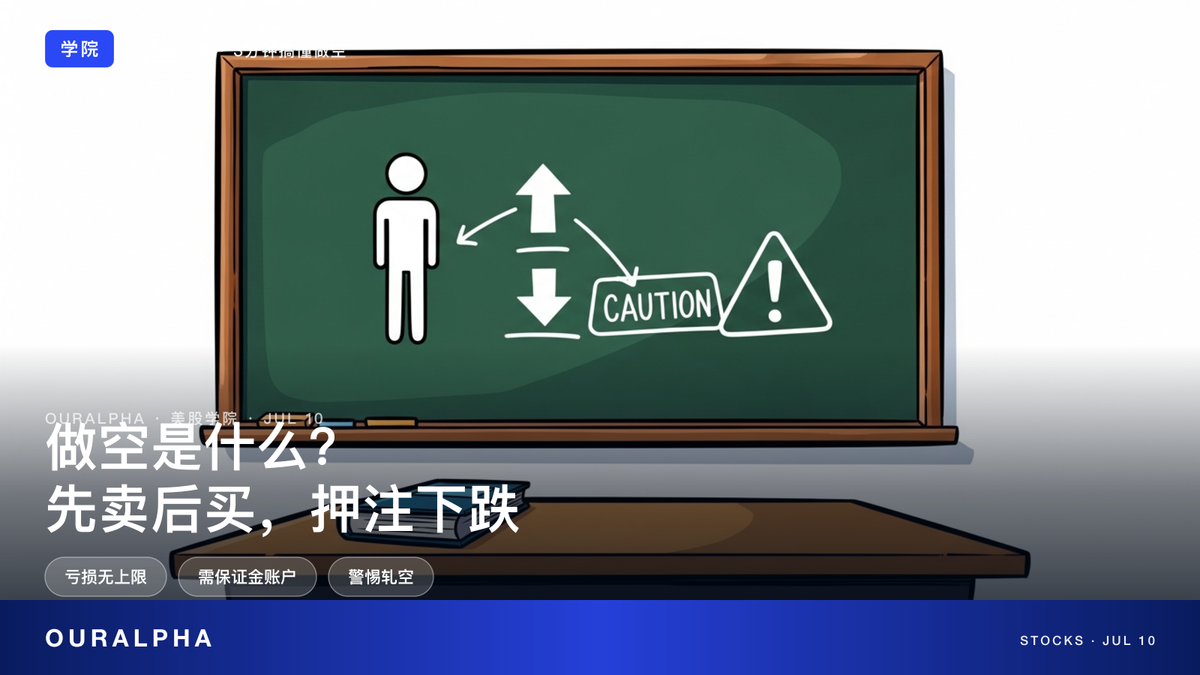
What Is Short Selling? How It Works, Risks, and Real Examples
Short selling isn't betting the opposite—it's borrowing shares to sell, then buying back cheaper. Profit is limited, losses are unlimited, and you pay borrowing fees and face short-squeeze risk. Understand short selling in 3 minutes.
What Is Short Selling in Stocks?
Sell First, Buy Later, Betting on a Drop
Many people think short selling is just 'betting the opposite,' but that's not quite right.
Short selling means borrowing shares to sell, then buying them back cheaper later to return them, pocketing the difference.
But the risk is asymmetric: profit is limited, while losses are theoretically unlimited.
TL;DR · IN SHORT
- Short selling = borrow shares, sell them, buy back cheaper, return them, profit from the difference
- Maximum profit is when the stock goes to zero; losses have no upper limit
- Short selling requires a margin account, and you pay borrowing fees and dividends
- A short squeeze is the most dangerous scenario for short sellers
KEY TERMS
Short Selling: Borrowing shares from a broker and selling them, hoping the price falls so you can buy them back cheaper and return them, profiting from the difference.
Buy to Cover: The action of buying back borrowed shares to return them to the lender, closing out a short position.
Short Squeeze: When a heavily shorted stock suddenly rises, forcing short sellers to buy back shares to cut losses, which drives the price even higher.
Naked Short Selling: Selling shares short without first borrowing them, which can lead to delivery failures and is heavily restricted.
CONTENTS
- How Does Short Selling Actually Make Money?
- Why Is the Risk of Short Selling Unlimited?
- Can Retail Investors Short? What Account Do You Need?
- What Is a Short Squeeze? Why Do Short Sellers Fear It Most?
- What Regulatory Restrictions Are There on Short Selling? Can You Short When the Price Is Plummeting?
- What Are the Uses of Short Selling? Is It Just Speculation?
- In a Nutshell: What's the Fundamental Difference Between Shorting and Going Long?
- FAQ
How Does Short Selling Actually Make Money?
Simply put, short selling is 'sell first, buy later.' You borrow shares from your broker, sell them on the market, and get cash. Then, if the price drops, you buy them back at a lower price, return the shares, and keep the difference as profit.[1] For example: You borrow 1 share of Apple stock and sell it at $150; later the price drops to $100, you buy it back for $100 and return it, making $50. It's like borrowing a book from a friend, selling it, then buying it back cheaper and returning it—you keep the difference. But stock short selling is more complex because you need your broker to 'borrow' the shares, and you must return them.
The process has three steps: ① Your broker 'locates' and lends you the shares; ② You sell the shares and receive cash; ③ Later you 'buy to cover' (buy back the shares) and return them to the lender.[2] Your profit or loss is the difference between the sell price and buy price, minus fees. Note: Short selling is not directly selling shares you don't own; you borrow them through your broker and then sell them. So essentially, you're 'borrowing goods to sell.' If the price rises instead of falls, you'll have to buy back at a higher price, resulting in a loss.
Why Is the Risk of Short Selling Unlimited?
The risk of short selling is the opposite of going long (buying). When you go long, your maximum loss is your initial investment (if the stock goes to zero), but your profit can be unlimited (the stock can rise indefinitely). Short selling is the reverse: your maximum profit is limited—the stock can only fall to zero, so that's your max gain—but your loss is theoretically unlimited because the stock can keep rising.[3] For example: You short a stock at $10. If it rises to $100, you lose $90; if it rises to $1,000, you lose $990. There's no ceiling on stock prices, so losses can be infinite. That's why short selling is considered 'high risk.'
To visualize, imagine you borrow a bicycle and sell it, hoping to buy it back cheaper. If the bike's price rises from $100 to $1,000, you lose $900. If you had bought (gone long) instead, your max loss would be $100 (if it went to zero). Short selling has no built-in 'stop loss' unless you close the position yourself or your broker forces you to. So you must set a stop-loss plan before shorting, or you could lose everything.
Can Retail Investors Short? What Account Do You Need?
Yes, but short selling requires a margin account—a regular cash account won't work.[4] A margin account lets you borrow money to trade, and short selling is essentially borrowing shares to sell, so your broker needs to extend credit. You also need to maintain a certain margin requirement. If the stock price rises and your account equity falls below the requirement, your broker will issue a margin call, forcing you to add funds or close positions. For example, if you have $2,000 in your account as margin, and the initial margin requirement is 50%, you can short about $4,000 worth of stock. If the price rises and your equity drops, the broker will ask you to deposit more money or liquidate.
Also, short selling isn't free. You pay a borrowing fee (hard-to-borrow fee), which can be high if the stock is hard to borrow. And if the borrowed stock pays a dividend while you're short, you must pay that dividend out of your own pocket to the lender.[5] These costs eat into your profits over time. For instance, if the stock pays a $1 dividend per share, you owe $1 per share to the lender, even though you never received the dividend. So the longer you hold a short position, the higher the cost, which is why short selling is usually a short-term strategy.
What Is a Short Squeeze? Why Do Short Sellers Fear It Most?
A short squeeze is one of the most dangerous scenarios for short sellers. When a stock is heavily shorted and suddenly gets good news or a wave of buying, the price starts rising. Short sellers, seeing losses, are forced to buy back shares to cover their positions (stop losses). Those buy orders push the price even higher, forcing more short sellers to buy, creating a chain reaction of 'rising prices cause more buying, which causes more rising.'[10] It's like a crowd pushing toward a door—those in front get trampled.
Common metrics to measure short-selling congestion are 'short interest' and 'days to cover.' If short interest is high and days to cover is long, a short squeeze is more likely when the price reverses.[11] One famous example is the GameStop (GME) squeeze, where short sellers suffered heavy losses in just a few days. Retail investors can check these indicators to gauge short-selling risk. For instance, if a stock's short interest is over 30% and days to cover is over 10, the risk of a squeeze is high.
What Regulatory Restrictions Are There on Short Selling? Can You Short When the Price Is Plummeting?
The SEC has several rules on short selling. Key ones include: ① Before shorting, your broker must have a 'reasonable basis' to believe the shares can be borrowed (locate requirement); naked short selling (shorting without borrowing) is prohibited because it can lead to delivery failures and is heavily restricted.[6][8] ② When a stock drops more than 10% in a single day, the 'alternative uptick rule' (Rule 201) is triggered. After that, short sales can only be executed at a price above the current national best bid, preventing short sellers from piling on during a crash.[9] This means if the stock has already plunged, you can't short at even lower prices—you must wait for the price to rise above the bid.
These rules aim to allow short selling's price-discovery function while preventing market manipulation and excessive declines. For example, Regulation SHO also requires brokers to close out 'fails to deliver' within a specific timeframe to maintain market order.[7] For retail investors, understanding these rules helps avoid violations, like attempting naked short selling, which could lead to penalties.
What Are the Uses of Short Selling? Is It Just Speculation?
Short selling isn't just speculation. It has two important uses: hedging and market making. For example, if you own a stock (long) and worry about a short-term drop, you can short a small amount of the same stock to hedge. If the price falls, the short profit offsets the long loss. Market makers use short selling to provide liquidity, making it easier for buyers and sellers to trade.[12] For instance, when someone wants to buy, a market maker can short shares to fill the order, then buy them back later.
Of course, short selling is controversial. Supporters say it improves price discovery and liquidity; critics worry it amplifies declines and can be used for manipulation. Regulators try to balance these concerns.[12] For ordinary retail investors, short selling is a double-edged sword: it can be used to profit or hedge, but it's very risky and not for beginners. If you're new to US stocks, start with going long, and only consider shorting after you're familiar with the market.
In a Nutshell: What's the Fundamental Difference Between Shorting and Going Long?
Going long means 'buy first, sell later,' betting on a rise, with losses limited to your investment. Shorting means 'sell first, buy later,' betting on a fall, with theoretically unlimited losses. The risk profiles are completely asymmetric. Shorting also requires a margin account, involves borrowing fees and dividend payments, faces short-squeeze risk, and is heavily regulated. If you're new to US stocks, start with going long, and only consider shorting after you're familiar with the market.
常见问题 FAQ
Do I have to pay taxes on short selling profits?
Yes. Short selling profits are generally taxed as short-term capital gains, at your ordinary income tax rate. This is because the shares you buy to cover are held for almost zero time, so regardless of how long your short position was open, the gain is usually short-term. There is no 'hold for over a year to get long-term rates' benefit for short selling. Consult a tax advisor for specifics.
What's the minimum amount of money needed to short?
Shorting requires a margin account. The minimum opening deposit is typically $2,000 (but some brokers may require more). You also need to maintain a certain margin ratio. The initial margin requirement is usually 50% of the short position's value. Under FINRA rules, the maintenance margin for short positions is typically 30% of the short position's value (higher for stocks under $5), which is higher than for long positions.[4]
Will shorting affect stocks I already own?
If you hold both a long and short position in the same stock in the same account, your broker may require you to close one, or treat it as a 'hedge' and lower the margin requirement. Rules vary by broker.
Can I hold a short position for a long time?
Theoretically yes, but the cost is high. Borrowing fees accrue daily, and if the stock is hard to borrow, fees can be steep. Also, if the stock pays dividends, you must pay an equal amount. Over time, these costs eat into profits, so shorting is usually a short-term strategy.
What is a 'failure to deliver'?
A failure to deliver occurs when the shares sold short cannot be delivered to the buyer on time. Naked short selling is a primary cause. The SEC's Regulation SHO requires brokers to close out such failures within a specific timeframe to reduce them.[6][7]
What's the difference between shorting stocks and shorting options?
Shorting a stock means borrowing and selling shares directly; profit/loss is linear with price, and losses are theoretically unlimited. With options, you need to distinguish between 'buying' and 'selling.' If you buy a put option (long put), your risk is limited to the premium paid. But if you sell (write) an option, like a call option, the risk is similar to shorting the stock—potentially unlimited. They are different tools; don't confuse the risk of buying options with selling/writing options.
What happens if my short position is forcibly closed?
If the stock price rises and your margin falls below the requirement, your broker has the right to buy back the shares (buy-in) without your consent. You may be closed out at an unfavorable price, and you bear the loss. Additional fees may also apply.
SOURCES
[1] SEC Investor.gov — Investor Bulletin: An Introduction to Short Sales
[2] SEC Investor.gov — Introduction to Short Sales
[3] FINRA / SEC Investor Education (Short Selling Risks)
[4] FINRA — Margin Regulation / Margin Accounts
[5] SEC Investor.gov — Introduction to Short Sales
[6] Nasdaq Trader — Regulation SHO
[7] NYSE — Short Selling & Regulation SHO Resource Guide
[8] SEC — Naked Short Sales (Fast Answers)
[9] SEC — Press Release: SEC Approves Short Selling Restrictions (2010-26)
[10] Charles Schwab — What's a Short Squeeze and Why Does It Happen?
[11] Corporate Finance Institute — Short Squeeze Overview
[12] U.S. Congress CRS — Short Selling: Background and Policy Issues
This content is for informational purposes only and does not constitute investment advice, trading advice, or any guarantee of returns.