Stock Buybacks in the U.S. Market: How They Work, Benefits, and Risks Explained
What is a stock buyback? How does a company buyback boost EPS? Are debt-funded buybacks risky? This article explains buyback mechanics, tax advantages, and potential pitfalls in plain English.
What Is a Stock Buyback?
Why Is It Often Seen as Good News?
You've probably seen news that a company announced a massive stock buyback and its stock price jumped.
But does a buyback really mean the company is more profitable? Not necessarily.
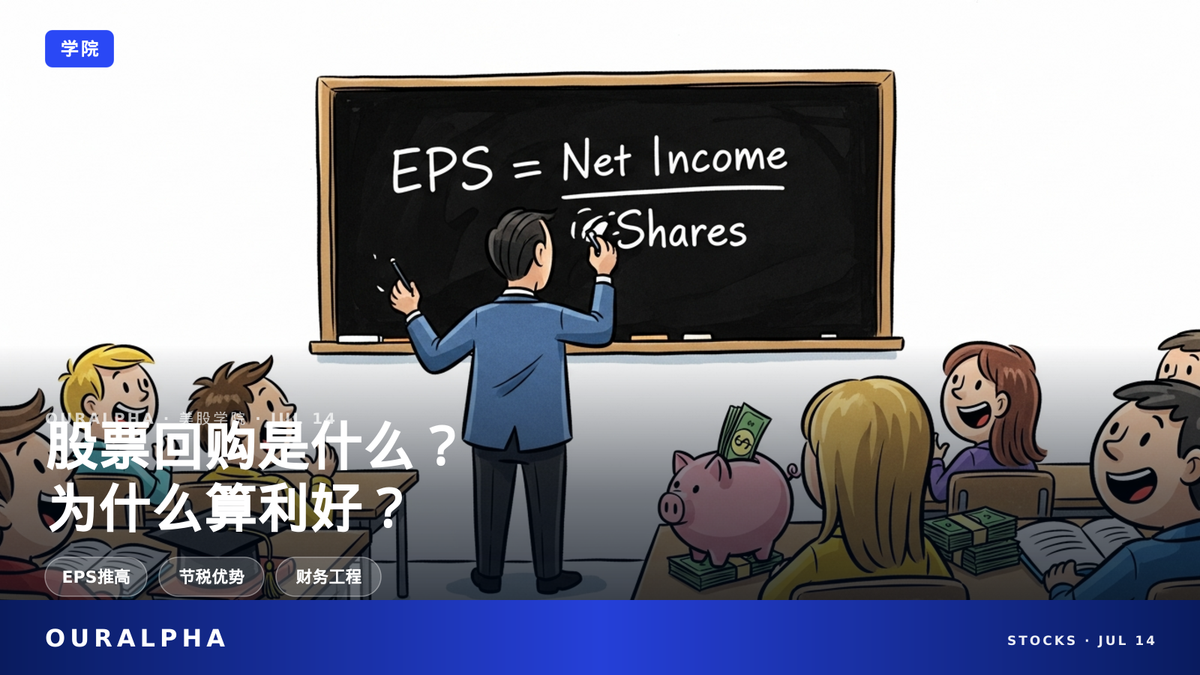
Simply put: a buyback is when a company uses its cash to buy its own shares, reducing the number of shares outstanding and automatically boosting earnings per share (EPS).
TL;DR · IN SHORT
- Buyback = company buys back its own shares, reduces shares outstanding, boosts EPS.
- EPS rise may come from fewer shares, not profit growth—don't confuse the two.
- Debt-funded buybacks increase financial risk; always check cash flow.
- Buybacks are more tax-efficient for shareholders, especially non-U.S. investors.
KEY TERMS
Stock Buyback: A publicly traded company uses cash to repurchase its own outstanding shares, reducing the number of shares in circulation.
Earnings Per Share (EPS): Net profit divided by total shares outstanding, measuring profitability per share.
Treasury Stock: Shares bought back but not canceled; they don't receive dividends and are excluded from EPS calculations.
Rule 10b-18 Safe Harbor: An SEC rule that, if conditions are met, protects a company's buybacks from being deemed market manipulation.
CONTENTS
- How Does a Stock Buyback Actually Work?
- Why Does a Buyback Boost EPS? Does It Mean the Company Is More Profitable?
- Why Do Companies Prefer Buybacks Over Dividends?
- Where Do the Repurchased Shares Go? Are They Canceled?
- Are Debt-Funded Buybacks Dangerous? What About Executives Selling Shares After a Buyback Announcement?
- Are Buybacks Taxed? What New Tax Was Added After 2022?
- How Big Are Buybacks? What Are Some Landmark Examples?
- FAQ
How Does a Stock Buyback Actually Work?
Simply put, a stock buyback is when a publicly traded company uses its own cash (or borrowed money) to buy back its own shares from the market. The repurchased shares can be canceled or held as “treasury stock” on the company's books, but in either case, they are no longer counted as shares outstanding.[1]
Companies use several methods to buy back shares: the most common is buying gradually in the open market, just like regular investors; another is a tender offer, where the company offers to buy shares from all shareholders at a fixed price; companies can also negotiate privately with large shareholders, or use an accelerated share repurchase (ASR) to buy a large block of shares from an investment bank all at once.[1]
To prevent buybacks from being used to manipulate stock prices, the SEC provides a “safe harbor” under Rule 10b-18. As long as the company follows four conditions during the buyback—using only one broker per day, not buying during the opening or closing periods, not paying more than the highest independent bid or last independent transaction price (whichever is higher), and limiting daily volume to 25% of the average daily trading volume over the past four weeks (with one block trade exception per week)—the day's buyback transactions are generally protected from being accused of market manipulation.[2] Of course, this is not a free pass: if the buyback is used to artificially boost the stock price or hide problems, the safe harbor protection is lost.[3]
Why Does a Buyback Boost EPS? Does It Mean the Company Is More Profitable?
Many people think a buyback means the company is more profitable, but that's not necessarily true. A buyback boosts EPS by shrinking the denominator (number of shares), not by increasing the numerator (net profit). For example: a company has a net profit of $100,000 and 10,000 shares outstanding, so EPS is $10. If the company buys back 2,000 shares and cancels them, shares outstanding drop to 8,000. With net profit unchanged, EPS automatically rises to $12.50—this increase comes entirely from fewer shares, not from any improvement in business performance.[4]
So when you see a company's EPS jump after a buyback, always ask: did profits actually grow? Or did the share count just shrink? If profits are flat or declining, the buyback is a form of “financial engineering” (making the financials look better through a numbers game, not by actually earning more), not a fundamental improvement.
Why Do Companies Prefer Buybacks Over Dividends?
Both buybacks and dividends are ways to return cash to shareholders, but buybacks have several unique advantages. First, buybacks are more flexible: once a company starts paying dividends, investors expect them to continue, and if the company suddenly cuts or eliminates the dividend, the market may see it as bad news and the stock price could drop. Buybacks, on the other hand, can be paused at any time without causing a negative reaction.[5]
Second, buybacks are more tax-friendly for shareholders. Cash dividends are taxed as ordinary income when paid, while buybacks don't trigger an immediate tax event. Shareholders only pay capital gains tax when they sell their shares, and long-term capital gains rates are usually lower. According to estimates, U.S. taxable shareholders save an average of about 9.3 percentage points in tax when companies use buybacks instead of dividends.[6]
This advantage is even bigger for non-U.S. investors: U.S. stock dividends are subject to a default 30% federal withholding tax (which can be reduced to 15% or less under tax treaties), while the price appreciation from buybacks is a capital gain, and nonresident aliens generally don't owe U.S. tax on capital gains.[7] That's why many international investors prefer companies that use buybacks.
Where Do the Repurchased Shares Go? Are They Canceled?
Repurchased shares have two possible fates: they can be canceled immediately, permanently reducing the total share count, or they can be held as “treasury stock” on the company's books, to be used later for employee stock compensation, acquisitions, or resale. Treasury stock is not counted as shares outstanding and does not receive dividends or affect EPS calculations.[1] So even without cancellation, a buyback still boosts EPS.
It's important to note that a buyback is completely different from a stock split. A stock split simply divides each share into multiple shares; the company's cash and total market value remain unchanged—it's just cutting the “pie” into smaller pieces. A buyback, on the other hand, involves the company spending real cash to reduce the total number of shares.[13] To learn more about stock splits, check out our previous article: What Is a Stock Split? Does It Affect Stock Price?
Are Debt-Funded Buybacks Dangerous? What About Executives Selling Shares After a Buyback Announcement?
If a company uses its own cash for a buyback, it's usually a positive sign that cash flow is strong. But if the company borrows money to fund the buyback, it increases financial leverage and debt repayment pressure, potentially crowding out long-term investments like R&D and capital spending. This “borrowing to look good” behavior has been criticized by many scholars and regulators as “financial engineering.”[12]
Even more concerning is when executives sell large amounts of their own shares after a buyback announcement, while the stock price is rising. Former SEC Commissioner Robert Jackson publicly noted in a speech that many executives sell large quantities of stock during the short window after a buyback announcement, and investors should be aware of this potential conflict of interest.[12] So when you see a buyback announcement, don't get excited too quickly—first check whether the company also announced insider sales.
Are Buybacks Taxed? What New Tax Was Added After 2022?
At the company level: The Inflation Reduction Act of 2022 introduced a 1% excise tax on the net value of stock buybacks by publicly traded companies, effective January 1, 2023. This tax cannot be deducted as a corporate income tax expense. The IRS issued final rules in November 2025, clarifying exemptions such as “going-private transactions.”[8]
At the shareholder level: A buyback itself does not trigger a tax event. Shareholders only pay capital gains tax when they sell their shares. This is different from dividends, which are taxed immediately. So buybacks are more tax-efficient for long-term holders.
How Big Are Buybacks? What Are Some Landmark Examples?
Buybacks are very common in the U.S. market, and their scale keeps hitting new records. According to S&P Dow Jones Indices, S&P 500 companies repurchased a record $293.5 billion in the first quarter of 2025, and over the 12 months ending September 2025, total buybacks reached $1.02 trillion—the second time the annual total has surpassed $1 trillion (the first was the 12 months ending June 2022, at about $1.005 trillion).[9]
Landmark example: In May 2024, Apple's board approved an additional $110 billion stock buyback authorization, the largest single buyback announcement in U.S. corporate history, surpassing Apple's own previous record of $100 billion set in 2018.[10] Apple is also one of the world's biggest buyback companies.
常见问题 FAQ
Is a stock buyback always good for the stock price?
Not necessarily. In the short term, a buyback can boost the stock price by reducing supply and signaling confidence. But if the company borrows to fund the buyback or executives sell shares afterward, it may increase risk in the long run. You need to evaluate the company's cash flow, debt level, and the motivation behind the buyback.
As a regular shareholder, will my shares be affected by the company's buyback?
No, the number of shares you hold won't decrease—the company is buying shares from other sellers in the market. If you don't sell, your share count stays the same. However, because the total number of shares outstanding decreases, your ownership percentage in the company increases slightly, meaning you indirectly own a bit more of the company. Unless the company launches a tender offer and you choose to participate, a buyback does not force you to trade.
Can ordinary retail investors profit from a company's buyback plan?
Yes, retail investors can benefit by holding shares of companies that actively buy back stock, enjoying EPS growth and potential price appreciation. But keep in mind that a buyback plan doesn't mean immediate buying—the company may execute it over several months, and the market may have already priced in the expectation.
Is a buyback really always better for shareholders than a dividend?
Not necessarily—it depends on the situation. Buybacks have advantages in flexibility and taxes: companies can pause buybacks without causing a stock price drop like cutting dividends would, and capital gains from buybacks are usually taxed more favorably than immediate dividend income. However, if a company borrows to fund buybacks, crowding out R&D and capital spending, or if executives use the buyback to boost the stock price and then sell their own shares, the buyback may actually harm long-term shareholder value. So the key isn't which is “better,” but whether the company's cash flow is healthy and the buyback funding is sound.
Why do executives sell their own shares right after the company announces a buyback?
This could be a red flag for a conflict of interest. Executives may use the buyback to boost the stock price and then cash out. A former SEC commissioner has pointed out this phenomenon. Investors can check insider trading records to identify such risks.[12]
What's the difference between a stock buyback and a stock split?
A buyback is when the company spends cash to buy back shares, reducing the total share count. A stock split simply divides each share into multiple shares, increasing the total share count, but the company's cash and market value remain unchanged. The two have completely different effects on stock price and shareholder equity.[13]
What are the tax advantages for non-U.S. investors in buybacks?
Non-U.S. investors typically have 30% withheld from U.S. stock dividends (reduced to 15% or less under tax treaties), while price appreciation from buybacks is a capital gain and generally not subject to U.S. tax. Therefore, buybacks are more favorable for international investors.[7]
How can I tell if a company actually follows through on its buyback announcement?
You can check the company's periodic disclosures on buyback execution. The SEC previously introduced stricter buyback disclosure rules in 2023 (requiring more frequent reporting and explanations), but those rules were struck down by a court in December 2023. Currently, the previous monthly disclosure standard (Item 703) applies, requiring companies to report the actual number of shares repurchased and the amount spent during the month in their periodic reports. This allows investors to verify whether the company is actually executing the buyback as announced and to what extent.[11] So after seeing a buyback announcement, don't just remember the authorized amount—also check the company's subsequent earnings reports to see how much it actually bought back.
SOURCES
[1] Stock Buyback Methods - Corporate Finance Institute
[2] SEC.gov — Division of Trading and Markets FAQ on Rule 10b-18
[3] SEC.gov — Rule 10b-18 and Purchases of Certain Equity Securities by the Issuer and Others
[4] What Are Share Buybacks? — Investing.com Academy
[5] What Is A Stock Buyback? — Forbes Advisor
[6] How the U.S. Taxes Stock Buybacks and Dividends — Bipartisan Policy Center
[7] IRS.gov — NRA Withholding
[8] Federal Register — Excise Tax on Repurchase of Corporate Stock (IRS Final Rule)
[9] S&P Dow Jones Indices — S&P 500 Q3 2025 Buybacks Official Press Release
[10] Bloomberg — Apple's $110 Billion Stock Buyback Plan Is Largest in US History
[11] Gibson Dunn — SEC Adopts Amendments to Enhance Company Stock Repurchase Disclosure Requirements (with Update on Vacatur)
[12] SEC.gov — Robert J. Jackson Jr. Speech: Stock Buybacks and Corporate Cashouts
[13] OurAlpha Academy — What Is a Stock Split? Does It Affect Stock Price?
This content is for informational purposes only and does not constitute investment advice, trading advice, or any guarantee of returns.