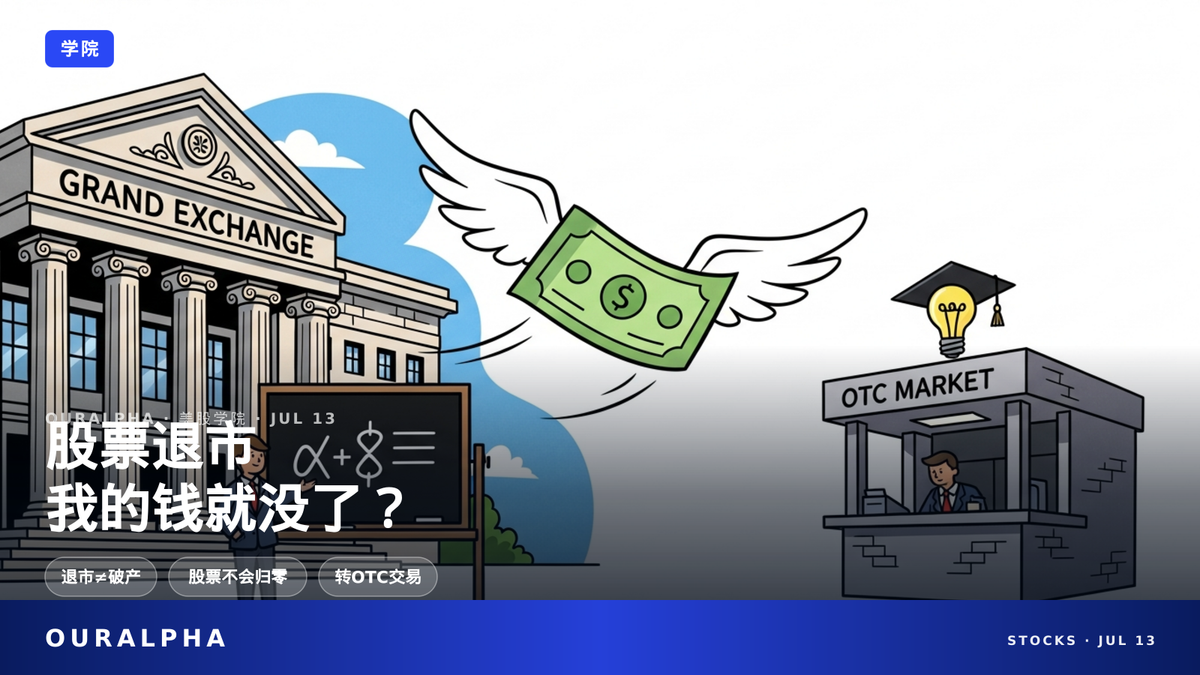
What Is US Stock Delisting? Does the Stock Go to Zero? A Clear Guide

Delisting ≠ bankruptcy; stocks don't go to zero. A clear guide to US stock delisting: reasons, process, impact on investors, and where stocks trade after delisting.

OURALPHA · ACADEMY

Stock Delisting: Is My Money Gone?
Clearing Up the Truth About Delisting

OurAlpha Academy · Delisting ≠ Bankruptcy, Stocks Don't Go to Zero

When new investors hear 'delisting,' their first thought is often 'Oh no, my stock is worthless.'

But in reality, delisting and bankruptcy are two completely different things.

Delisting just means the stock trades somewhere else—you still own it, but liquidity drops sharply.

TL;DR · IN SHORT

  • Delisting ≠ bankruptcy; stocks don't go to zero
  • After delisting, stocks move to the OTC market—still tradable but with poor liquidity
  • What really makes stocks worthless is bankruptcy reorganization, not delisting

KEY TERMS

Delisting: When a company's stock is formally removed from listing on an exchange (e.g., NYSE, Nasdaq) and can no longer be traded there. It can be voluntary (privatization, merger) or involuntary (failure to meet listing standards).

Over-the-Counter (OTC) Market: The trading venue where delisted stocks typically go. Market makers provide two-sided quotes. Disclosure and regulatory requirements are much lower than on NYSE/Nasdaq, and liquidity and transparency are worse.

Form 25 Delisting Notice: The formal delisting document submitted by an exchange to the SEC under Rule 12d2-2. Delisting takes effect 10 days after filing, and the security's registration is formally terminated after 90 days.

Common Stock Cancellation in Bankruptcy Liquidation: When a company enters Chapter 11 bankruptcy reorganization, common shareholders are last in the creditor priority order. After the reorganization plan takes effect, the original shares are often canceled to zero. This is the main way stocks 'truly go to zero,' not delisting itself.

CONTENTS

  1. What Does Stock Delisting Actually Mean?
  2. Is Delisting the Same as Bankruptcy?
  3. Where Does the Stock Go After Delisting? Can I Still Sell It?
  4. What Are Common Reasons for Forced Delisting of US Stocks?
  5. How Much Time Does a Company Have to Fix the Issue After a Delisting Warning?
  6. What Are the Real Impacts of Delisting on Ordinary Investors?
  7. What Should I Do If a Stock I Own Is About to Be Delisted?
  8. FAQ

What Does Stock Delisting Actually Mean?

Simply put, delisting means a company's stock is removed from the listing on an exchange (like the NYSE or Nasdaq), so you can no longer buy or sell it on that exchange[1]. Think of it like a store being kicked out of a mall—it can't operate in the mall anymore, but the store itself still exists; it just moves to a street market. Delisting does not mean the company goes out of business, and your stock doesn't disappear.

There are two types of delisting: involuntary (forced by the exchange) and voluntary (chosen by the company). Involuntary delisting happens when, for example, the stock price stays below $1 for too long, market cap falls short, or the company fails to file financial reports on time. Voluntary delisting occurs when the company is acquired or goes private[1]. Companies often choose to delist voluntarily because the cost of staying listed is too high, or they want to restructure privately.

Is Delisting the Same as Bankruptcy?

Absolutely not! This is the most common misunderstanding. Delisting and bankruptcy are two completely different things[11]. Delisting just means the stock no longer trades on an exchange—the company may still be operating normally. Bankruptcy, on the other hand, means the company is insolvent and enters legal liquidation or reorganization.

For example, a company might be delisted because its stock price is too low, but it could still be profitable and operating. Its stock just moves to the over-the-counter (OTC) market. In contrast, a bankrupt company—say, one in Chapter 11 reorganization—puts common shareholders last in line for payment. After the reorganization plan takes effect, the original shares are usually canceled to zero. That's what truly makes a stock 'worthless'[12].

So, delisting ≠ bankruptcy. Your stock doesn't become worthless just because it's delisted. You still own the shares—only the trading venue changes.

Where Does the Stock Go After Delisting? Can I Still Sell It?

After delisting, the stock typically moves to the over-the-counter (OTC) market for continued trading[8]. The OTC market is like a 'flea market' for stocks, where market makers provide two-sided quotes. It has much looser regulation and disclosure requirements than exchanges. The OTC market has several tiers: OTCQX, OTCQB, OTCID, and Pink Limited[9]. Stocks delisted from major exchanges usually end up in the Pink tier, which has the lowest standards and the least liquidity and transparency[9]. Think of OTCQX as a more reputable stall in the flea market with basic vetting, while Pink Limited is like a no-questions-asked sidewalk stand—companies can say whatever they want and disclose as much or as little as they like.

On the OTC market, you can still buy and sell the stock, but liquidity drops sharply. Bid-ask spreads widen, and trading volume plummets[14]. Many institutional investors are prohibited from holding OTC Pink stocks due to compliance rules, so they are forced to sell around the time of delisting, further pushing down the price[14]. So, while the stock may fall a lot after delisting, it doesn't necessarily go to zero.

Also, in 2020, the SEC amended Rule 15c2-11, requiring brokers to verify that a company has current public information available before quoting its OTC stock[10]. This further reduces liquidity for delisted stocks. If your stock is delisted, contact your broker first to confirm whether they support OTC trading and what special rules apply.

What Are Common Reasons for Forced Delisting of US Stocks?

The most common reason is a stock price staying below $1 for too long. Nasdaq Listing Rule 5550(a)(2) requires that the closing bid price be at least $1[3]. It's like a school rule that you can't fail exams repeatedly—once you fall below the passing line, you get a warning. If the stock closes below $1 for 30 consecutive trading days, Nasdaq issues a non-compliance notice. The company then has 180 calendar days to get the price back above $1[4]. During that period, if the stock closes above $1 for 10 consecutive trading days, compliance is restored and the issue is resolved[4]. If the company still hasn't met the requirement after the first 180 days, it can request a second 180-day extension, provided it meets certain conditions like market cap requirements. At that point, companies often use a 'reverse stock split' to quickly boost the share price—for example, merging 10 shares into 1, which raises the price per share without changing the total market value or the value of your holdings[4]. Only after failing both compliance periods does the delisting process truly begin.

The NYSE has similar rules. For example, if a company's average global market cap falls below $50 million and its shareholders' equity is also below $50 million for 30 consecutive trading days, it is deemed non-compliant[5]. If the average market cap drops below $15 million, the exchange will directly initiate suspension and delisting procedures[5].

Other reasons include failing to file financial reports on time, receiving an adverse audit opinion, or engaging in improper trading. For instance, server maker Super Micro Computer was suspended and delisted by Nasdaq in 2018 due to delayed financial reports, and its stock moved to the OTC market. The formal delisting notice (Form 25-NSE) was filed in 2019[7].

How Much Time Does a Company Have to Fix the Issue After a Delisting Warning?

For Nasdaq, after receiving a non-compliance notice, the company has 180 calendar days to remedy the issue[4]. If it still hasn't met the requirement by the deadline, it can request a second 180-day extension, subject to conditions like meeting market cap thresholds[4].

If Nasdaq ultimately decides to delist the company, the company can request a hearing before the Nasdaq Hearings Panel within 7 calendar days after the notice is issued. A timely request typically suspends the delisting process[6]. The hearing is usually held within 30–45 days of the request, and the panel issues a decision within 30 days after the hearing[6]. If the company disagrees with the decision, it can appeal to the Listing and Hearing Review Council[6].

So, from the initial warning to final delisting, there can be several months or even longer, with multiple opportunities for the company to fix the problem—for example, by doing a reverse stock split to raise the share price or filing overdue financial reports.

What Are the Real Impacts of Delisting on Ordinary Investors?

The biggest impact is a sharp drop in liquidity. After delisting, the stock moves to the OTC market, where trading volume becomes very low and bid-ask spreads are wide. You may have difficulty selling at a desirable price[14]. Also, many brokers and trading platforms may not support OTC stock trading, so you'll need to contact customer support to check.

In addition, the OTC market has low disclosure requirements. The company may stop publishing regular financial reports, making it hard to stay informed about its condition[9]. If the company enters bankruptcy proceedings, the stock ticker may have the letter 'Q' added at the end as a warning, helping investors identify that the company is in bankruptcy[13].

However, delisting itself does not change your shareholder rights. You still own the stock—it's just harder to trade.

What Should I Do If a Stock I Own Is About to Be Delisted?

First, don't panic. Delisting does not mean your stock is worthless. You still have time to act.

Step one: Find out why the stock is being delisted. If it's involuntary (e.g., price too low), the company may still be operating normally, and the stock will move to the OTC market. You can decide whether to hold or sell. If it's voluntary (e.g., acquisition), there will usually be a buyout offer at a certain price—watch for company announcements.

Step two: Contact your broker to confirm whether they support OTC trading and what special rules apply. Some brokers may not allow trading of OTC Pink stocks.

Step three: Monitor company announcements, especially regarding bankruptcy. If the company enters Chapter 11, common shares are likely to be canceled, which is when you truly lose your investment[12].

In short, after delisting, your stock still belongs to you and still has value—but liquidity drops sharply and trading becomes difficult. Understanding the reason for delisting and contacting your broker promptly are the two most practical steps you can take.

常见问题 FAQ

Can a delisted stock ever go back up?

It's possible, but the probability is very low. After delisting, the stock moves to the OTC market, where liquidity is poor and attention is low. The price usually continues to fall. A few companies manage to improve their operations and meet listing requirements again, allowing them to re-list, but this is extremely rare.

Do I have to pay taxes on a delisted stock?

Delisting itself is not a taxable event. However, if you sell the stock after delisting, any capital gain or loss must be reported. If the stock is canceled due to bankruptcy, you can typically claim a capital loss. Consult a tax professional for specifics.

Does the stock ticker change after delisting?

Yes. After delisting, the ticker symbol usually changes, often with a letter added at the end. For example, when trading on the OTC market, the ticker may end with 'Q' to indicate bankruptcy status[13].

Do all delisted stocks go to the OTC market?

Most do, but not all. Some companies may go directly into bankruptcy liquidation, and their shares are canceled. Others may be acquired, and shares are exchanged for cash or the acquirer's stock. It depends on the reason for delisting.

Can I still receive dividends after delisting?

If the company is still operating and declares a dividend, theoretically yes. However, after delisting, the company's financial condition is usually poor, making dividends very unlikely. Also, OTC market trading is inconvenient, and dividend payments may be delayed.

Is US stock delisting the same as A-share delisting?

No. In the US, delisted stocks typically move to the OTC market for continued trading. In China's A-share market, delisted stocks enter a 'delisting period' and then move to the National SME Share Transfer System (the 'Old Third Board'), with different rules and liquidity.

Can I short a delisted stock?

Usually not. The OTC market has poor liquidity, and market makers rarely offer short-selling services. Regulatory restrictions also apply.

SOURCES

[1] SEC.gov | Exchange Delistings
[2] 17 CFR § 240.12d2-2 - Removal from listing and registration (e-CFR)
[3] Nasdaq Rule 5550 Series - Nasdaq Listing Center Rulebook
[4] SEC.gov - Notice of Filing of Proposed Rule Change (Nasdaq minimum bid price rule)
[5] Amplify Energy Corp. 10-Q (SEC EDGAR filing referencing NYSE Rule 802.01B)
[6] Sonder Holdings Inc. 10-Q (SEC EDGAR filing describing Nasdaq Hearings Panel process)
[7] Super Micro Computer, Inc. - Form 25-NSE (SEC EDGAR)
[8] Investor Bulletin: Bankruptcy for a Public Company | Investor.gov
[9] OTC Markets | Official site of OTCQX, OTCQB and Pink Markets — OTC Market Tiers
[10] SEC Adopts Amendments to Enhance Retail Investor Protections and Modernize the Rule Governing Quotations for Over-the-Counter Securities
[11] Investor Bulletin: Bankruptcy for a Public Company | Investor.gov
[12] What a Corporate Bankruptcy Means for Shareholders | FINRA.org
[13] What Happens if a Stock is Delisted? Investors Should Know
[14] OTC Markets | Official site of OTCQX, OTCQB and Pink Markets — OTC Market Tiers

This content is for informational purposes only and does not constitute investment advice, trading advice, or any guarantee of returns.

Keep Reading

What is a US stock market maker? How is it different from matching? One article to understand

What is a US stock market maker? How is it different from matching? One article to understand
OURALPHA · ACADEMY

undefined

US Stock Academy · Unveiling the providers of market liquidity

Think when you place an order to buy a stock, you're directly trading with another retail investor?

On Nasdaq, your counterparty is likely a professional market maker.

Market makers aren't matchmakers—they're 'dealers' trading with their own capital.

TL;DR · IN SHORT

  • A market maker is a securities firm that stands ready to buy or sell a stock at any time, providing instant execution.
  • Market makers earn the bid-ask spread, not commissions.
  • Nasdaq
Read full story →

Stay ahead of the market — never miss a deep dive

Follow OurAlpha for AI-driven US equity research and market insight, every day.