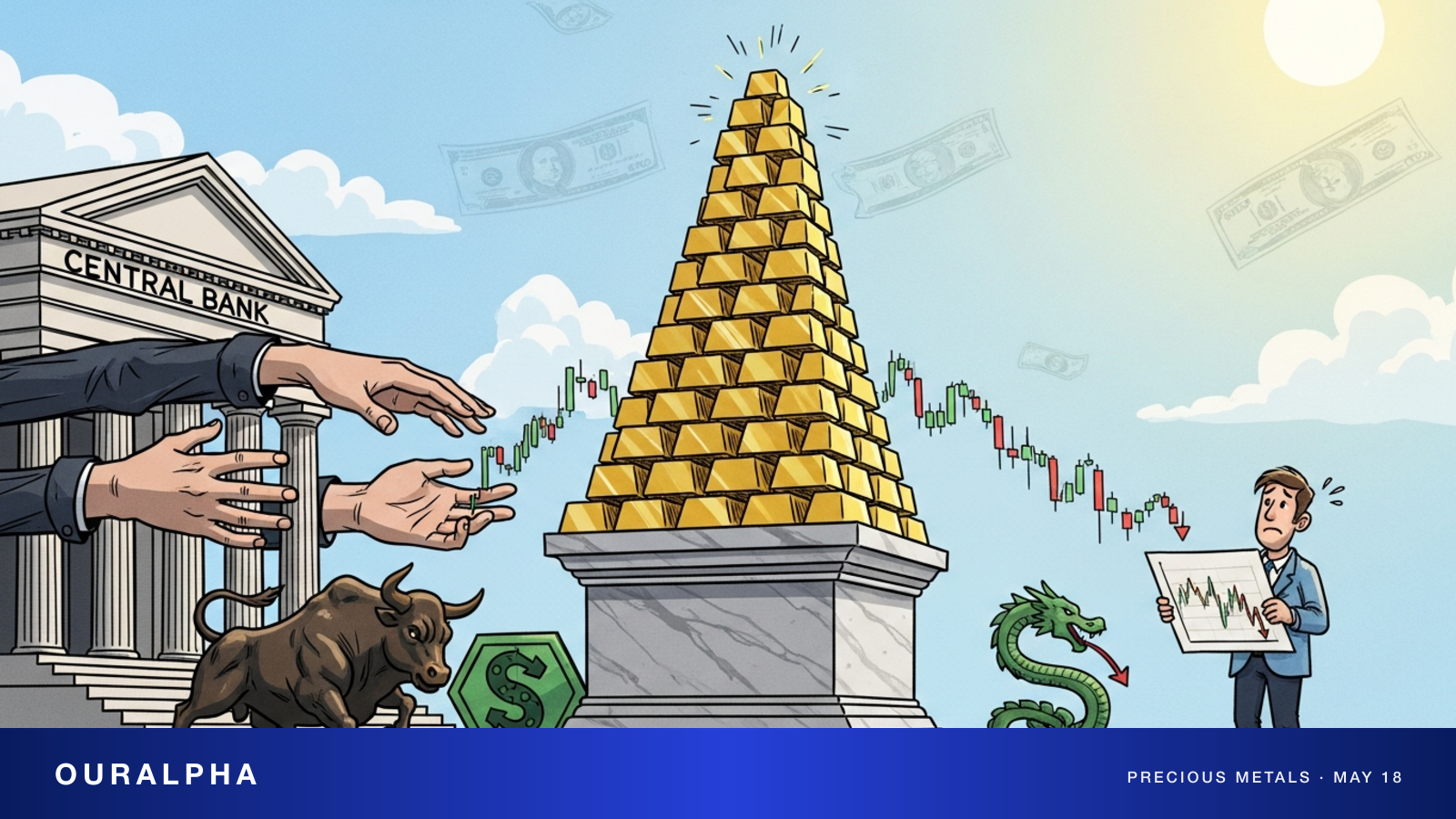
Gold Is Down 23% in Four Months. Is the Bull Market Over — or Just Taking a Breather?
Gold has shed 23% from its January all-time high to a new 2026 low. Central banks bought 244 tonnes in Q1 anyway. Goldman sees $5,400 by year-end; JPMorgan sees $6,300. The structural bull case isn't dead — but the near-term is genuinely messy.

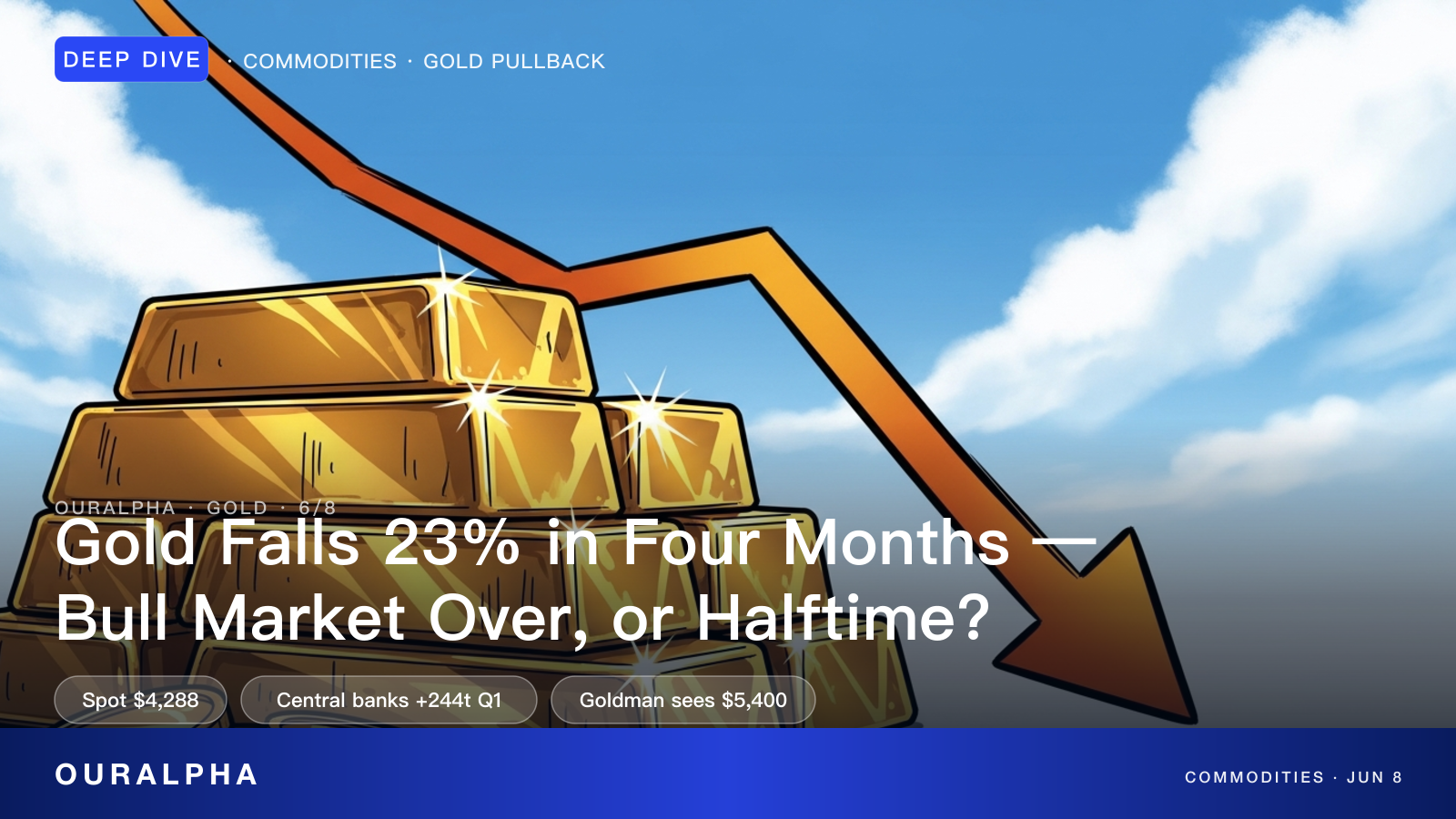
TL;DR
From its late-January all-time high near $5,590 to today's (6/8) $4,288, gold has fallen roughly 23% in four months — the lowest print of 2026. Over that same stretch, central banks net purchased 244 tonnes in Q1 alone. Those two facts are pulling in opposite directions. That tension is the whole story.
- Get the timeline straight: The real gut-punch was last Friday (6/5), when a blowout May jobs report hit gold for ~-3.3% on the day and ~-4% on the week. Today (Monday) is a continuation slide of ~-1% that set a new 2026 low[TradingEconomics]
- The trigger was a rate-expectations whipsaw: May NFP came in at 172K vs. ~85K expected; unemployment held at 4.3% — markets pivoted from pricing in cuts to pricing in possible hikes this year, sending the dollar and Treasury yields higher while non-yielding gold took the hardest hit
- But structural buyers never left: WGC data show central banks net purchased 244 tonnes in Q1 — above the prior quarter and the five-year average; gold bar and coin demand hit its second-highest quarter on record; the full-year central bank buying target remains 700–900 tonnes[World Gold Council]
- Every major bank's target sits well above spot: Goldman's year-end call is $5,400 (the most conservative on the Street); JPMorgan sees $6,300 — both treat this selloff as a bull-market correction, not a top[TheStreet]
The selling is being done by tactical money: one strong payrolls print killed rate-cut pricing, real yields and the dollar firmed up, and trend-followers and ETFs have been cutting exposure. That pressure is real and it isn't over. But structural money — central banks, sovereign funds, long-duration allocators — is operating on an entirely different thesis: debt monetization, de-dollarization, geopolitical hedging. Those buyers added 244 tonnes in Q1; they typically lean in as prices fall, not out.
So this isn't "gold is broken." It's two pools of capital pricing the same asset on entirely different time horizons: tactical traders are pricing the next few months of Fed policy; allocators are pricing the next few years of monetary credibility. The depth of the correction is a function of the traders; the floor is a function of the allocators. The one scenario that turns "correction" into "bear market" is US-Iran tensions pushing oil high enough that inflation truly runs out of control and forces the Fed to actually hike — that is the only real structural threat to gold. Until that happens, $4,000–4,500 is where multiple institutions consistently peg fair value.
OurAlpha Signal Scorecard
| Dimension | Score | Notes |
|---|---|---|
| Event Intensity | 8/10 | -23% in four months + new 2026 low + NFP-triggered rate-expectations reversal — macro signal density is high |
| Market Sentiment | 5/10 | Short-term fear (trend traders/ETFs reducing), offset by allocators buying the dip — sharply bifurcated |
| Trend Condition | 6/10 | Medium-term uptrend intact (spot remains above the $4,000+ "fair value" floor), but near-term momentum has rolled over |
| Retail Risk | 6/10 | High volatility; catching-a-falling-knife risk is real, but structural buying provides a floor — not a one-way collapse |
Overall: 6.25/10 — near-term under pressure, medium-term structure intact; scale in gradually, don't go all-in.
A few terms, briefly (flagged again on first use in each section):
- Real yield: nominal rate minus inflation expectations. Gold pays nothing, so its chief competition is assets that both pay interest and hedge inflation — most directly, TIPS. Rising real yields = higher opportunity cost of holding gold = bearish for gold. This is gold's first-principles pricing driver
- NFP (Non-Farm Payrolls): the monthly US jobs report. Stronger jobs → less reason to cut rates → higher rates → bearish for gold
- DXY (Dollar Index): gold is priced in dollars; a stronger dollar makes gold more expensive for non-US buyers, suppressing demand
- PCE / CPI: the Fed's two inflation gauges (PCE is its preferred read). Higher prints reinforce "higher for longer" rate expectations
- Debt debasement: the long-run thesis that heavy sovereign debt erodes currency purchasing power, making gold — which can't be printed — a structural hedge. This is the core buy logic for central banks and long-duration allocators
- LBMA fix vs. spot: the London Bullion Market Association publishes two daily benchmark prices that can differ from real-time spot or COMEX futures by tens of dollars. This article uses spot prices throughout and notes the source
1. Friday vs. Monday: Which Day Was the Real Crash?
Precision on timing matters here — because "gold cratered today" and "gold is continuing to slide" are two very different stories.
| Date | Spot Price | Move | Catalyst |
|---|---|---|---|
| Friday, 6/5 | Broke below $4,370 | ~-3.3% on the day; ~-4% on the week | May NFP blew past expectations |
| Today, 6/8 (Monday) | ~$4,288 | ~-0.98% | Continuation selloff; new 2026 low |
Source: TradingEconomics spot price; 6/8 reading $4,288.37, -0.98% vs. prior day[TradingEconomics]. Note: different data vendors (spot, futures, LBMA fix) can diverge by tens of dollars.
The precise read: the real crash happened Friday, on NFP day — a single-day drop of -3.3% is among the sharpest in recent months. Monday's -1% is a continuation drift, but it matters because it printed a new 2026 low — extending the downtrend channel that has been in place since February.
Keeping those two days distinct is important: Friday was an event-driven shock; Monday is evidence that selling pressure hasn't been fully absorbed yet.
Zoom out and the picture is starker: from the late-January all-time high near $5,590 to today's $4,288, gold has given back roughly 23% in four months. That's the real reason to write a deep dive — not any single day's move, but a four-month trend-level correction that deserves a full accounting.
2. The Trigger: A Jobs Report That Was Too Good
The immediate catalyst for this leg down was the May employment report, released June 5.
Key numbers:
| Metric | May Actual | Consensus | Implication |
|---|---|---|---|
| NFP Job Adds | 172K | ~85K | Blew past expectations; economy is not soft-landing |
| Unemployment Rate | 4.3% | 4.3% | In line; labor market remains tight |
| Average Hourly Earnings YoY | 3.4% | ~3.4% | In line; wage pressure is contained |
Source: US Bureau of Labor Statistics May NFP report, via multiple financial media[LiteFinance].
Why a "too good" jobs report hits gold, step by step:
- Payrolls double expectations → the economy is not as fragile as feared
- Strong economy + inflation still running at 3.8% → the Fed has no reason to cut, and some desks started pricing possible hikes before year-end
- Hike pricing → Treasury yields and real yields move higher + the dollar firms up
- Gold pays nothing → in a "higher rates, stronger dollar" world, the opportunity cost of holding gold goes up → sell
One-liner: for gold, bad news is good news. The stronger the economy and the more distant the prospect of cuts, the more gold suffers. This NFP was the textbook version — a single data print that whipped the market from pricing cuts to pricing hikes.
3. Gold's Number-One Enemy: Real Yields
Section 2 covered the trigger. This section covers the mechanism — why gold is so sensitive to rates in the first place.
Gold has one structural problem: it pays nothing. No coupon, no dividend. So its real competition is assets that both pay interest and protect against inflation — most directly, TIPS, whose yield is the market's real yield quote.
The one equation that explains gold pricing:
Real yield = nominal rate − inflation expectations
Real yields rise → opportunity cost of holding gold goes up → bearish for gold. Real yields fall → holding gold costs you almost nothing in foregone income → bullish for gold.
What happened this time:
- Strong NFP → markets expect the Fed to hold — or even hike → nominal rate expectations move higher
- Simultaneously, markets assume the Fed can contain inflation → inflation expectations don't move up proportionally
- Net result → real yields rise → gold gets hit
This same logic explains the entire four-month chart: in late February, escalating US-Iran tensions sent gold surging on safe-haven demand and a spike in inflation expectations (which compressed real yields). Then the dollar rebounded, the market concluded the Fed would use high rates to fight the oil-driven inflation, and real yields turned back up — which is precisely when gold's slide began.
OurAlpha take: understand real yields and you understand everything about gold's near-term price action. The first thing to watch for a bottom isn't geopolitics or central bank data — it's whether the market's Fed rate expectations flip back toward cuts, which is a function of the incoming inflation data (see Section 8).
4. The Dollar and Treasuries: Two More Hands Pressing Down
Real yields are the primary driver, but two related forces compound the pressure.
① Dollar strength
Gold is priced in dollars. When the DXY rallies, the same ounce of gold costs more for European, Chinese, and Indian buyers — that suppresses demand and weighs on price. The strong NFP boosted the dollar directly (strong economy → capital inflows into dollar assets), delivering a second blow to gold on top of the real-yield move.
② Treasury yields rising
The 10-year Treasury is the benchmark risk-free income asset. When yields rise, capital tilts toward income-generating Treasuries and away from non-yielding gold. Strong NFP → hike expectations → yields up → gold's relative appeal dims.
These three forces are really one story: strong NFP → Fed turns more hawkish → real yields up + dollar up + Treasury yields up → three hands pressing gold simultaneously. They are not three independent bearish catalysts — they are three expressions of the same "hawkish Fed" repricing.
The key asymmetry here: all three of these headwinds are short-cycle and reversible. One softer inflation print or one weak jobs report, and the market's Fed pricing can flip back toward cuts — at which point all three hands lift at once, and the gold snapback can be sharp. That's the core reason we characterize this as a correction rather than a bear market.
5. But Structural Buyers Never Left: Central Banks Added 244 Tonnes in Q1
The first four sections were all about why gold is falling. This one is the other side of the ledger — why this isn't a bear market.
While tactical traders were selling on rate-expectations, a different class of buyer was leaning in the other direction: central banks.
World Gold Council Q1 2026 data (primary source):
| Metric | Figure |
|---|---|
| Central bank net purchases, Q1 2026 | 244 tonnes (above prior quarter + five-year average) |
| Largest single buyer | National Bank of Poland: +31 tonnes (→ 582 tonnes total) |
| Other major buyers | Uzbekistan: +25 tonnes (→ 416 tonnes); People's Bank of China: +7 tonnes (→ 2,313 tonnes) |
| Full-year central bank buying target | 700–900 tonnes (roughly in line with last year) |
| Gold bar and coin demand | Second-highest quarterly level on record |
| LBMA PM quarterly average price | Record $4,873/oz (January intraday high: $5,405) |
Source: World Gold Council, Gold Demand Trends Q1 2026[World Gold Council].
Why central banks keep buying at these levels:
- De-dollarization / reserve diversification — emerging-market central banks (China, Poland, Middle East, Central Asia) are actively reducing exposure to dollar-denominated assets in the wake of heightened geopolitical tensions, and gold is the natural alternative that no single government controls
- Debt debasement hedge — major economies are running elevated debt loads; over the long run, that erodes currency purchasing power, and gold is the one reserve asset that can't be inflated away
- Allocators are pricing years, not months — central banks don't flinch at a 5% swing; price dips are attractive entry points, not reasons to sell
This is the other side of the ledger: gold bar and coin demand at near-record levels, central banks buying more as the price falls. Put differently, the sellers in this correction are trend traders and ETFs; the buyers are central banks and long-duration capital. That structure — tactical sellers vs. structural buyers — typically means there is a floor, and the correction is unlikely to become a one-way collapse.
OurAlpha take: central bank buying is the hardest foundation under this gold bull cycle. It's slow, steady, and indifferent to near-term price. As long as de-dollarization and debt monetization remain the macro backdrop — and there's no sign of reversal — that structural bid will keep providing support from below. It's the single most important reason we call this a correction, not a top.
6. What the Banks Think: Goldman at $5,400, JPMorgan at $6,300 — Both Well Above Spot
Laying out sell-side price targets is useful not because they're reliable timing tools, but because the gap between targets and spot is itself information.
Major bank year-end 2026 gold price targets:
| Bank | Year-End Target | vs. Spot ($4,288) | Rationale |
|---|---|---|---|
| Goldman Sachs (most conservative) | $5,400 | ~+26% | Debt debasement "repricing"; fair value anchored at $4,000–4,500; base case doesn't require incremental buying[TheStreet] |
| JPMorgan | $6,300 | ~+47% | Q4 2026 average price target ~$5,055; sees further appreciation toward $5,400 by end-2027[J.P. Morgan] |
⚠️ These are institutional forecasts (our D-tier: model-based projections), subject to revision as data evolves. Worth noting: after gold fell more than 10% in a single month in March — the steepest monthly drop since June 2013 — Goldman reiterated its $5,400 call, signaling that the bank views this correction as noise within a broader bull move.
Two takeaways:
- Every major bank target is materially above current spot — the sell-side consensus is that $4,288 is below fair value. Targets get things wrong, and they're not timing tools, but the directional consensus is notable: not one major institution is calling a top
- Goldman's "fair value $4,000–4,500" band is the key reference point — its debt-debasement model puts the structural floor squarely in that range. At $4,288, spot is trading right in the middle of that band. In Goldman's framework, the market has already retraced to a zone that should attract support
OurAlpha take: bank price targets aren't buy signals (they were bullish at $5,590 in January, and the market fell 23%). But they provide a useful coordinate system: current levels are below virtually every mainstream institution's fair value estimate. That doesn't mean gold can't fall further — it means that further downside increasingly enters "consensus considers this undervalued" territory.
7. The Tug-of-War: Tactical Traders vs. Structural Allocators
Here's the single framework that ties everything together — and it's the most useful lens for understanding gold right now.
Two distinct pools of capital are currently pricing the same asset on completely different time horizons:
| Tactical Traders (sellers) | Structural Allocators (buyers) | |
|---|---|---|
| Who | Trend-followers, CTAs, gold ETFs | Central banks, sovereign wealth funds, long-duration capital |
| What they're pricing | The next few months of Fed rate policy (real yields, dollar, Treasuries) | The next few years of monetary credibility (debt debasement, de-dollarization) |
| Current posture | Reducing on hawkish Fed repricing | Adding on dips on unchanged long-run thesis |
| Effect on price | Determines the depth and speed of the correction | Determines where the floor is |
The framework translates directly into positioning logic:
- Near term (weeks to months): tactical traders have the upper hand. Until rate-cut expectations revive, gold remains under pressure and could set new lows. Don't try to call the bottom
- Medium to long term (quarters to years): structural allocators have the upper hand. Central bank buying + debt monetization narrative = persistent bid from below; the $4,000–4,500 fair value zone keeps getting cited as the structural anchor
- The real risk trigger (see Section 9): only one scenario unseats the allocator logic — runaway inflation that forces actual Fed hikes
OurAlpha take: once you internalize this "two pools, two time horizons" dynamic, you stop panicking when gold falls and stop chasing when it bounces. The right posture in this correction is to acknowledge near-term downside still exists (traders aren't done), while recognizing that medium-term support remains (allocators haven't left) — which means scaling in methodically, not going all-in or bailing out entirely.
8. What to Watch: Four Signals That Will Decide the Next Move
Over the coming weeks, a handful of data points will determine whether this correction finds a floor or extends further.
① May CPI (this week) — most important
- Inflation softens → rate-cut expectations return → real yields ease → bullish for gold (this correction may be finding a bottom)
- Inflation surprises high → higher-for-longer thesis strengthens → bearish for gold (more downside ahead)
② University of Michigan Inflation Expectations (this week)
- A closely watched Fed input. If expectations tick up, it reinforces the hawkish narrative and keeps pressure on gold
③ Oil prices / US-Iran situation
- The Iran tensions driving oil above $100 are the inflation source. If oil keeps climbing → inflation pressure builds → but note the reflexivity trap: escalating geopolitics is bullish for gold as a safe haven, yet the inflation it generates is bearish via rate expectations. Which force dominates depends on whether markets are more afraid of "inflation" or "geopolitical risk" at a given moment
- If US-Iran tensions materially ease → oil pulls back → inflation pressure eases → rate-cut expectations return → bullish for gold
④ Fed speakers + next FOMC
- Any "hike is on the table" language from Fed officials → headwind for gold
- Any "inflation is subsiding; we can be patient" language → supportive for gold
OurAlpha take: this week's CPI is the most immediate swing factor. It will directly move the real-yield variable — which is, in effect, gold's master switch in the near term.
9. What Would Turn This Correction Into a Bear Market?
Every call needs falsification conditions. We've characterized this as a correction, not a bear market. Here's what would prove that wrong.
- Inflation genuinely runs out of control and the Fed actually hikes (not just pricing in hikes — actual rate increases) — this is the only scenario that simultaneously undercuts both the tactical and structural case for gold. Real rate hikes at scale would demolish real-yield math and force even long-duration allocators to reconsider their opportunity cost. This is gold's only true structural enemy.
- US-Iran conflict rapidly and fully de-escalates + oil collapses — short-term this looks bullish (inflation eases → cuts return), but it would drain the geopolitical risk premium from gold and could trigger a wave of safe-haven profit-taking
- The dollar breaks out into a sustained structural bull run (DXY surges persistently) — if US economic exceptionalism becomes entrenched and the dollar strengthens on a multi-year trend, that would systematically weigh on dollar-priced gold
- Central bank buying reverses unexpectedly — if subsequent WGC data show a meaningful deceleration or net selling, the structural bid thesis weakens. (No current evidence of this; full-year target remains 700–900 tonnes)
- Risk assets go full melt-up, safe-haven demand evaporates — if equities and crypto surge persistently, capital could rotate out of gold and other haven assets
- Liquidity-crisis forced selling — in extreme stress scenarios, gold is often the first thing sold to raise cash (it happened in March 2020 and in 2008); this can produce counterintuitive sharp drops even when the fundamental case is intact
The key dividing line: of the six scenarios above, only #1 (actual Fed hikes) has the power to flip a "correction" into a "structural bear market." The others could deepen the pullback but are unlikely to reverse the long-cycle trend. So watch inflation above all else — it is the single most important variable for determining whether this gold bull cycle is intact or broken.
10. Bottom Line: How to Read Gold Right Now
Four months, -23%, a new 2026 low. Gold is at a clear crossroads:
- Near term (tactical traders in control): more downside is possible. The strong NFP wiped out rate-cut pricing; real yields, the dollar, and Treasury yields are all pointing the wrong way. If this week's CPI doesn't soften, gold will likely stay under pressure and continue grinding lower — don't try to catch the falling knife, don't call the bottom
- Medium to long term (structural allocators in control): the architecture hasn't changed. Central banks bought 244 tonnes in Q1 with a 700–900 tonne full-year target; gold bar and coin demand is near record levels; at $4,288, spot is trading inside the $4,000–4,500 fair value band cited by multiple institutions — there is structural support below
- The one real risk: inflation spiraling out of control and forcing actual Fed hikes. That is the switch that flips "correction" into "bear market." Until it's thrown, the structural underpinning of this bull cycle remains intact
OurAlpha in one sentence: this isn't the end of the gold story — it's a tug-of-war between traders selling the macro and allocators buying the monetary system. Near-term pressured, medium-term intact. For long-term gold bulls, this is a position to scale into, not a moment to go all-in or walk away; for short-term traders, the right move is to wait for inflation data to give you a direction rather than guessing where the floor is.
A Note on Data Reliability
This article uses OurAlpha's four-tier data framework:
- Tier A (official / authoritative sources): World Gold Council, Gold Demand Trends Q1 2026 — the 244-tonne figure, country-level breakdowns, full-year targets, and LBMA quarterly average all come from here; US Bureau of Labor Statistics May NFP report
- Tier B (real-time benchmark data): TradingEconomics spot price (6/8: $4,288.37, -0.98%) — the primary price reference for this article. Note that spot, futures, and LBMA fix prices can diverge by tens of dollars
- Tier C (major financial media): TheStreet (Goldman Sachs commentary), J.P. Morgan Global Research (JPMorgan price target), LiteFinance (NFP and intraday price context) — used to present institutional views and market background
- Tier D (institutional forecasts / model outputs): Goldman's $5,400 year-end target, JPMorgan's $6,300 target, the "$4,000–4,500 fair value" range — these are forward-looking projections, not factual claims, and should be read as directional reference points only
Core facts (prices, drawdown magnitude, central bank tonnage, NFP figures) are supported by Tier A/B sources. Institutional price targets are Tier D. Please distinguish clearly between what has already happened and what is being forecast. Nothing in this article constitutes investment advice.
Sources
- Gold Demand Trends Q1 2026 — Central Banks (244 tonnes) — World Gold Council
- Gold Demand Trends Q1 2026 (full report) — World Gold Council
- Gold Spot Price — Live Data (6/8: $4,288.37, -0.98%) — TradingEconomics
- Goldman Sachs reaffirms $5,400 year-end gold target — TheStreet
- A new high? Gold price predictions ($6,300 target) — J.P. Morgan Global Research
- Gold (XAU/USD) Forecast — NFP impact and intraday — LiteFinance
- Central Banks Added 244 Tonnes of Gold in Q1 2026 — Canadian Mining Report
This content is for informational purposes only and does not constitute investment advice, trading advice, or any guarantee of returns.