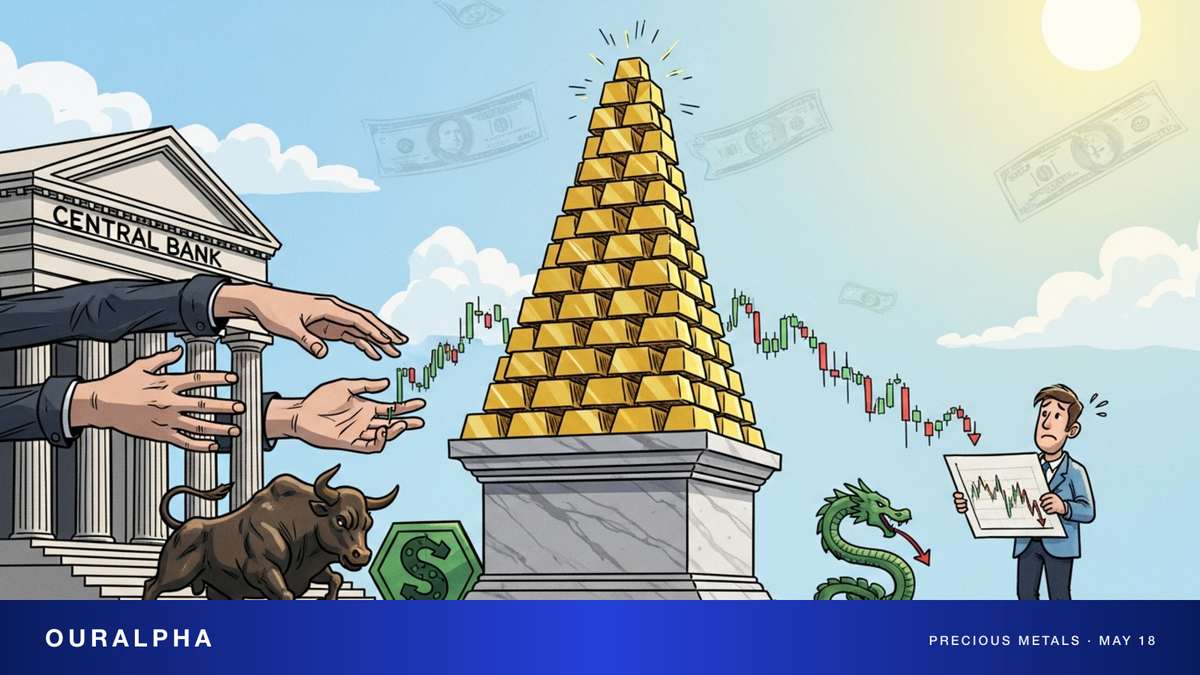
Gold at $4,540 vs. 244 Tons of Q1 Central Bank Buying: The Structural-vs-Tactical Tug of War

Gold hovers at $4,540 as central banks bought a net 244 tons in Q1 — PBoC has accumulated for 18 straight months — while a 4.60% ten-year yield and "higher for longer" give tactical sellers the daily edge. Knowing who's running the price right now matters more than calling the direction.

Gold bars and silver coins against a vault backdrop — OurAlpha precious metals research

TL;DR · The One-Paragraph Version

On 5/18/2026, spot gold was quoted around $4,560/oz, silver around $77.5/oz, and the gold/silver ratio had recovered to roughly 59. On the surface, gold is still pulling back even as Middle East risk lingers and central banks keep buying. What's really happening is a structural split: structural buyers and tactical sellers fighting over the same price band. On the structural side, WGC data shows Q1 2026 global central bank net purchases hit 244t; China's PBoC ran 17 consecutive months of accumulation through March (+7t in Q1), pushing official reserves to 2,313t — and by the April reading, that streak extended to 18 consecutive months with reserves climbing to 2,322t. On the tactical side, April CPI came in at 3.8% YoY, the 10-year Treasury briefly touched 4.63%, and 2026 rate-cut expectations are being repriced sharply lower — raising the opportunity cost of holding a non-yielding asset like gold.

So the current gold price isn't a sign that "central bank buying has faded." It's long-term de-dollarization demand and short-term high-rate trading pulling in opposite directions within the same price range. For long-term allocators, $4,400–4,500 remains the more sensible zone to scale in. For short-term traders, late May calls for watching the gold/WTI/DXY/VIX interplay rather than making directional bets on geopolitics alone.

OURALPHA KEY VIEW
Gold at $4,540 isn't a "neutral range" — it's the result of two very different buyer types alternating control on a daily basis. Knowing who's in the driver's seat matters more than predicting price direction.

Gold's four-week pullback from $4,600 to $4,540 has led many to read this as "central bank buying isn't enough and gold has peaked" — that's wrong. WGC data shows Q1 2026 global central banks net bought 244t (above the 5-year average), PBoC hasn't paused for 18 months (through April), and April's single-month addition of +8t — the largest since December 2024 — pushed official reserves to 2,322t. Structural demand hasn't weakened; it actually accelerated during March's price softness. Note that JPMorgan on 5/18 cited a different "reported" figure — Q1 reported net purchases of just 16t (which nets out certain central bank sales) — and used that to cut its 2026 average price forecast from $5,708 to $5,243. WGC's unreported 244t versus JPMorgan's reported 16t reflects two different counting methodologies, not a genuine collapse in central bank buying.

What's actually driving daily gold prices in May is nominal rates + dollar traders: on 5/18, the 10-year nominal yield opened at 4.607%, hit an intraday high of 4.631% — the highest since early 2025 — and closed around 4.57%; the DXY was ~98; and the "higher for longer" consensus is hardening — all of which raises the opportunity cost of holding a non-yielding asset and fuels tactical selling. This means two fundamentally different players: (1) central banks and de-dollarization capital, which care about dollar-system exposure rather than price levels and treat every pullback as a buying window; (2) rates and dollar traders who track the 10-year, DXY, and Fed expectations daily. OurAlpha's view: downside risk is limited (central bank bid underneath), while the upside catalyst depends on the 5/19 US-Iran policy signal + June Fed. Scaling in between $4,400–4,500 offers better risk/reward than chasing; for short-term traders, monitoring gold + WTI + VIX as a package beats reading the gold chart in isolation.

I. Price Snapshot: $4,540 / $77.5 / Ratio ~59

On 5/18/2026, the mid-market gold price across major dealer quotes was approximately $4,540/oz. To be precise: one major dealer quoted bid $4,506.5 / ask $4,556.5 on 5/18; a separate source reported $4,564.44 (+0.59% DoD)[150currency 5/18 quote]. The spread reflects bid-ask differences across dealers and methodology (spot vs. retail). From the ~$4,600 level in early May, gold has given back roughly 1–2%.

Silver was more dramatic. Spot silver closed at $77.52/oz on 5/15/2026, down 10.6% in a single session — an atypically sharp high-beta selloff. The backdrop: April CPI's 3.8% headline print on 5/12 came in above consensus, pushing markets to reprice "higher for longer" and triggering a synchronized selloff across industrial metals and silver (which carries a meaningful industrial component). Worth noting: silver set an all-time high of $121.64 on 1/29/2026 and has since pulled back nearly 36% from that peak — a far steeper retreat than gold, which has only retraced ~1–2%.

The gold/silver ratio briefly compressed to ~55.25 on 5/14 — having fallen steadily from 62 to below 55 since early May (the 5/10–11 US-China 90-day tariff truce triggered a single-week 6% surge in silver). By 5/18, using spot $4,567 / $77.5, the ratio had recovered to roughly 59 — approaching the lower end of the historical median range of 60–65. Silver is no longer clearly cheap relative to gold; in the near term it trades more like a high-beta vehicle than an undervalued asset.

Source credibility: World Gold Council = A+ (authoritative industry primary source); Trading Economics + JM Bullion = A (real-time price aggregators); individual dealer quotes = B (include retail spread).

II. Central Bank Demand: 244t in Q1 (WGC) + PBoC's 18-Month Streak

This is the single heaviest plank beneath the current gold price floor.

WGC's Q1 2026 central bank net purchases: 244 tons globallyabove the 5-year Q1 average. The breakdown:

  • China's PBoC: Q1 +7t / April single month +8t (the largest monthly addition since December 2024), 18 consecutive months of accumulation (through April 2026), with official reserves rising to 2,322 tons, or 9% of total FX reserves[WGC · China May Update]
  • The three major structural buyers — Poland, Uzbekistan, and China — accelerated purchases during the March price dip. The key point: their buying is calendar-driven, not price-driven
  • Simultaneously, China reduced its US Treasury holdings, reinforcing the "long gold / short Treasuries" reserve rebalancing thesis[Central Banking analysis]

Three market implications:

(1) Central banks don't watch the gold price — they watch the political risk of the dollar reserve system (Russia's 2022 reserve freeze was the watershed moment). These are price-insensitive buyers who will absorb every dip.

(2) Central banks don't trade — their positions are multi-year commitments. That makes 244t not "bought in Q1 and done" — it's a run rate. If 2026 holds this pace, the annual total approaches 1,000t, more than 30% of annual global mine supply — an extremely hard structural floor.

(3) PBoC's 18-month streak (through April) has pushed China's official gold allocation to 9% of total reserves — still low relative to the US (gold is 70%+ of total reserves), Germany (70%+), and Italy (70%+). The structural catch-up runway remains substantial, and that's the core thesis for gold over the next 3–5 years.

On the WGC 244t vs. JPMorgan 16t discrepancy: WGC's Q1 244t is "total demand" including unreported central bank net purchases; JPMorgan's "Q1 reported net purchases of 16t" cited on 5/18 uses the IMF monthly reporting methodology netted for any central bank sales. The two figures aren't contradictory — over time, the unreported share has grown as central banks increasingly prefer not to disclose in real time. WGC's total demand figure is the more reliable gauge of structural buying, but the weakness in the reported-side figure is precisely the evidence JPMorgan used to cut its 2026 average price forecast from $5,708 to $5,243.

Source credibility: WGC Q1 2026 central bank data = A+ (most authoritative in the industry); Central Banking China analysis = A (specialist trade publication).

III. Nominal Rates + DXY: The Biggest Short-Term Headwind

If central banks are the price floor, nominal Treasury yields and the DXY are the daily and monthly drag.

Key parameters right now:

  • US 10-year nominal yield ~4.60% on 5/18 (open 4.607% / intraday high 4.631% / close ~4.57%) — the highest since early 2025[Reuters · US Treasuries 5/18]. TIPS real yields differ from nominal — check the DFII10 series separately; this piece uses nominal yields as an opportunity-cost proxy only
  • DXY ~98 (5/6 reading) — dollar resilience has exceeded most expectations from the start of the year
  • CME FedWatch: ~60% probability of no rate cuts in 2026 — that number stood at 25% at the start of 2026, climbed to 40% in March, and has now reached 60%. "Higher for longer" is being priced in harder and harder

The transmission mechanism to gold:

(1) Gold has no cash flow. The opportunity cost of holding it equals the real yield on comparable-maturity Treasuries. When TIPS real yields rise, gold's opportunity cost rises and gold pulls back accordingly. This is one of the most stable negative correlations in precious metals markets over the past 30 years.

(2) DXY up → the same quantity of gold requires fewer dollars → gold's USD price falls. The dollar-gold inverse relationship is nearly mechanical. The DXY's move from 96 back to 98 since early May maps cleanly onto gold's move from $4,600 back to $4,540.

(3) "Higher for longer" is gold's biggest opponent in May — because it keeps (1) and (2) in force simultaneously.

But this is tactical, not structural. The moment the Fed actually pivots — or even when the expectation of a pivot shifts — (1), (2), and (3) all reverse at once, and gold's catch-up move will be fast. This is why OurAlpha frames the current level as: "structural allocators can scale in; tactical traders should wait for a clear signal."

IV. US-Iran Policy Signal Around 5/19: Three Scenarios

Markets are closely watching US-Iran policy signals around 5/19. Trump issued a public hardline warning on 5/17 ("time is of the essence / clock is ticking"); meanwhile, competing news flow around a ceasefire, sanctions relief, military options, and Iran's revised peace framework is affecting near-term pricing in gold, oil, and the dollar[Time comprehensive report]. Note: Axios reported a specific 5/19 NSC Situation Room meeting convened by Trump to discuss military options, but Reuters had not independently confirmed it at the time — this piece treats it as a "policy signal window" framework only, not a hard scheduled event.

Three scenarios for gold (OurAlpha's subjective assessment based on public information, not derivatives market pricing):

Scenario A · Signal tilts toward escalation (probability ~30%): Spot gold would likely jump +3–5% overnight (+$130 to +$230), WTI would push toward the $115 range, and DXY would briefly strengthen (safe-haven + dollar funding demand). This is the largest potential upside catalyst for gold in May. Note: when gold, WTI, and DXY all rally simultaneously, dollar-denominated gold gains are partially offset by dollar strength — real gains in physical gold priced in other currencies could be even larger.

Scenario B · Signal tilts toward negotiating pressure + sanctions relief talks (probability ~55%): Gold gives back $30–60 in the short term, retreating to the $4,480–4,510 range. Markets quickly price out this catalyst; DXY softens and the 10-year nominal yield ticks lower. But central bank buying would absorb the dip, limiting the downside.

Scenario C · Ambiguous signal / delayed action (probability ~15%): Gold stays range-bound; market attention shifts to the next catalyst (June FOMC + Warsh's first meeting as Fed Chair). This is the toughest scenario for short-term traders to extract returns from.

Readers should independently check implied volatility on gold ATM options — the current 25-delta vs. 50-delta IV spread reflects how markets are pricing tail risk.

V. Market Sentiment: Retail +42%, ETF Flows, CFTC

(1) Retail demand (bars + coins) reached 474t globally in Q1 2026, +42% YoY (historically the second-highest quarter on record) — WGC explicitly noted that "Asian investors, primarily China, drove this round of accumulation," with global safe-haven flows as a secondary driver[WGC · Gold Outlook 2026]. This is the most direct retail sentiment proxy — better than ETF holdings for capturing raw "panic-buying + portfolio rebalancing" demand.

(2) ETF holdings (GLD / IAU, etc.): Net inflows have been sustained since April 2026, but the pace remains below the 2020 and 2024 peak periods — meaning institutional positioning still has room to grow with no sign of crowding.

(3) CFTC gold futures managed money net longs: May data shows net longs at historically neutral-to-elevated levels, but nowhere near the extreme crowding seen in 2024 — suggesting meaningful short-squeeze potential remains in the market.

The sentiment picture: panicked retail buyers + non-crowded institutions + structural central bank buying + tactical rate headwind — a classic "strong fundamentals, weak momentum" setup. In this environment, directional bets are low-efficiency; using volatility instruments and scaling into positions is the smarter play.

VI. OurAlpha Trading Framework and Key Levels

Gold (XAU/USD) key levels:

  • $4,400: Dual support from central banks + retail; near the low end of multiple 2026 pullbacks — the preferred zone to begin scaling in
  • $4,500: Psychological level + short-term moving averages; currently ~$40 below spot — the near-term tactical stop reference
  • $4,600: Early-May high + top of the 6-week trading range — a break above opens the next target at $4,750
  • $4,750: Local high from before the early-April Iran ceasefire talks
  • $5,243: JPMorgan's revised 2026 average price forecast (cut from $5,708 on 5/18), maintaining an end-2026 target of $6,000 — institutions still expect an elevated price environment, though near-term optimism has been trimmed

Silver (XAG/USD) key levels:

  • $75: Near the 100-week moving average
  • $80: Psychological level
  • $87: 5/12 high
  • $100: Psychological level + industrial demand anchor + potential retest zone in a full tariff-rollback scenario

OurAlpha framework:

(1) Long-term allocation position: Scale into physical gold / GLD / central-bank-thesis ETFs (e.g., PHYS) between $4,400–4,500. Central bank buying and de-dollarization are a 3–5 year theme — no need to time intraday entries.

(2) Short-term trading position: Don't bet on 5/19 direction — bet on volatility. If implied vol on gold ATM options is currently below its historical average, buying a strangle offers better odds than a directional play. Scenario A, B, or C all produce a meaningful IV spike.

(3) Silver: With the gold/silver ratio recovering to ~59 on 5/18 (near the lower end of the 60–65 historical median), silver is no longer cheap. We don't recommend a standalone long silver position as a gold catch-up play. If the US-China tariff truce escalates to a full removal, the ratio could compress back to 50–55 — but that's an exogenous event-driven outcome, not a base case to position around.

(4) Gold miners vs. physical: Physical gold is outperforming miners right now as generalist capital hasn't rotated back. If you have conviction on a Fed pivot in the next 12 months, miners offer 1.5–2x the leverage of physical and are the more aggressive expression of the same thesis.

Sources

  1. World Gold Council · Q1 2026 Central Bank Demand — Primary source for 244t global central bank net purchases in Q1 (A+ tier).
  2. WGC · China May Update — Source for PBoC Q1 +7t, April +8t, 18-month streak, and 2,322t reserve figure (A+ tier).
  3. Central Banking · China Long Gold Short Treasuries — Reserve rebalancing analysis (A-tier trade publication).
  4. WGC · Gold Outlook 2026 — Source for retail +42% YoY and CME FedWatch 60% no-cut probability.
  5. JPMorgan 5/18: 2026 gold average cut to $5,243 — Cut from $5,708; maintains end-2026 $6,000 target; full-year CB estimate lowered to 640t (A-tier, cross-verified by multiple outlets).
  6. Reuters · US Treasury Yields 5/18 — Source for 10Y nominal yield 4.60% / intraday high 4.63% (A-tier).
  7. Trading Economics · Gold Spot 5/18 — Mid-price spot reference.
  8. 150currency · 5/18 dealer quote — Dealer bid/ask spread data.
  9. GoldSilver · Silver Price Outlook May 2026 — Source for silver's 5/15 single-day -10.6% drop and ATH of $121.64.
  10. GoldSilver · Gold/Silver Ratio Analysis — Source for ratio low of 55.25 and historical median 60–65.
  11. Time · US-Iran Conflict Overview — Source for 5/19 NSC signal and Trump's 5/17 statement.

This content is for informational purposes only and does not constitute investment advice, trading advice, or any guarantee of returns.

Keep Reading

Gold Is Down 23% in Four Months. Is the Bull Market Over — or Just Taking a Breather?

TL;DR

From its late-January all-time high near $5,590 to today's (6/8) $4,288, gold has fallen roughly 23% in four months — the lowest print of 2026. Over that same stretch, central banks net purchased 244 tonnes in Q1 alone. Those two facts are pulling in opposite directions. That tension is the whole story.

  • Get the timeline straight: The real gut-punch was last Friday (6/5), when a blowout May jobs report hit gold for ~-3.3% on the day and ~-4% on
Read full story →

Stay ahead of the market — never miss a deep dive

Follow OurAlpha for AI-driven US equity research and market insight, every day.