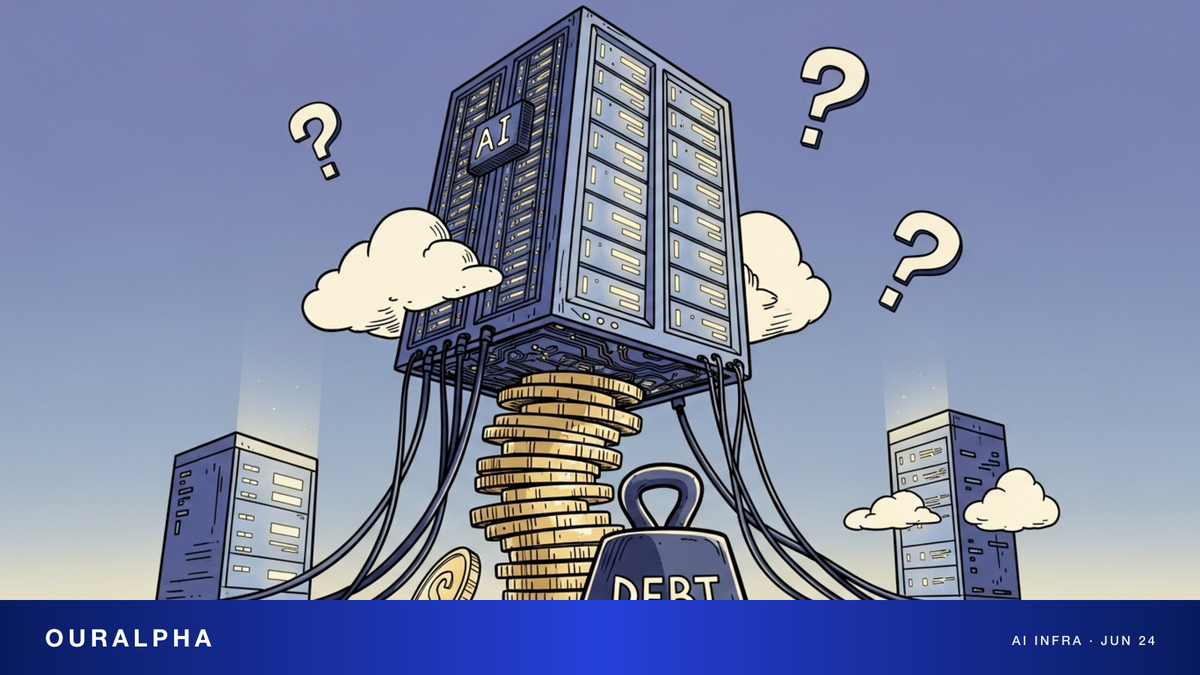
Big Tech's $520B AI Bet Is Running on Borrowed Money — and Markets Are Asking Questions
The five biggest cloud players are on track to spend roughly $520 billion on AI infrastructure in 2026 — increasingly funded by debt. On June 23, Wall Street's patience with the tab ran out, at least for a day.
Tech stocks sold off on June 23, with semis leading the decline. The trigger wasn't a single earnings miss — it was a structural question: hyperscalers are pouring record sums into AI infrastructure, funding more of it with debt, and the returns remain unclear.
- The five largest cloud players — Alphabet, Amazon, Meta, Microsoft, and Oracle — are projected to spend a combined ~$520 billion on AI capex in 2026, up roughly 30% YoY.
- The Philadelphia Semiconductor Index fell 7.9% on the day; the Nasdaq dropped 2.21% and the S&P 500 lost 1.44%.
- Nvidia (NVDA) fell 4.1%; memory chipmakers including Micron (MU) dropped roughly 13%.
- Reuters cited a fund manager who said recent AI headlines are raising questions about the pace of spending, capex, and semiconductor capacity expansion.
- Oracle (ORCL) emerged as the starkest example of debt-driven AI spending, raising tens of billions in the bond market — including a record $25 billion bond deal — during its fiscal year.
- This article examines why markets are suddenly scrutinizing AI spending. It is not investment advice.
On Tuesday, June 23, U.S. tech stocks sold off sharply, with semiconductors taking the hardest hit. Unlike past volatility driven by a single earnings report, the conversation this time centered on something bigger: hyperscalers — Amazon (AMZN), Alphabet (GOOGL), Meta (META), Microsoft (MSFT), and Oracle (ORCL) — are committing staggering sums to AI infrastructure, increasingly financed by debt, and investors are starting to ask when and how those bets pay off.1
How Large Is the AI Spending Tab
At the heart of the concern is the sheer scale of hyperscaler AI capex.
- According to U.S. media reports, the five largest cloud players — Alphabet, Amazon, Meta, Microsoft, and Oracle — are on track to spend a combined ~$520 billion on AI capital expenditure in 2026, up roughly 30% from the prior year.2
- Research firms using a broader "total capex" definition — which includes non-AI infrastructure — put the combined figure even higher, in the range of $600 billion to $690 billion, representing roughly 36% growth YoY.3
- At the company level, publicly aggregated figures show Amazon leading in absolute terms, followed by Alphabet, Microsoft, and Meta. Oracle's total is smaller in dollar terms, but its capex-to-revenue ratio is the highest of the five.
The $520 billion and $600-plus billion figures aren't contradictory — they measure different things. The lower number typically refers to AI-specific infrastructure (GPUs, HBM memory, networking gear, data centers, power). The higher number captures all capex. The distinction matters because different publications use different definitions without flagging it, making apples-to-apples comparisons harder than they look.
Why Debt Financing Is Spooking Markets
Capex itself is nothing new. What shifted the narrative is where the money is coming from.
- When capex outpaces operating cash flow, companies turn to bond markets. Reuters flagged concerns about "debt-funded AI spending" among hyperscalers as a contributing factor in the day's selloff.
- Oracle is the most-discussed case. According to third-party tallies, Oracle raised tens of billions in debt and equity markets during fiscal 2026 — including a record $25 billion bond deal — to fund capex of approximately $55.6 billion, well above what its operating cash flow could cover on its own.4
- Hyperscalers aren't alone. Reuters also noted that SpaceX (Space Exploration Technologies), which completed its first-ever bond offering this month, has joined the roster of major tech companies tapping debt markets — underscoring how capital-intensive sectors from AI to aerospace are increasingly reliant on external financing.
The core concern follows a simple logic: data centers and chips require upfront investment years before the associated revenue — including payments from AI model companies — materializes. In the gap between spending and returns, debt raises near-term leverage and increases sensitivity to interest rates. If financing costs rise or AI demand growth disappoints, that borrowed capital becomes a drag on earnings.5
For the better part of the past decade, hyperscalers funded expansion largely from their own cash flows. The shift toward external debt — at a moment when capex is growing faster than revenue — turns what was once a long-horizon narrative into a variable that could affect near-term valuations. Markets aren't questioning whether hyperscalers should invest in AI. They're asking: with whose money, at what pace, and at what leverage.
What the Skeptics Are Saying
On June 23, at least one prominent fund manager put the concern on the record.
- Thomas Martin, senior portfolio manager at Globalt, told Reuters: "Some of the news around AI recently has raised questions about all this spending, capex, and the expansion of semiconductor capacity."6
- Credit researchers have also been tracking the trend. Public reports indicate that hyperscaler capex as a share of revenue has climbed to multi-year highs, with some companies showing ratios well above historical norms — a signal that AI investment is consuming an increasingly large portion of their balance sheets. Much of this analysis comes from sell-side credit research and represents market estimates rather than audited disclosures.
The bull case deserves equal airtime. Proponents argue that AI demand is still expanding rapidly and that building capacity ahead of the curve is the right long-term move. Goldman Sachs, for its part, has estimated that AI-related investment could exceed $500 billion in 2026 — framing the number as a reflection of the industry's demand outlook, not a warning sign.7 Whether the spending is excessive remains an open debate, not a settled verdict.
How the Concern Showed Up in Prices
The anxiety over AI spending played out most visibly in chips and memory stocks on June 23.
- Broad market: the S&P 500 fell 1.44%, the Nasdaq dropped 2.21%, and the Dow edged down roughly 0.09%.
- Chips fell harder: the Philadelphia Semiconductor Index lost 7.9%. Nvidia (NVDA) dropped 4.1%; Alphabet slid roughly 1%; Intel (INTC), Marvell (MRVL), and AMD each fell between 5.8% and 9.4%.
- Memory was hit hardest: both Micron (MU) and SanDisk (SNDK) fell roughly 13% on the day.8
The pattern is telling. The steepest declines were concentrated in the AI supply chain — Nvidia and AMD making the chips, Marvell and Micron supplying networking and memory — the very vendors whose revenue forecasts are directly tied to hyperscaler spending plans. The hyperscalers themselves held up relatively well by comparison: Alphabet, for instance, fell only about 1%. In other words, the market hit the "picks-and-shovels" names first, because they're most exposed if cloud giants slow their build.
One caveat: single-day moves reflect multiple inputs, and Reuters cited macro factors including interest rate expectations alongside AI spending concerns. Attributing any one-day selloff entirely to a single thesis warrants care. The key things to watch going forward: how hyperscalers frame capex guidance in their next earnings calls, and how bond markets price new tech debt issuance. This article is a factual summary of public reporting and represents no prediction of future market movements, nor investment advice.
Sources
- Reuters / Yahoo Finance — Wall Street ends lower on semiconductor selloff as AI spending concerns mount
- AOL — Google, Meta, Amazon and others: hyperscaler AI capex outlook
- Honolulu Star-Advertiser — Wall Street falls as chip stocks slide on AI spending concerns
- Global Data Center Hub — Oracle Q4 FY2026: capex and debt financing
- Goldman Sachs — Why AI companies may invest more than $500 billion in 2026
This content is for informational purposes only and does not constitute investment advice, trading advice, or any guarantee of returns.