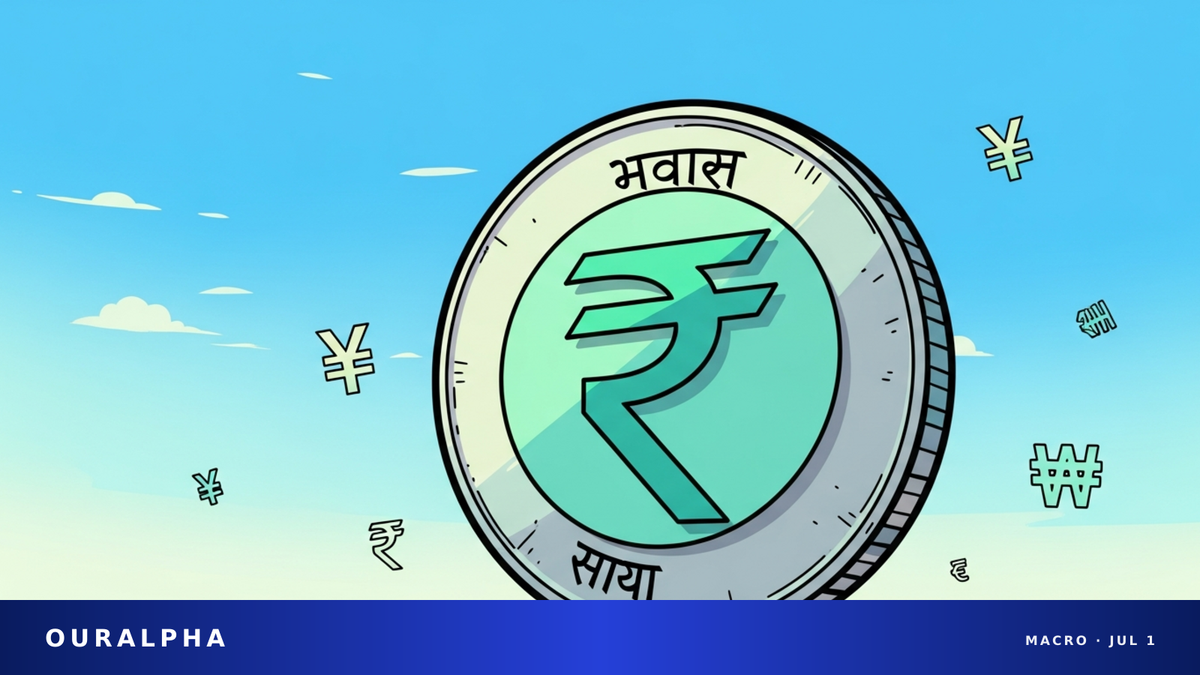
Asian Currencies Under Pressure as Indian Rupee Hits Three-Week Low

The Indian rupee slid to a three-week low as a resurgent dollar and fresh US-Iran tensions weighed on Asian currencies. The yen sank to a 40-year trough, keeping traders on intervention watch.

Asian currencies under pressure, Indian rupee at three-week low, dollar strong
A strong dollar and geopolitical risks are putting a double squeeze on Asian currencies.

Asian currencies are buckling under the weight of a resurgent dollar and renewed US-Iran tensions, with the Indian rupee sliding to a three-week low.

  • The Indian rupee hit a three-week low against the dollar as Asian currencies broadly weakened.
  • The dollar index is on track for its biggest monthly gain in nearly a year, fueled by rate-hike expectations and optimism on the US economy.
  • US and Iran agreed to meet in Qatar after fresh weekend attacks, but the ceasefire remains fragile, nudging oil prices higher.
  • The yen sank to a 40-year low, touching 162.41 per dollar, keeping markets on alert for potential intervention by Japanese authorities.
  • Asian equity markets delivered a split performance in Q2: the Nikkei 225 surged over 38% and Korea's KOSPI jumped nearly 71%, but foreign funds still pulled out $17.3 billion.

As of 8:00 AM ET (20:00 Beijing time) on July 1, Asian FX markets were extending recent trends in pre-market trading. The Indian rupee fell to a three-week low against the dollar, a stark symbol of the broader pressure on Asian currencies. The dollar index is on track for its biggest monthly gain in nearly a year, while the yen slumped to a 40-year nadir, keeping traders on edge over possible intervention.

Dollar Strength Squeezes Asian Currencies

The dollar had a blockbuster June, on pace for its largest monthly gain since July 2025. According to Reuters, the dollar index held steady at 101.34 on June 29, near the 13-month high hit the previous week. The greenback gained against every major currency this month, with the sharpest moves against Scandinavian and Antipodean currencies, which fell between 4.7% and 7%.[Kitco]

"This is significant because there has been so much talk about the structural decline of the dollar since last April," said Jane Foley, chief FX strategist at Rabobank. "But I think even if you buy that story, you have to acknowledge there is cyclical upside."[Reuters]

Behind the dollar's rally: rising US inflation pressure and a surprisingly hawkish debut from Fed Chair Kevin Warsh, which upended market expectations for rate cuts this year. Meanwhile, the AI-driven US stock boom is sucking in capital at breakneck speed.[Kitco]

Weekly data from the Commodity Futures Trading Commission showed investors holding the largest net long dollar position since 2019, worth roughly $36.4 billion against other major currencies.[Reuters]

US-Iran Tensions and Oil Volatility

US-Iran relations flared up again over the weekend. Iran launched fresh drone and missile strikes on Bahrain and Kuwait in response to new US airstrikes. The two sides then agreed to meet in Qatar, but investors remain cautious about the ceasefire, nudging oil prices modestly higher.[Houston Chronicle]

On June 29, Brent crude futures rose 0.7% to $73.27 a barrel, while US benchmark crude gained 0.8% to $70.02. Both are near pre-war price levels.[Houston Chronicle]

ING commodity strategists Warren Patterson and Ewa Manthey noted that oil markets still face the risk of renewed US-Iran escalation, as vessel safety in the Strait of Hormuz raises fresh concerns. They argued that oil traders are "too optimistic" on the timeline for restoring Persian Gulf supply, calling the complacency "odd" and warning of "significant upside risk if supply restoration is slow or if there is a major escalation."[Houston Chronicle]

Yen Sinks to 40-Year Low, Intervention Watch

The yen is the biggest casualty of dollar strength. On June 30, it touched a 40-year low of 162.41 per dollar during Asian trading, keeping traders on alert for possible intervention by Japanese authorities.[Reuters]

Finance Minister Satsuki Katayama said authorities are ready to respond appropriately.[Reuters]

The euro edged up 0.2% to $1.14 on June 29, after hitting a 13-month low, and is on track for a 2.4% monthly decline. Sterling held steady at $1.322, after touching a seven-month low.[Kitco]

Asia Equities Q2 Split, Foreign Outflows

Asian stocks ended the second quarter on a strong note, but with sharp internal divergence. Japan's Nikkei 225 rose 1.6% on June 30, on track for a record quarterly gain of over 38%. South Korea's KOSPI jumped 3%, surging nearly 71% in Q2 and more than doubling year-to-date.[Reuters]

But foreign flows tell a different story. According to BNY Mellon, South Korean stocks have seen net outflows of $17.3 billion this year. "The gap between returns and flows fits a broader pattern in Asia's tech-heavy markets: strong performance is triggering rebalancing and profit-taking, not new institutional buying," said BNY Mellon macro strategist Jeff Yu.[Reuters]

Taiwan's Taiex index gained over 46% in Q2. Hong Kong's Hang Seng lagged, falling 7.5% over the quarter.[Reuters]

The prior trading day (June 29) saw Asian markets weak on an AI-related selloff. The Nikkei 225 fell 1%, following a 4.2% plunge on Friday; the KOSPI dropped 2%, after Friday's 5.8% rout.[Houston Chronicle]

This Week's Focus: US Jobs Data & Fed Speech

Market attention this week shifts to the US employment report, which could offer clues on whether the market's pricing of Fed rate hikes is accurate. Money markets show traders fully pricing in one rate hike this year, with about a 50% chance of a second.[Kitco]

The European Central Bank's annual forum kicked off on June 29 with opening remarks from President Christine Lagarde. A key policy panel on Wednesday will feature Fed Chair Kevin Warsh, with investors closely watching for his latest views on the rate outlook.[Reuters]

"Now that oil prices have fallen, it reinforces our view that global growth will be closer to trend rather than the sluggish levels we considered a few months ago, which also supports a better earnings story," said Kerry Craig, strategist at JPMorgan Asset Management.[Reuters]

This content is for informational purposes only and does not constitute investment advice, trading advice, or any guarantee of returns.

Keep Reading

Alphabet’s Antitrust Headache Deepens: Sweden Orders $1.5B Payout to Klarna, South Korea Opens New Probe

Alphabet’s Antitrust Headache Deepens: Sweden Orders $1.5B Payout to Klarna, South Korea Opens New Probe

Alphabet edged higher in early trading Tuesday, but antitrust pressure is building. A Swedish court ordered Google to pay Klarna $1.5 billion in damages, while South Korea’s antitrust watchdog launched a fresh probe.

  • Price action: As of 9:30 a.m. ET on July 1, Alphabet (GOOGL) was at $357.98, up 0.17% (+$0.61) from Friday’s close of $357.37. Opened at $358.38, with an intraday range of $357.89–$358.39.
  • Swedish verdict: The Stockholm District Court ruled
Read full story →

Stay ahead of the market — never miss a deep dive

Follow OurAlpha for AI-driven US equity research and market insight, every day.