Oil Slides 4-5%: How Much Can Delta, FedEx, and the Airlines Really Bounce?

WTI dropped 4% and Brent nearly 5% on Iran diplomacy hopes, handing airlines, freight, and fuel-sensitive retailers a clear tailwind. Every sustained $5 move lower in crude translates to roughly $1 billion in annual fuel cost relief for U.S. carriers.

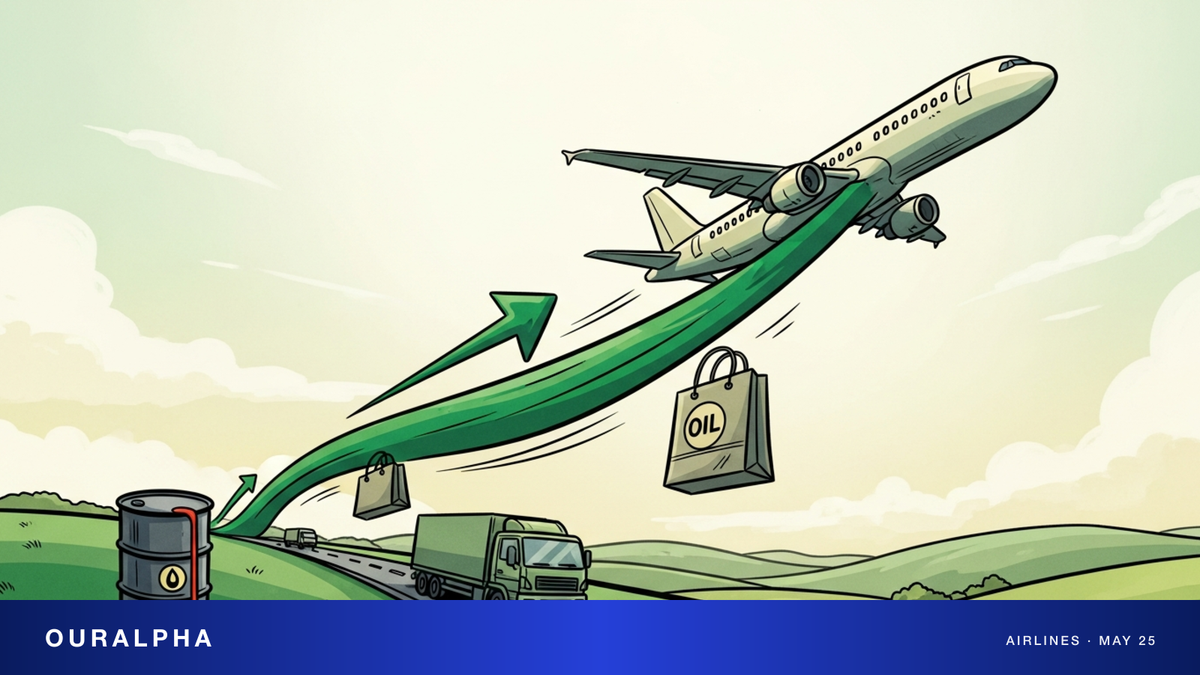
A commercial jet and freight truck lifted by a green tailwind arrow, with a dripping oil barrel in the lower left — symbolizing falling oil prices as a tailwind for airlines, transport,…

TL;DR

Progress on U.S.-Iran diplomacy sent WTI down 4% and Brent nearly 5% in a single session. If crude holds the lower range, airlines, freight carriers, and fuel-sensitive retailers stand to pocket meaningful margin relief. Delta Air Lines (DAL) and United Airlines (UAL) Tuesday's open is the first reprice window.

  • Every sustained $5 drop in WTI unlocks roughly $1 billion in annual fuel cost savings across U.S. airlines
  • Benefit order: airlines (DAL, UAL, AAL) most direct > freight (FDX, UPS) next > consumer staples (WMT, TGT, COST) most diffuse
  • Long energy / short airlines was one of the best-performing pairs on the Street over the past two weeks — the asymmetry has now flipped
  • Two things to watch: whether WTI holds below $94, and whether U.S. shale producers respond to higher prices by adding rigs

The Memorial Day holiday-session oil selloff handed U.S. equities a clean set of beneficiaries. Airlines, freight and logistics, and fuel-sensitive retailers all get breathing room if WTI holds a lower range. According to Barron's, a single-session move of 4% in WTI and nearly 5% in Brent is large enough to flip Q2 modeling assumptions for U.S. airlines from a meaningful headwind to a modest tailwind — with a smaller but real read-through for FedEx (FDX) and UPS, and a more diffuse but still genuine effect on logistics-heavy retailers like Walmart (WMT), Target (TGT), and Costco (COST).

Tuesday's open is the first real test of whether positioning will follow the math.

The Fuel Math: Every $5 Drop in WTI Saves $1 Billion

U.S. airlines burn roughly 18 billion gallons of jet fuel per year. Using industry-average refinery crack spreads, every sustained $5 decline in WTI translates to approximately $1 billion in annual fuel cost savings spread across the four majors — Delta (DAL), United (UAL), American (AAL), and Southwest (LUV). WTI closed Friday around $90, versus an intraday high near $92 earlier in the week and a spike above $103 at the recent peak — a swing worth roughly $1.5 billion annualized if it holds.

For DAL and UAL the impact is direct EPS. Both carriers issued Q2 guidance assuming WTI at $90 per barrel for the quarter; actual fuel costs ran well above that as crude pushed above $95 and briefly touched $103. If Tuesday's spot correction pulls the realized fuel curve back toward original guidance, the single biggest headwind embedded in Q2 estimates effectively disappears. Sell-side price targets on both names were already being nudged higher in premarket.

Freight and logistics exposure is more spread out, but the logic is identical. FedEx and UPS together consume roughly 6 billion gallons of diesel and jet fuel annually; the same $5 WTI move corresponds to approximately $300–$400 million in combined annual savings. Smaller in absolute terms than the airline read-through, but meaningful enough to support a bounce in names already weighed down by cyclical freight demand concerns.

Consumer staples with heavy logistics footprints are the most indirect beneficiaries. Walmart, Target, and Costco each operate massive distribution networks where fuel is a real line item in cost of goods sold. But a sustained oil pullback won't directly improve gross margins in a single quarter — fuel costs are hedged, locked in advance, and amortized through renegotiated supplier contracts — so the benefit shows up in the medium-term margin trajectory, not in Tuesday's opening print. These names belong on the cross-quarter watchlist, not the tactical day-one reaction sheet.

Does the Crude Drop Hold, or Does It Snap Back?

Whether Monday's rally in fuel-sensitive sectors becomes a sustained rotation depends entirely on whether the oil pullback itself has legs. If WTI reclaims $95 within 48 hours, the whole move was holiday thin-market noise, and airlines and transports will give back their premarket gains by Tuesday's close.

Two structural factors, however, argue that this move has at least some durability.

First, the U.S.-Iran diplomatic de-escalation narrative — even without a signed agreement — has meaningfully reduced the implied probability of a worst-case Strait of Hormuz scenario. The geopolitical risk premium that got squeezed out was real.

Second, U.S. shale producers maintained capital discipline through the recent oil rally, meaning the supply side did not respond aggressively to higher prices. Geopolitical premium coming out plus supply not ramping quickly = more room for crude to drift lower, which extends the relief for airlines and transport names.

To be direct: this is an asymmetric setup for fuel-sensitive sectors. If the oil pullback holds, the trade has a 2-to-4-week runway. If crude bounces back, those gains get returned in a comparable window.

How to Play Tuesday's Open

For investors who were underweight airlines and consumer discretionary during the oil spike, Tuesday's open is the first chance to re-enter without paying peak-crude prices. The most direct expression: modestly add airlines (DAL, UAL, AAL), layer in a smaller position in freight (FDX, UPS), and leave the consumer staples beneficiaries for cross-quarter positioning rather than tactical rotation.

There's also a pairs trade to unwind. Long energy / short airlines has been one of the highest risk-adjusted-return sector pairs on the Street over the past two weeks. Anyone running that book enjoyed a clear outperformance run — Tuesday's open is the natural point to take it off. The asymmetry has flipped: one adverse Iran headline could hand back the entire trade's P&L in a few sessions. The better risk-reward is to close the pair, lock the realized gain, and free up macro positioning ahead of Friday's PCE print.

Three Things to Watch Over the Next Two Weeks

1. WTI spot closes Tuesday and Wednesday. A close below $94 alongside declining WTI implied vol would confirm that the Iran de-escalation narrative is sticking. A rebound above $95 signals the move hasn't truly settled.

2. JETS vs. XLE relative performance. These two ETFs traded in sharp opposition over the past two weeks. Their spread is the most direct real-time indicator of whether the sector rotation is genuine.

3. Consumer staples same-store sales updates and quarterly logistics commentary. Walmart's, Target's, and Costco's medium-term margin trajectories will start getting confirmed — or refuted — by guidance updates beginning in late June. Watch for any signals that U.S. shale management teams are softening their capex discipline in response to high prices — for now they're holding the line, but that's the structural variable that changes everything.

Tuesday's open offers a clean entry point. How you manage the follow-through over the next two weeks determines whether this is a tactical trade or the start of a strategic rotation.

This content is for informational purposes only and does not constitute investment advice, trading advice, or any guarantee of returns.

Keep Reading

Alphabet’s Antitrust Headache Deepens: Sweden Orders $1.5B Payout to Klarna, South Korea Opens New Probe

Alphabet’s Antitrust Headache Deepens: Sweden Orders $1.5B Payout to Klarna, South Korea Opens New Probe

Alphabet edged higher in early trading Tuesday, but antitrust pressure is building. A Swedish court ordered Google to pay Klarna $1.5 billion in damages, while South Korea’s antitrust watchdog launched a fresh probe.

  • Price action: As of 9:30 a.m. ET on July 1, Alphabet (GOOGL) was at $357.98, up 0.17% (+$0.61) from Friday’s close of $357.37. Opened at $358.38, with an intraday range of $357.89–$358.39.
  • Swedish verdict: The Stockholm District Court ruled
Read full story →

Stay ahead of the market — never miss a deep dive

Follow OurAlpha for AI-driven US equity research and market insight, every day.