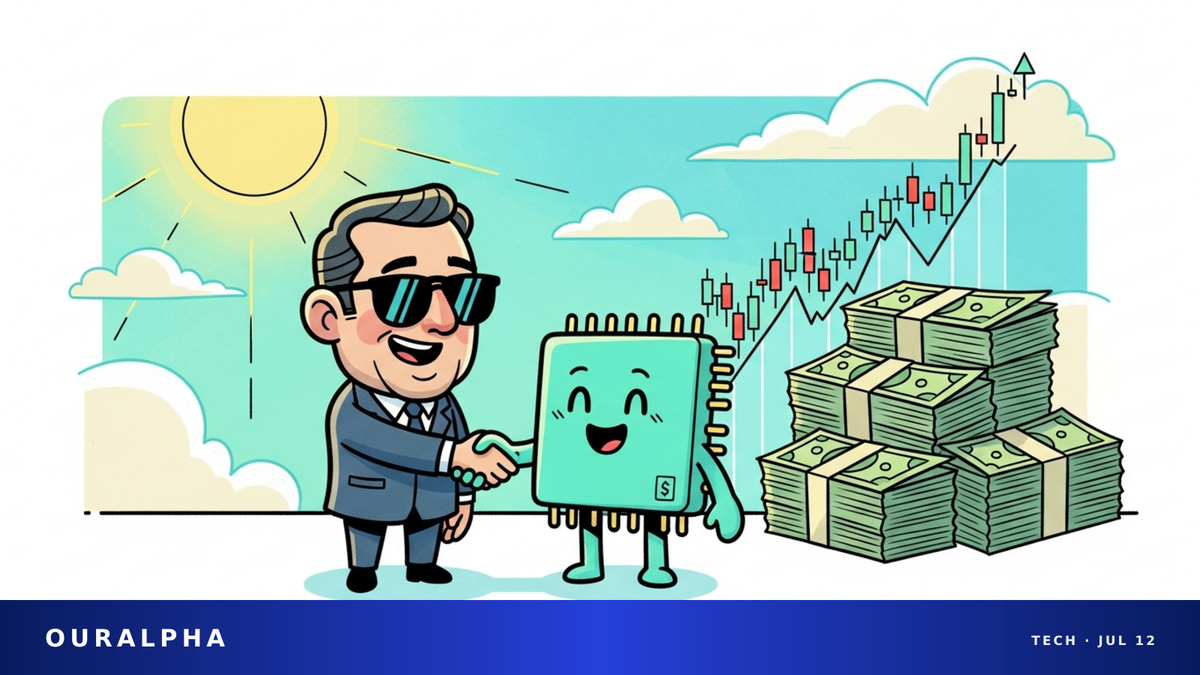
Cook’s Swan Song: Apple Locks In $30 Billion Broadcom Chip Deal, Stock Hits One-Month High

Tim Cook’s final act as Apple CEO is the company’s biggest-ever U.S. manufacturing pact: a $30B+ multiyear chip deal with Broadcom. Apple stock hit a one-month high, making it the only Magnificent Seven name near its all-time peak.

Tim Cook Apple Broadcom $30 billion chip deal stock high
Tim Cook’s final move as Apple CEO locks in the company’s largest-ever U.S. chip manufacturing deal, sending shares to a one-month high.

Two months before stepping down, Apple (AAPL) CEO Tim Cook announced the company’s largest-ever U.S. manufacturing deal: a chip supply agreement with Broadcom (AVGO) valued at over $30 billion and running through 2031. Meanwhile, Apple shares closed Friday, July 10 at $315.32, down 0.28% from the prior close but still hitting their highest level in over a month, making Apple the only Magnificent Seven stock near its all-time high. Markets are closely watching the broader AI chip pullback and the impact of surging memory costs on consumer electronics.

  • Apple and Broadcom struck a multiyear deal worth over $30 billion to produce more than 15 billion chips in the U.S., including a $1.5 billion expansion of Broadcom’s Colorado facility[247wallst].
  • Memory chip costs have surged roughly 500% since August 2025, forcing Apple to raise MacBook and iPad prices by 17-25%, though iPhone prices remain unchanged[247wallst].
  • Apple shares closed at $315.32 on July 10, up roughly 16.5% year-to-date, the best performance among the Magnificent Seven; Microsoft and Tesla remain in negative territory for the year[CNBC].
  • Broadcom shares rose as much as 5% in pre-market trading on Monday, July 6, closing at $370.78 on July 7, up 36.22% over the past 12 months[247wallst].
  • The PHLX Semiconductor Index has fallen 15% from its record high in late June, but is still up 75% year-to-date[CNN].
  • Research firm Omdia forecasts that shipments of smartphones priced under $400 will drop 22% from the second half of 2026 through 2027 due to high memory costs[CNET].

With less than two months left in his tenure, Apple (AAPL) CEO Tim Cook on Wednesday, July 8 announced the company’s largest-ever U.S. manufacturing commitment: a multiyear agreement with Broadcom (AVGO) valued at over $30 billion to produce more than 15 billion American-made chips, including a $1.5 billion expansion of Broadcom’s Colorado facility. According to Bloomberg, the deal runs through 2031, extending well beyond Cook’s tenure. As of Friday, July 10, Apple shares closed at $315.32, down 0.28% from the prior close of $316.22, with an intraday range of $312.17 to $316.91. Despite the slight dip, CNBC noted that Apple shares hit a one-month closing record on Thursday, July 9, making it the only Magnificent Seven stock near its all-time high — the other six (Amazon, Alphabet, Microsoft, Nvidia, Meta, and Tesla) all trade well below their respective record closes[CNBC].

Cook’s Final Legacy: A $30 Billion Domestic Chip Supply Chain

According to 24/7 Wall St., the Broadcom deal is the largest single commitment in Apple’s “Made in America” initiative. Broadcom’s Fort Collins, Colorado facility will produce advanced RF components, including FBAR (film bulk acoustic resonator) filters that clean radio signals inside iPhones to ensure clear calls and data transmission[247wallst]. Cook said in a statement: “Apple and Broadcom have a long history of collaboration, and this new chapter in our partnership further accelerates our commitment to American manufacturing and innovation. The cutting-edge components made in Fort Collins are critical to delivering the exceptional performance and connectivity our customers expect.” He also thanked President Trump and his administration for their support. Broadcom CEO Hock Tan credited Apple’s commitment for the Colorado expansion[247wallst].

Behind the massive investment lies deep concern over supply-chain risk. Cook told investors on Apple’s fiscal Q2 earnings call that capacity constraints at TSMC (TSM) were limiting iPhone supply. Meanwhile, memory chip costs have surged roughly 500% since August 2025, as AI data centers compete with consumer electronics for chip capacity, forcing Apple to raise MacBook and iPad prices by 17% to 25%, though iPhone prices were spared. Apple’s latest 10-Q filing also lists reliance on third-party components, technology, and manufacturing as its top risk[247wallst]. Building a domestic supply chain for critical wireless silicon has become a strategic imperative.

Broadcom and Apple: A Win-Win Dynamic

The deal is equally significant for Broadcom. According to 24/7 Wall St., Broadcom shares rose as much as 5% in pre-market trading on Monday, July 6, after the news. On Tuesday, July 7, Broadcom closed at $370.78, up 36.22% over the past 12 months. Broadcom’s fiscal Q2 2026 revenue was $22.19 billion, up 47.9% year-over-year, with AI semiconductor revenue hitting $10.8 billion, up 143%[247wallst]. Apple accounts for roughly 20% of Broadcom’s annual revenue, and this long-term agreement locks in that critical customer relationship.

Apple’s market performance also stands out. CNBC’s analysis shows Apple’s roughly 16.5% year-to-date gain is the best among the Magnificent Seven, while Microsoft and Tesla remain in negative territory for the year. Wall Street is reassessing valuations of other big tech names as customers favor efficient AI consumption models over a “maximization” mindset. This shift from “tokenmaxxing” to “token optimization” marks a new chapter in the generative AI boom and is creating clear ripple effects in the stock market[CNBC]. Apple’s low-cost approach to the AI race is winning Wall Street’s approval.

AI Chip Rally Cools, Memory Crisis Hits Budget Phone Market

Despite the boost from the Apple-Broadcom deal, the broader semiconductor sector is under pressure. CNN reported on July 9 that chip stocks, which had powered Wall Street’s AI rally, are suddenly under strain as investors assess escalating Middle East tensions, take profits after historic gains, and hunt for value. The S&P 500 and Nasdaq Composite have fallen nearly 2% and 5%, respectively, from their record highs on June 2. The PHLX Semiconductor Index has dropped 15% from its record high in late June, but is still up 75% year-to-date[CNN].

“The semiconductor rally has gone far beyond what is reasonable,” said Jeff Buchbinder, chief equity strategist at LPL Financial. “Investor positioning in tech, especially semiconductors, has reached unprecedented levels.” Saxo Markets strategist Neil Wilson noted in a report: “Stock prices already price in extremely strong future earnings growth, and the worry is that AI infrastructure spending can’t keep driving memory prices higher forever.” Markets are closely watching the upcoming earnings season, particularly capital expenditure plans for AI infrastructure at “hyperscalers” like Microsoft, Meta, and Google, and whether those investments will translate into real returns[CNN].

Surging memory costs are having a structural impact on consumer electronics. CNET, citing Omdia, reports that with memory manufacturing costs nearly doubling between Q3 2025 and Q1 2026, the market for smartphones priced under $400 will be hit hard. Omdia analyst Zaker Li says some phone makers are trying to offset memory price hikes by cutting costs on other components like screens and sensors, but there is limited room. As Chinese phone makers OPPO, vivo, Honor, Xiaomi, and Transsion are forced to raise prices, cost-sensitive consumers will stop buying, potentially pushing manufacturers to exit the low-end market entirely. “Some manufacturers tell us they are considering completely exiting the low-end market,” said Francisco Jeronimo, IDC’s vice president for global client devices. “If you sell a $150 phone and half the cost is memory, where do you make money?” IDC expects the memory crisis to ease by fall 2027 or early 2028[CNET].

Chinese Chip Makers Surge, Market Divergence Widens

Amid the global chip shortage, Chinese A-share chip companies are also posting stellar results. According to finance.biggo.com, memory chip leader GigaDevice issued a profit forecast, expecting net profit attributable to shareholders for the first half of 2026 to be roughly 6.9 billion yuan, up about 1,099% year-over-year. The company attributed the surge to persistently tight supply in the memory chip industry, with both volume and prices rising for its memory products, along with expanded shipments of microcontroller products[finance.biggo.com].

Meanwhile, AI servers and the new-energy supply chain have become the two brightest themes in A-share earnings pre-announcements. Foxconn affiliate Foxconn Industrial Internet expects first-half net profit between 23.4 billion and 24.4 billion yuan, up 93% to 101% year-over-year, with AI server revenue in its cloud business growing over 230% and shipments of 800G and higher data-center switches up 1.4 times. Laser equipment leader Han’s Laser also benefited from PCB equipment demand driven by AI server and high-speed network switch deployments, expecting first-half net profit to rise 156% to 177%[finance.biggo.com].

But not all is rosy. Domestic GPU maker Muxi shares issued an urgent clarification that market rumors of its “order book being full through next year” are untrue, stressing the company remains in the red. Traditional sectors like steel and hog farming face dual pressure from weak demand and rising costs. Valin Steel’s net profit plunged over 80%, while Jiangxi Zhengbang Technology expects a large loss due to falling hog prices and typhoon damage[finance.biggo.com]. This divergence mirrors the uneven heating and cooling across different links in the global AI chip supply chain.

This content is for informational purposes only and does not constitute investment advice, trading advice, or any guarantee of returns.

Keep Reading

Meta Stock Logs Best Week Since Early 2024 as AI Blitz and In-House Chip Plans Ignite Rally

Meta Stock Logs Best Week Since Early 2024 as AI Blitz and In-House Chip Plans Ignite Rally

Meta (META) shares surged roughly 15% last week, their best weekly performance since early 2024, as a flurry of new AI model releases and news of an in-house chip production timeline reignited investor enthusiasm. The stock closed Friday, July 10, at $669.21, up 5.97% from the prior close of $631.48. (U.S. markets were closed for the weekend; the quote reflects the last trading session.)

  • Best week since 2024: Meta’s 15% weekly gain was its strongest since the week ending February
Read full story →

Stay ahead of the market — never miss a deep dive

Follow OurAlpha for AI-driven US equity research and market insight, every day.