After NVIDIA: ASML, GE Vernova, and Lumentum Are AI Infrastructure's Next Three Legs
IBD's weekend watchlist flags three stocks sitting at three distinct layers of AI infrastructure — chip equipment, power grid, and optical interconnects. For investors who feel NVIDIA's upside is already priced in, these are the cheaper, higher-conviction ways to stay long the same trade.
TL;DR
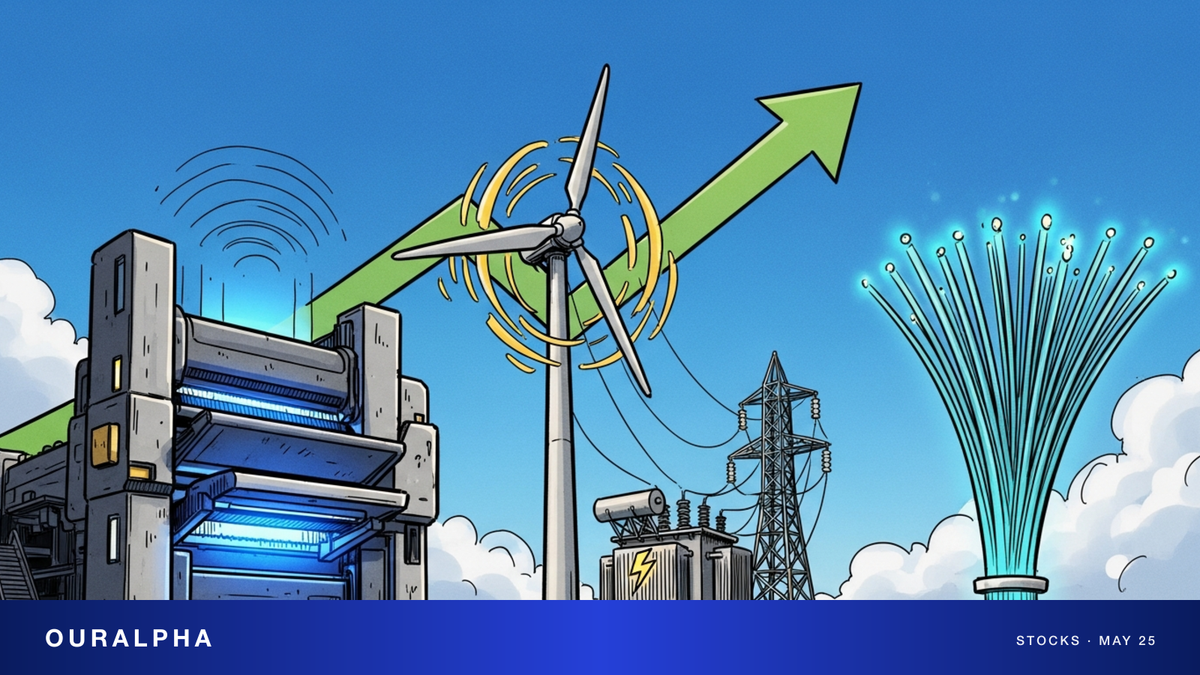
IBD's weekend watchlist includes three names that aren't a random assortment: ASML (Dutch lithography monopoly), GE Vernova (the General Electric power equipment spinoff), and Lumentum (optical components) map onto three distinct layers of AI infrastructure — upstream chip equipment / power and grid / optical interconnects. Together they answer one question: if NVIDIA's upside is already priced in, where else can you express the same AI capex theme?
- For investors worried NVIDIA's expectations are fully baked, all three offer meaningfully cheaper entry valuations
- The common thread: none carries NVIDIA's "fully-priced" overhang, but all benefit from the same underlying AI capex cycle
- No need to exit the AI trade — these are rotation destinations within it, not replacements
- Historical precedent: in every major capex-driven cycle, second-order beneficiaries (equipment, power, connectivity) tend to generate higher cumulative returns than the headline stock
IBD's weekend watchlist — beyond Tesla — included three names worth pulling apart: ASML (Dutch lithography giant), GE Vernova (the power equipment company spun out of General Electric in April 2024), and Lumentum (optical components). This isn't a random assortment. Each company sits at a different layer of the AI infrastructure stack, and together they frame a useful question: has the market actually started broadening the AI trade beyond NVIDIA, or is it still a one-stock story?
For anyone who watched NVIDIA's (NVDA) post-earnings price action and concluded that expectations are fully baked, these three are the most direct answer to "where can I express the AI thesis at a cheaper valuation."
Three Companies, Three Layers of AI Infrastructure
ASML — Upstream Equipment
ASML is one of the quietest beneficiaries of this AI cycle. Its EUV (extreme ultraviolet lithography) platform is the physical prerequisite for manufacturing every advanced-node chip at scale — NVIDIA's Blackwell, Apple's (AAPL) A- and M-series, AMD's MI lineup, and the custom ASICs being fabbed for the major cloud providers. When NVIDIA's data center demand expands, ASML's order book expands with it.
What's notable is that ASML has traded at a persistent valuation discount relative to its US semiconductor equipment peers — Applied Materials (AMAT), Lam Research (LRCX), KLA — over the past year. Two reasons: market concern over China export restrictions, and the fact that ASML's 18-to-24-month EUV delivery cycles make revenue visibility lumpier than peers'. IBD adding ASML to the watchlist signals the relative-strength gap may be closing — the discount could be starting to mean-revert.
GE Vernova — Power and Grid
GE Vernova became an independent public company when General Electric completed its spinoff in April 2024. It is now the cleanest pure-play on AI power demand in public markets. Its product portfolio — gas turbines, grid infrastructure, renewable energy systems — is exactly what new data centers need to physically connect to the US grid.
Over the past 12 months, hyperscaler capex has accelerated, and major US utilities (NextEra, Duke Energy, Southern Company) have been explicit on investor calls: AI data center load growth is the dominant variable in their five-year US power demand forecasts. Once that framing shifted, GE Vernova's order book and backlog visibility improved materially.
Lumentum — Connectivity and Optical Interconnects
Lumentum is the highest-leverage AI connectivity play of the three. Its optical transceivers and laser products are the core components enabling the bandwidth and latency required to move data between GPUs within a rack and across racks at the scale modern AI training demands. The larger the AI cluster and the deeper the shift from copper to optical interconnects, the higher the per-rack value of Lumentum's content.
Together, the three cover all three layers of the AI infrastructure stack: upstream chip equipment, power and grid, and connectivity. None carries the "fully priced" expectations overhang that NVIDIA does, but all benefit from the same underlying demand.
Is This Rotation Real?
The leadership structure in US equities in 2026 has oscillated between "concentrated in NVIDIA" and "broadening to multiple names." NVIDIA's post-earnings pullback last week was the cleanest stress test yet — strong numbers, stock sold off anyway — signaling that expectations had been fully priced in.
If the AI theme is going to keep pulling the index higher, the baton has to pass from NVIDIA to a wider set of names. IBD's watchlist is a useful filter: where the market actually puts money tends to be more informative than sell-side consensus.
The historical precedent is strong. In every major capex-driven US equity cycle — late-1990s internet infrastructure, post-2008 smartphone supply chains, 2015–2020 cloud migration — the names that ultimately delivered the highest cumulative returns weren't the headline stocks. They were the second-order beneficiaries one step back in the supply chain: equipment makers, power and grid, connectivity. The logic is simple: they enter at cheaper valuations with higher certainty, because they don't require a bet on who wins — only a bet that the buildout continues.
Since May, market breadth signals have pointed in this direction — leadership expanding from the Magnificent Seven to mid-cap semis, power utilities, and optical names — consistent with this historical pattern.
How to Build a Position
For investors who want AI exposure without paying NVIDIA's current multiple, these three offer three distinct entry angles.
- ASML — Upstream equipment. The deepest moat in the semiconductor supply chain; there is no substitute for EUV lithography.
- GE Vernova — Power and grid. The starting point of a US power infrastructure reinvestment cycle with an order book that extends five to ten years.
- Lumentum — Optical interconnects. Every order-of-magnitude increase in AI cluster scale drives another step-up in per-rack optical content value.
None of the three is a perfect NVIDIA substitute. But a cheaper entry valuation, a more durable competitive position, and multi-year order book visibility make this trio a natural complement for any portfolio already carrying meaningful NVIDIA exposure.
Zoom out one more level: the AI trade has moved past its first phase. Phase one was "own the chip giant." Phase two is "own the entire infrastructure ecosystem." IBD putting these three on the watchlist is one of the clearest market signals yet that phase-two positioning is already underway.
Three Things to Watch Over the Next Two Weeks
The market will use price action this week to answer whether this broadening is real or another head fake. Three metrics to track:
1. Relative strength of all three vs. the iShares Semiconductor ETF (SOXX) and NVIDIA itself. Sustained outperformance against both confirms genuine rotation. Outperforming NVIDIA but lagging SOXX likely reflects NVIDIA's own pullback — not true broadening.
2. GE Vernova's relative strength vs. the Utilities ETF (XLU). AI power demand is the defining sector narrative through 2027, and GE Vernova is the purest equipment-side expression of that thesis. If it starts outperforming XLU, the market is beginning to price AI power as a distinct, premium theme.
3. ASML's implied volatility as its next earnings window approaches. Meaningfully compressed IV alongside a continuing price uptrend is the clearest signal that the market is treating ASML as a core holding rather than a tactical trade.
The single most direct read, though, is how all three perform relative to NVIDIA over the next 10 trading sessions:
- Gap widens → the AI theme is broadening for the right reasons; second-order beneficiaries are reclaiming relative strength.
- NVIDIA reasserts leadership → the rotation was tactical, and the next real entry point comes after NVIDIA's next earnings reset.
Sources
- IBD Weekly Watchlist: ASML, GE Vernova, Lumentum Join Bullish Setup Names — Investor's Business Daily
- AI Trade Broadens Beyond NVDA: Equipment, Power, Optical Names Step Up — Barron's
- US Utilities Cite AI Data Center Load Growth as Top Five-Year Demand Driver — Reuters
- ASML Investor Relations — Q1 2026 Earnings & Order Book — ASML
This content is for informational purposes only and does not constitute investment advice, trading advice, or any guarantee of returns.