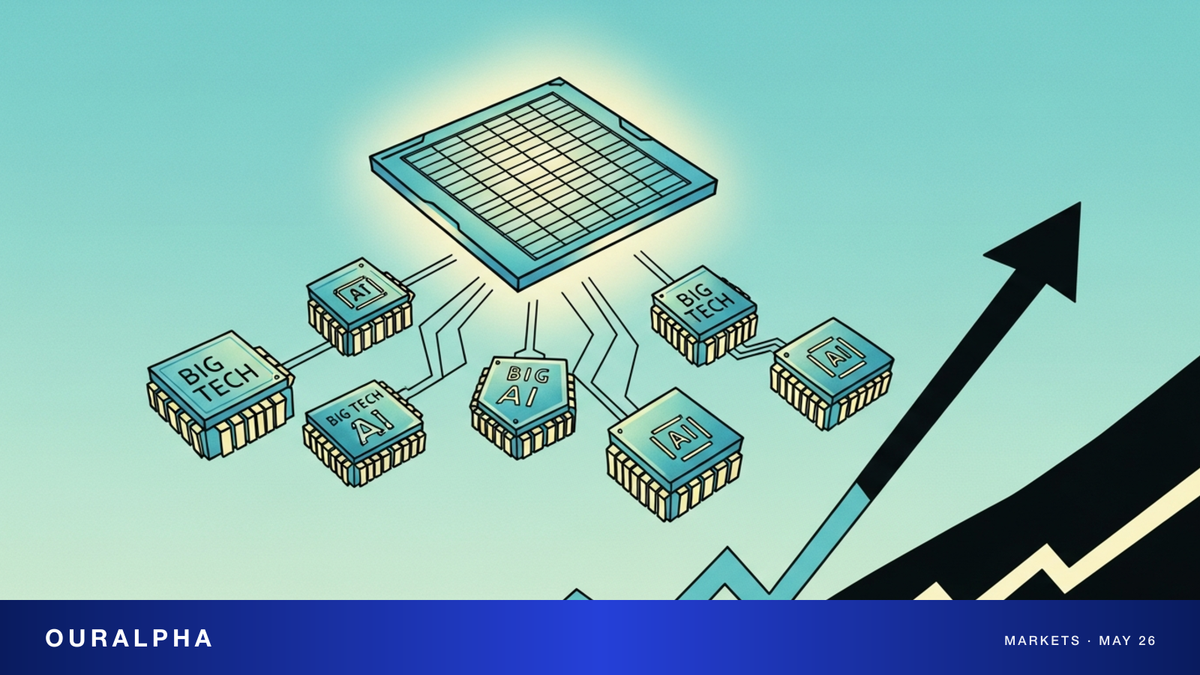
Broadcom Hits All-Time High $419.91: Why It's Picking Up Where Nvidia Left Off

Broadcom (AVGO) surged to an intraday record of $419.91 on May 25, 2026, pushing its market cap past $1.9 trillion for the first time. With TSMC's Q2 guidance raised and every Mag 7 AI chip running through Broadcom's design shop, the "stealth Nvidia" thesis just got validated again.

Broadcom AVGO hits all-time high $419 as AI hardware repricing accelerates
TSMC's Q2 earnings revision validates the "stealth Nvidia" thesis — again.

TL;DR

On May 25, 2026, Broadcom (AVGO) hit an intraday all-time high of $419.91 (low: $410.21), crossing a $1.9 trillion market cap for the first time. The immediate catalyst: TSMC's May 23 guidance raise — which confirmed the "stealth Nvidia" thesis the market has been building around Broadcom.

  • Intraday high $419.91, low $410.21 (May 25, 2026)
  • Market cap $1.9T — closing in on TSMC's $2.0T
  • Core thesis: Google TPU, Meta MTIA, and Apple's custom AI silicon are all Broadcom-designed ASICs
  • TSMC Q2 revenue guidance of $39.0–40.2B (vs. Q1's $35.7B) implies Broadcom's foundry orders are moving up in lockstep

On May 25, 2026, Broadcom (AVGO) hit an intraday all-time high of $419.91 — with a session low of $410.21 — pushing its market cap above $1.9 trillion for the first time. That puts it within striking distance of TSMC's $2.0 trillion and makes Broadcom the largest semiconductor company in the US market outside of Nvidia ($5.2T).

The proximate catalyst was TSMC's May 23 guidance raise, which handed Broadcom's "stealth Nvidia" thesis its latest round of market validation. This piece covers three things: how AVGO got to $419, what the "stealth Nvidia" label actually means in terms of real business, and how Broadcom stacks up against Nvidia right now.

How AVGO Got to $419 on May 25

Broadcom climbed roughly 10% in under two weeks — from around $380 in early May to the $419.91 intraday high on May 25 — on the back of several catalysts stacking up simultaneously.

First, TSMC's April 17 earnings. Net income rose 58% YoY, with CEO C.C. Wei calling AI chip demand "very strong" and flagging the need to accelerate capacity buildout. That has direct read-through to Broadcom: virtually all of Broadcom's most advanced chips — Google TPUs, Meta's MTIA, Apple's networking silicon — are manufactured by TSMC.

Second, TSMC's May 23 Q2 guidance raise. Revenue guidance came in at $39.0–40.2B, up from Q1's $35.7B. The market broadly read a meaningful portion of that incremental capacity as earmarked for Broadcom's customers — Google's next-gen TPU in particular.

Third, ASML's concurrent upward revision to its full-year 2026 guidance — a signal that equipment orders for the next wave of capacity expansion have already been placed, locking in 2027 buildout. Broadcom sits squarely in the path of that expansion.

Fourth, renewed Apple AI chip speculation. Multiple outlets reported that Apple's server-grade AI chip — internally codenamed "Baltra" — is in active sample delivery, co-designed by Broadcom and manufactured by TSMC. That would add another Magnificent Seven name to Broadcom's ASIC client roster.

With all four catalysts converging, Broadcom cleared the $419 level. On valuation, Broadcom's forward P/E of roughly 30x is now cheaper than Nvidia's — even as its client list spans nearly the entire Mag 7.

What "Stealth Nvidia" Actually Means

The "hidden Nvidia" (or "stealth Nvidia") nickname started circulating in mid-2024, when several sell-side research teams began systematically working through one question: when the Mag 7 build their own AI chips, who is actually doing the design work?

The answer caught the market off guard — it's almost entirely Broadcom.

  • Google TPU v5e / v5p / next-gen v6 — Broadcom is the primary design partner, handling ASIC back-end implementation and packaging
  • Meta MTIA v1 / v2 — same arrangement
  • Apple data center AI chip (codename Baltra) — reportedly the same
  • Microsoft Maia / Azure Cobalt — Broadcom contributed the networking silicon
  • OpenAI's rumored in-house chip — Broadcom and TSMC have both been named as likely partners

In other words, every Mag 7 "in-house chip" initiative aimed at reducing Nvidia dependence still has to route through Broadcom. That's the origin of the nickname: the market narrative celebrates custom chips displacing Nvidia, but the economics flow straight to Broadcom.

Add in Broadcom's own networking silicon franchise — Ethernet switching, AI NICs, optical components — and you have a business that is structurally indispensable to AI data center buildout. Broadcom holds more than 60% share in AI data center networking chips, with essentially no serious challenger (Marvell is second at under 15%).

Financially, Broadcom's AI-related revenue has rapidly scaled from roughly 15% of total revenue in FY2024 to 30%+ in FY2025. In its Q1 FY26 earnings call, management guided that AI-related revenue could reach an annualized run-rate of $60–90 billion by FY27. That guidance has driven a persistent valuation premium over the past six months — $419 is just the latest expression of it.

What TSMC's Q2 Raise Means for Broadcom

TSMC's Q2 revenue guidance of $39.0–40.2B — up from Q1's $35.7B — signals fully loaded foundry capacity in the June quarter, at higher pricing. As one of TSMC's most important AI ASIC customers, that capacity raise maps directly to expansion in Broadcom's order book.

Three transmission mechanisms matter here:

First, Broadcom's AI ASIC pricing moves up with foundry costs. As TSMC raises prices on N3/N3P/N2 nodes, Broadcom passes the increase downstream to Google, Meta, and Apple. Margins hold — because Broadcom is the only company that can deliver the full ASIC design + packaging + networking silicon stack as a single integrated solution.

Second, customer lock-in deepens. Google's next-gen TPU v6 is committed to the Broadcom-design / TSMC-foundry supply chain. Once that relationship is locked in, a substantial share of Google's AI capex — already revised up to $180–190B for 2026 — will effectively flow through Broadcom for the next three to five years.

Third, Apple's Baltra chip, if it hits volume production in 2027, would bring Broadcom into Apple's custom AI silicon supply chain. Apple's AI capex may be smaller than Google's or Meta's, but Apple is exactly the kind of customer that pays premium prices on single-chip programs over multi-year horizons.

TSMC's Q2 guidance raise is, in effect, the market re-pricing the value of Broadcom's client roster. The $1.9 trillion market cap is what that signal is worth right now.

Broadcom vs. Nvidia: Which Do You Own?

This is the sharpest portfolio trade-off in semis right now. The market cap gap is still wide — Nvidia at $5.2T vs. Broadcom at $1.9T — but the growth momentum is converging.

Nvidia is the purest AI play, the single most profitable semiconductor franchise in history — but expectations are priced to perfection. This past quarter: revenue up 85% YoY, a massive beat, and the stock still fell 1.86% on the day. That reaction is the clearest possible signal that "expectations too full" is a real risk here.

Broadcom covers the entire Mag 7 client roster, trades at a cheaper forward P/E (~30x vs. Nvidia's), is still growing its AI revenue mix rapidly, and is still in the phase where estimates are being revised higher — not fully priced in. Second-half catalysts are concrete: Apple Baltra production timeline, Google TPU v6 shipment cadence, Meta MTIA v2 deployment scale.

If forced to choose one: Broadcom offers better risk/reward at this moment. Its position in the AI supply chain is further upstream, its customer base is more diversified (no "top-5 customers = 50%+ of revenue" concentration risk like Nvidia carries), and valuation still has room to run.

But there's a more durable approach: own both, roughly equal-weight. That expresses the core conviction — "AI infrastructure spending continues" — without having to pick a winner. Nvidia as the foundation, Broadcom as the extension. That's the position easiest to defend heading into the second half.

One final point: $419 is not Broadcom's ceiling. If TSMC's Q3 guidance continues to move up and Google TPU v6 ships on schedule before July — a path to $500 and a $2.3 trillion market cap by year-end 2026 is entirely defensible. The next 60 days will tell us whether that line holds.

This content is for informational purposes only and does not constitute investment advice, trading advice, or any guarantee of returns.

Keep Reading

Alphabet’s Antitrust Headache Deepens: Sweden Orders $1.5B Payout to Klarna, South Korea Opens New Probe

Alphabet’s Antitrust Headache Deepens: Sweden Orders $1.5B Payout to Klarna, South Korea Opens New Probe

Alphabet edged higher in early trading Tuesday, but antitrust pressure is building. A Swedish court ordered Google to pay Klarna $1.5 billion in damages, while South Korea’s antitrust watchdog launched a fresh probe.

  • Price action: As of 9:30 a.m. ET on July 1, Alphabet (GOOGL) was at $357.98, up 0.17% (+$0.61) from Friday’s close of $357.37. Opened at $358.38, with an intraday range of $357.89–$358.39.
  • Swedish verdict: The Stockholm District Court ruled
Read full story →

Stay ahead of the market — never miss a deep dive

Follow OurAlpha for AI-driven US equity research and market insight, every day.