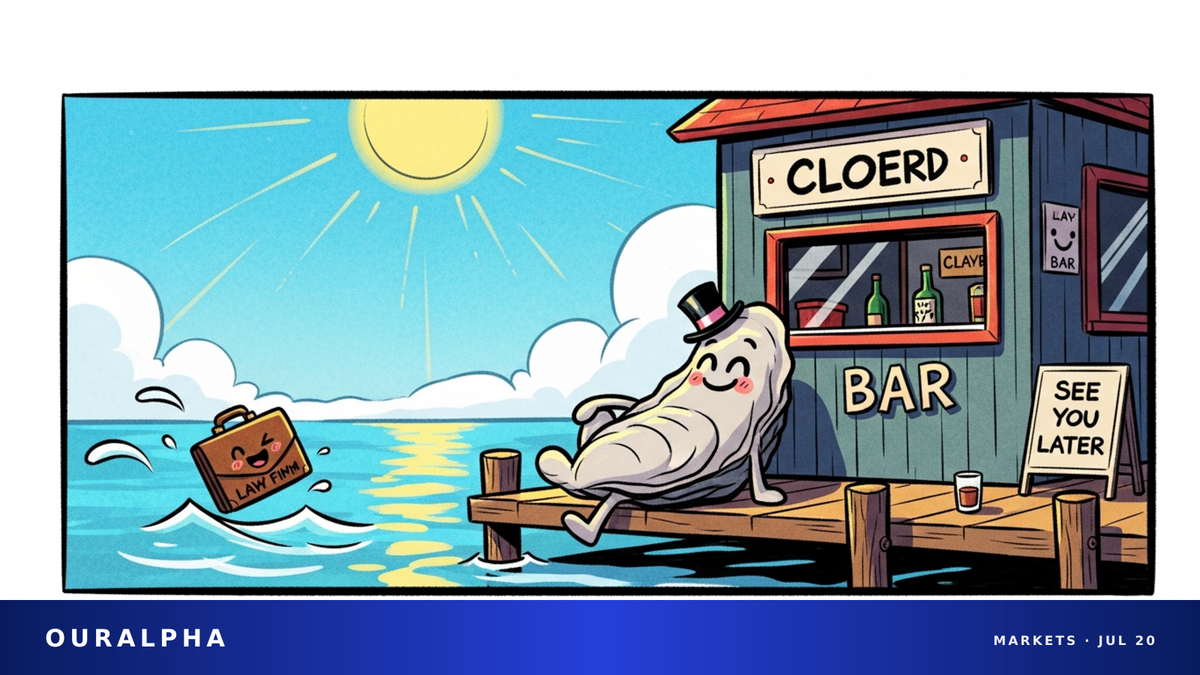
SF Oyster Bar Shutters, Law Firm Liquidates: A Week in Bankruptcy Filings
From a San Francisco oyster bar to a century-old New Orleans law firm, a wave of bankruptcies and liquidations hit restaurants, legal, and mining sectors last week.
Several well-known U.S. businesses and institutions entered bankruptcy or liquidation proceedings last week, spanning restaurants, law firms, and mining. As of the July 17, 2026 close, JPMorgan Chase (JPM) sat at $341.10, down 0.60% from the prior close of $343.15. U.S. markets were closed for the holiday, so this is the last trading day’s data.
- San Francisco’s upscale Leo’s Oyster Bar closed; its owner, Big Night Restaurant Group founder Anna Weinberg, filed for bankruptcy in May, listing personal assets under $50,000.
- New Orleans century-old law firm McGlinchey Stafford is liquidating, with dozens of its art pieces auctioned off on July 16.
- Liberty Bell Bay manganese smelter in Tasmania, Australia, confirmed its closure after a failed acquisition, affecting roughly 217 workers.
- The U.S. Trustee objected to MMA Law’s Chapter 11 reorganization plan, arguing it improperly shields insiders.
- SIMAD received bids for two of its summer camp properties in its Chapter 11 case.
Last week, a string of businesses — from a San Francisco fine-dining spot to a century-old New Orleans law firm and an Australian industrial smelter — entered bankruptcy or liquidation, driven by financial distress, legal battles, or failed acquisitions. These cases highlight the pressures different industries face in the current economy.
San Francisco Landmark Closes: Founder’s Personal Bankruptcy
Leo’s Oyster Bar, an upscale oyster bar in San Francisco’s Financial District, has officially closed. The restaurant opened in 2016, known for its black-and-white tile floors and vintage decor, and was hailed as a “huge success” by San Francisco Chronicle restaurant critic Michael Bauer.[San Francisco Chronicle]
Founder Anna Weinberg confirmed the closure on Sunday, saying her lease expired on July 1. “Changes in personal circumstances and priorities made renewal no longer feasible,” she said in a text message. Weinberg founded Big Night Restaurant Group, which once operated some of San Francisco’s hottest spots, including Marlowe, Park Tavern, and Cavalier.[San Francisco Chronicle]
Over the following decade, Weinberg struggled with substance abuse and mounting legal disputes. She divorced her husband and split the business. In April, a judge ordered Weinberg to pay $1.1 million in damages for breach of contract to Tosca Cafe business partner David Stanton.[San Francisco Chronicle]
Weinberg filed for bankruptcy in May, estimating her assets at less than $50,000. The following month, she disclosed roughly $7,000 in her bank account and $23,000 in personal belongings, including a smartphone and kitchenware. Meanwhile, she owes debt to Stanton and food distributor Bi-Rite, plus $37,000 in credit card debt. She reports monthly income of about $12,000 from Tosca Dream Team LLC. Her bankruptcy case is ongoing.[San Francisco Chronicle]
Century-Old Law Firm Liquidates: Art Auctioned to Pay Creditors
McGlinchey Stafford, a historic New Orleans law firm, is liquidating its assets after shutting down. On July 16, dozens of art pieces from its collection were auctioned at Neal Auction Company, including Ida Rittenberg Kohlmeyer’s oil painting Circus Series, 84-6, Enrique Alferez’s sculpture Woman in a Huipil (Seated Woman), and Elemore Morgan Jr.’s Spring Landscape.[NOLA.com]
According to NOLA.com, the artworks once hung on the walls of McGlinchey Stafford’s New Orleans office, with one painting even sitting above the copy machine. The auction is part of the firm’s asset liquidation to repay creditors. Founded in the 19th century, McGlinchey Stafford was once one of Louisiana’s most prestigious law firms but announced its closure earlier this year.[NOLA.com]
Australian Smelter Closes: Acquisition Talks Collapse
In Australia, GFG Alliance’s Liberty Bell Bay manganese smelter has confirmed its immediate closure. A consortium that initially included Adroit Capital and White Oak informed administrators it would not proceed with the acquisition. EY Parthenon administrators confirmed the closure and told employees the plant in northern Tasmania would cease operations after failing to find a buyer.[Mining Technology]
The smelter has been in administration since March. Last month, one of its main financial backers withdrew from the acquisition consortium, clouding its prospects. Roughly 217 workers are affected by the closure. Robert Flanagan, Tasmanian secretary of the Australian Workers’ Union, called it a major blow to the workforce, with contracts expected to be terminated at an upcoming meeting. Employees will continue to be paid until that point, after which they may need to seek unpaid entitlements through the federal government’s Fair Entitlements Guarantee scheme, a process that could take 8 to 12 weeks.[Mining Technology]
Tasmania Premier Jeremy Rockliff and Federal Industry Minister Tim Ayres issued a joint statement, calling the closure a “sad day” for the community that relied on the smelter. Both state and federal governments pledged immediate assistance. The smelter had been operating at reduced capacity due to ore supply shortages. Last year, the Tasmanian government provided a A$20 million (about $14 million) loan for ore purchases, and the state and federal governments jointly funded A$9.6 million to keep paying workers during the sale attempt. A proposed 10-year electricity deal was also offered to potential buyers, but it wasn’t enough to secure a deal.[Mining Technology]
Legal & Summer Camps: Disputes and Progress in Bankruptcy
In bankruptcy law, the U.S. Trustee objected to MMA Law’s Chapter 11 reorganization plan. According to Law360, the Trustee argued the plan improperly protects insiders from creditor claims. The Trustee said the plan fails to treat all creditors fairly and may violate bankruptcy law. The case is ongoing.[Law360]
Meanwhile, SIMAD made progress in its Chapter 11 case. According to Law360, the company received bids for two of its summer camp properties. These assets are part of SIMAD’s reorganization plan, which aims to sell non-core assets to repay debt and keep operations running. The court will review the bids and decide whether to approve the sales.[Law360]
Sources
- San Francisco Chronicle — Upscale S.F. oyster bar closes as owner files for bankruptcy
- NOLA.com — McGlinchey Stafford art auctioned off as shuttered law firm continues liquidating assets
- Mining Technology — Liberty Bell Bay smelter closure confirmed as sale collapses
- Law360 — U.S. Trustee Says MMA Law's Ch. 11 Plan Shields Insiders
- Law360 — SIMAD Scores Bids For 2 More Summer Camps In Ch. 11
This content is for informational purposes only and does not constitute investment advice, trading advice, or any guarantee of returns.