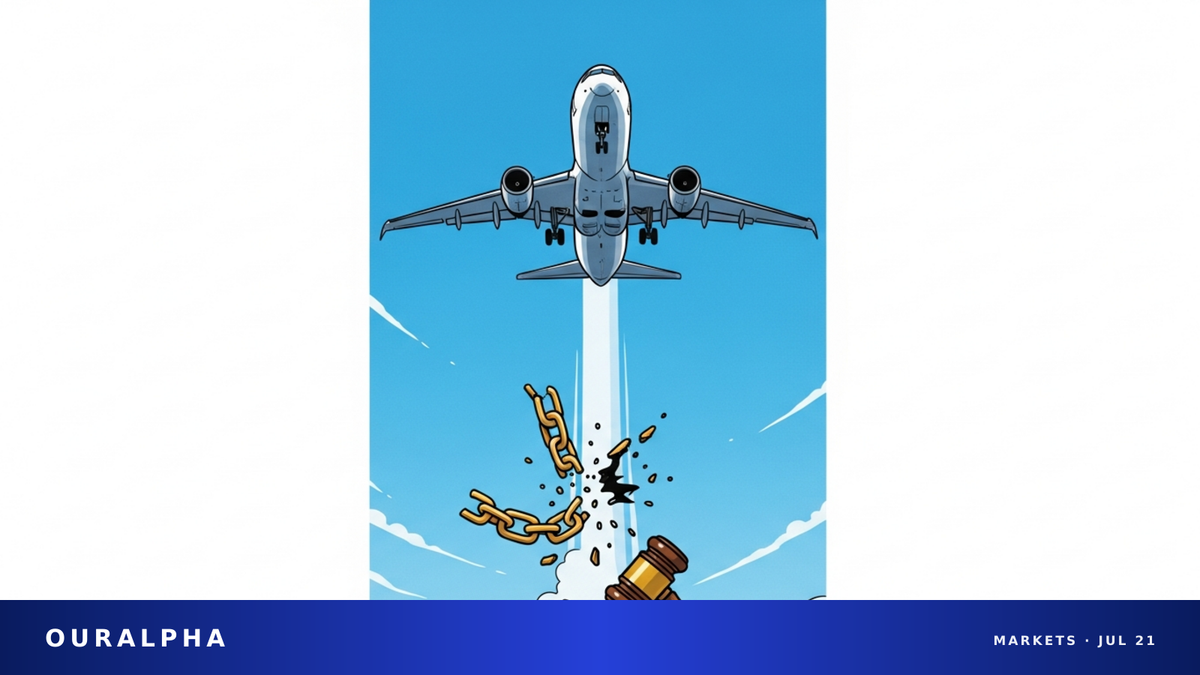
Boeing Wins Key Shareholder Suit as Appeals Court Tosses Class Action
A federal appeals court decertified the shareholder class action against Boeing over the 737 MAX 9 door-plug blowout, a major legal win for the company. Shares closed at $209.48, down 2.13%.
A U.S. federal appeals court has decertified the shareholder class action against Boeing (BA) tied to the January 2024 Alaska Airlines 737 MAX 9 door-plug blowout. As of the close of trading on July 20, Boeing shares were at $209.48, down 2.13% from the prior close.
- The U.S. Court of Appeals for the Fourth Circuit ruled on July 20 to overturn the lower court's certification of the shareholder class action.[Reuters]
- The suit alleged Boeing made false statements to investors about aircraft safety before the 737 MAX 9 door-plug blowout.[Law360]
- The ruling means shareholders cannot sue Boeing as a group, though individual lawsuits can still proceed.[Reuters]
- As of the close of trading on July 20, Boeing (BA) was at $209.48, down 2.13% (-$4.55), with an intraday low of $208.70.
The U.S. Court of Appeals for the Fourth Circuit ruled Monday (July 20) to decertify the shareholder class action against Boeing (BA). The suit stemmed from the January 2024 in-flight door-plug blowout on an Alaska Airlines 737 MAX 9, with shareholders alleging Boeing made false and misleading statements about aircraft safety before the incident.[Reuters] The legal development is a significant win for Boeing. As of the close of trading on July 20, Boeing shares were at $209.48, down 2.13% (-$4.55) from the prior close of $214.03, with an intraday range of $208.70 to $216.73.
Appeals Court Overturns Class Certification
A three-judge panel of the U.S. Court of Appeals for the Fourth Circuit ruled to overturn the certification of the shareholder class action previously granted by the U.S. District Court for the District of Maryland, according to Reuters.[Reuters] Legal publication Law360 reported the ruling reversed the court order that had allowed shareholders to sue Boeing as a group.[Law360] The appeals court's decision means shareholders cannot pursue damages collectively, though individual shareholders can still file separate lawsuits. The court's full opinion has not been publicly released, but the ruling is a clear positive for Boeing.
Suit Background: The MAX 9 Door-Plug Blowout
The core event behind the class action was the harrowing incident on Alaska Airlines Flight 1282 on January 5, 2024. A brand-new Boeing 737 MAX 9 was flying at roughly 16,000 feet when a door plug on the left side of the fuselage blew out, leaving a gaping hole in the plane's side and causing a rapid cabin decompression. The aircraft returned safely, with no serious injuries.[Reuters] The event triggered intense scrutiny from regulators, Congress, and investors. Shareholders then filed suit, alleging Boeing and its executives knew of manufacturing quality issues but continued to assure the market of the 737 MAX family's safety, misleading investors while the stock was trading at elevated levels.
Market Reaction and Stock Performance
Despite the legal victory, Boeing shares still closed lower on the day. According to real-time data, Boeing (BA) opened at $216.18, hit a high of $216.73 and a low of $208.70, before closing at $209.48, down 2.13% from the prior day's close of $214.03.[Reuters] Analysts noted the decline likely reflects ongoing investor concerns about Boeing's broader business outlook, including production and delivery cadence, regulatory scrutiny, and potential liabilities. While the decertification removes one legal overhang, Boeing still faces multiple other lawsuits and investigations related to the MAX 9 incident.
Analyst and Legal Observer Views
Legal observers widely view the Fourth Circuit's ruling as a significant legal victory for Boeing. Class certification typically creates immense settlement pressure on defendant companies due to the potential for massive damages. Decertification substantially reduces Boeing's overall financial exposure in this case.[Law360] However, legal experts caution that Boeing is not entirely off the hook. Individual investors can still file personal lawsuits, though these are far smaller in scale and impact than a class action. Boeing also continues to face a criminal investigation by the U.S. Department of Justice (DOJ) and intense oversight from the Federal Aviation Administration (FAA).
Sources
This content is for informational purposes only and does not constitute investment advice, trading advice, or any guarantee of returns.