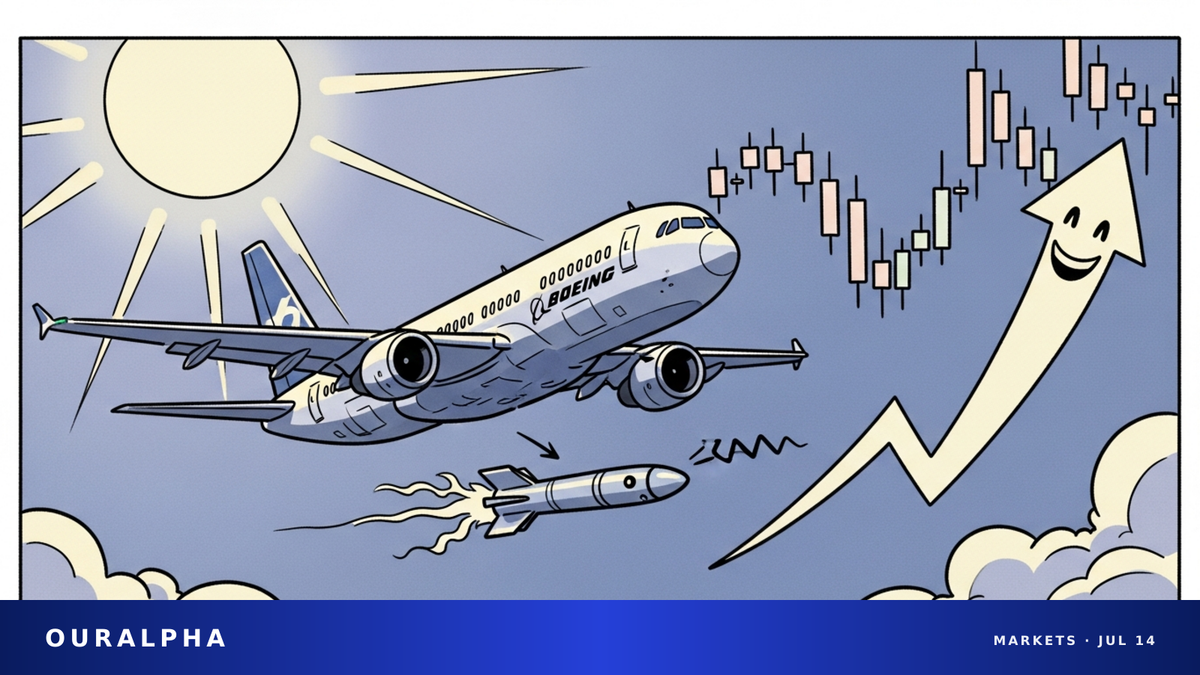
Boeing Drops 3% After Hours as Iran Conflict Escalates — Why Defense Stocks Aren’t Rallying

Iran launched missiles at US bases in Jordan and Bahrain over the weekend and claimed to have closed the Strait of Hormuz. Yet defense stocks like Boeing fell 3% after hours, as depleted munitions stockpiles and a lack of congressional funding overshadow the geopolitical flashpoint.

Boeing stock down after hours amid Iran conflict escalation
Geopolitical tensions escalate but defense stocks fail to rally, with Boeing sliding over 3% after hours.

The US-Iran conflict escalated sharply over the weekend, with Iran striking US military bases and claiming to have closed the Strait of Hormuz. But defense stocks didn’t get the expected boost. As of 6:00 PM ET on July 13, Boeing (BA) traded at $215.51 after hours, down 3.05% from its prior close of $222.28.

  • Boeing (BA) was at $215.51 after hours, down 3.05%, after hitting an intraday low of $215.11.
  • Iran launched missiles and drones at US military facilities in Jordan and Bahrain over the weekend, widening the conflict.[Crypto Briefing]
  • Iran’s Revolutionary Guard claimed to have closed the Strait of Hormuz, but President Trump denied it, saying the waterway remains open to commercial shipping.[Investing.com]
  • Brent crude rose over 3.5% to $78.68 on Monday, while WTI crude gained 3.47% to $73.89, as energy markets swung sharply.[Marine News]
  • US munitions stockpiles are severely depleted from earlier conflicts. CSIS analysis shows THAAD interceptors are more than half gone, Patriot interceptors nearly half gone, and Tomahawk missiles about 30% depleted.[CNN]
  • Congress has yet to appropriate funds to replenish munitions, and defense industrial capacity is expanding slowly. Analysts estimate it will take 2 to 5 years to rebuild inventories.[CNN]

The US-Iran conflict escalated sharply over the weekend, with Iran launching missile strikes on US bases in Jordan and Bahrain and claiming to have closed the Strait of Hormuz, the world’s most critical oil transit chokepoint. Yet this geopolitical flashpoint didn’t lift defense stocks the way conventional logic would suggest. As of 6:00 PM ET on July 13, aerospace and defense giant Boeing (BA) traded at $215.51 after hours, down 3.05% from its prior close of $222.28, after hitting an intraday low of $215.11. Broader market sentiment also took a hit: S&P 500 futures fell 0.3%, and Nasdaq 100 futures widened losses to 1%, led lower by a selloff in Asian chip stocks.[Investing.com]

Conflict Escalates, Strait of Hormuz in Focus

Over the weekend, US Central Command announced a fresh wave of strikes on dozens of targets inside Iran, aimed at weakening Iran’s ability to threaten shipping.[Investing.com] In response, Iran’s Revolutionary Guard attacked US military facilities in Kuwait and Bahrain on Sunday and claimed to have closed the Strait of Hormuz.[Marine News] Iran also fired missiles and drones at Prince Hassan Air Base in Jordan and the US Fifth Fleet in Bahrain, marking a significant expansion of the conflict.[Crypto Briefing]

President Trump denied the closure claim on Sunday, insisting the waterway remains open to commercial shipping.[Investing.com] Trump had previously declared the ceasefire with Iran “over” on Friday.[CNN] Despite the tensions, Trump also indicated that Iran has proactively sought more dialogue.[Investing.com]

The status of the Strait of Hormuz has become the market’s biggest geopolitical risk. According to Marine News, the strait handled roughly one-fifth of the world’s oil and liquefied natural gas supply daily before the conflict erupted. On Sunday, the number of vessels transiting the strait fell to a five-week low, with just six ships passing through.[Marine News] The International Energy Agency’s (IEA) monthly report released Friday showed that while global oil supply rose by 4.1 million barrels per day in June due to a temporary agreement, it remains 9.4 million bpd below pre-war levels.[Marine News]

Oil Surges, Defense Stocks Slide

The escalation directly pushed energy prices higher. On Monday, Brent crude futures rose 3.51% to $78.68/barrel, while US WTI crude futures gained 3.47% to $73.89/barrel.[Marine News] ANZ analysts noted: “Shipping operators are taking a cautious approach, with inbound vessel traffic already slowing amid heightened security concerns.”[Marine News]

Yet the defense sector didn’t benefit from this conflict. Boeing shares fell 3.05% in after-hours trading, even as the S&P 500 rose 1.2% and the Nasdaq Composite gained 1.7% last week, with the market seemingly “looking through” the news of the ceasefire collapse.[Barron's] Investing.com noted that Wall Street may have “seen through” the end of the ceasefire, as the US simultaneously indicated it is still negotiating with Iran.[Investing.com]

Munitions Stockpiles Depleted, Long Road to Rebuild

A key reason defense stocks failed to rally may lie in the grim reality of US munitions inventories. According to CNN, by the time full-scale fighting stopped in April, the Pentagon had consumed at least half of its THAAD ballistic missile interceptors, nearly half of its Patriot air-defense interceptors, and roughly 30% of its Tomahawk land-attack missiles.[CNN] The Center for Strategic and International Studies (CSIS) confirmed these figures, and CNN verified them through three sources familiar with internal Pentagon inventory estimates.[CNN]

Even more concerning is the slow pace of replenishment. CSIS defense analyst and retired Marine Colonel Mark Cancian noted that, based on current fiscal year delivery schedules, the Pentagon receives only about 15 new Tomahawk missiles and 20 new Patriot missiles per month, with no THAAD deliveries scheduled for 2026. CSIS estimates it will take three years or longer to restore these inventories to pre-war levels.[CNN] Elaine McCusker, a senior fellow at the American Enterprise Institute (AEI) and former Pentagon deputy comptroller and acting comptroller, told CNN, “The rebuild timeline for most munitions will be measured in years — most will take 2 to 5 years.”[CNN]

Congressional Funding Missing, Industrial Capacity Slow

The biggest obstacle to replenishing munitions is funding. AEI defense procurement expert and retired two-star Army General John Ferrari stressed that since the war began, “Congress has not appropriated a single dollar to replace a single missile,” relying only on “normal, slow peacetime annual processes.”[CNN] The White House recently submitted a formal request to Congress for supplemental funding to cover the costs of the Iran conflict (and some unrelated programs), but the bill faces significant hurdles on Capitol Hill.[CNN]

Although Trump invoked the Defense Production Act in June to remove regulatory hurdles and accelerate missile production, and the Pentagon has signed agreements with manufacturers to expand production lines, the impact has been limited. Cancian said invoking the DPA “helps” but “the effect will be small” because expanding capacity takes time.[CNN] A Pentagon official told CNN the department is “committed to rapidly expanding the defense industrial base” and is “actively pursuing and integrating American innovation, wherever it resides, to achieve production at scale and enhance supply chain resilience.”[CNN]

Michael O’Hanlon, director of foreign policy research at the Brookings Institution, said stockpile levels are “unquestionably” “lower than we would like.”[CNN] Experts warn that if the conflict continues at its current pace, it will erode the US military’s ability to fight potential future wars, such as against China or North Korea.[CNN]

This content is for informational purposes only and does not constitute investment advice, trading advice, or any guarantee of returns.

Keep Reading

Intel’s $5.7B Ireland Fab Expansion Fails to Impress, Shares Slide 6% After Hours

Intel’s $5.7B Ireland Fab Expansion Fails to Impress, Shares Slide 6% After Hours

Intel (INTC) announced a $5.7 billion capital investment to expand its wafer fabrication facility in Ireland, aiming to boost advanced process capacity. Yet the stock tumbled in after-hours trading on the news.

  • Investment size: Intel announced a $5.7 billion capital investment in its Irish manufacturing hub.[Reuters]
  • Stock performance: As of 9:00 PM ET on July 13, Intel was trading at $103.12 after hours, down 6.12% from its prior close of $109.84.[Design and Development Today]
  • Government support: The
Read full story →

Stay ahead of the market — never miss a deep dive

Follow OurAlpha for AI-driven US equity research and market insight, every day.