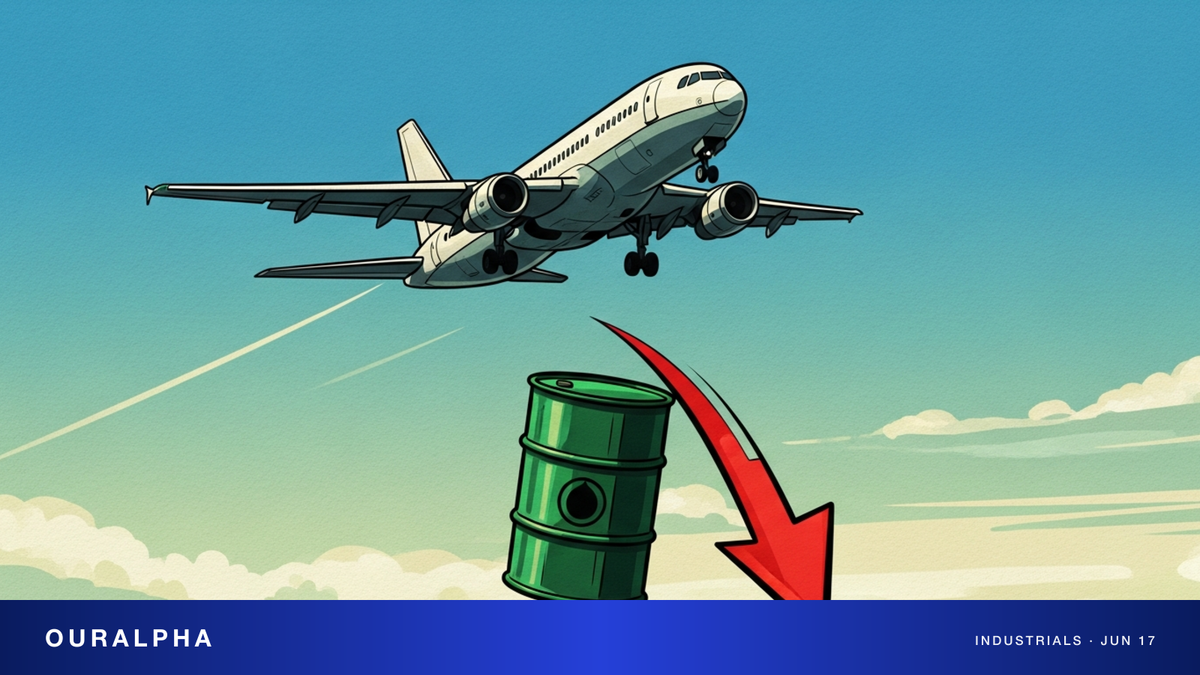
Oil Price Plunge Sends Boeing Up ~4.5% in a Single Session

Boeing surged ~4.5% on June 16 after a U.S.-brokered Middle East peace deal triggered a 5%+ oil price drop — cheaper fuel means healthier airline margins, and healthier airlines buy more planes. Here's how the transmission mechanism works.

Oil price drop lowers airline fuel costs, boosting Boeing stock
Boeing doesn't burn jet fuel — but when oil falls, the logic runs straight through the airlines' income statements.

Bottom line: On Tuesday, June 16, Boeing (BA) shares rose ~4.5%, with the move widely attributed to a U.S.-announced Middle East peace deal that is expected to reopen the Strait of Hormuz — sending oil prices sharply lower and brightening the profit outlook for airlines, which in turn benefits Boeing's order and delivery pipeline.

  • Move: BA up roughly 4.4%–4.5% intraday
  • Catalyst: U.S.-brokered peace deal set to reopen the Strait of Hormuz
  • Oil: crude fell more than 5% on the day
  • Transmission: lower oil → lower airline fuel costs → better margins → more capacity to order and accept aircraft on schedule

Boeing (BA) climbed roughly 4.5% during afternoon trading on Tuesday, June 16. The rally was broadly linked to a U.S.-government-announced Middle East peace agreement expected to reopen the Strait of Hormuz, which drove a sharp sell-off in crude oil.[FinancialContent]

How Oil Prices Flow Through to Boeing

Boeing is an aircraft manufacturer, not a fuel consumer — so why does a drop in crude move its stock? The reported logic runs through airline profitability:

  • Geopolitical thaw: the U.S.-brokered deal opens the Strait of Hormuz
  • Oil sell-off: crude falls more than 5% on the day
  • Cost relief: lower jet fuel prices directly reduce one of airlines' largest operating expenses
  • Margin recovery: airlines with healthier bottom lines are more likely to place new orders and take deliveries on schedule
  • Boeing wins: stronger airline demand translates into improved order and delivery prospects for the manufacturer

For context, IATA has estimated the industry's 2026 fuel bill could exceed $350 billion, up from roughly $252 billion the prior year. Against that backdrop, the peace-deal-driven drop in oil is seen as meaningful cost relief for carriers — relief that travels up the supply chain directly to Boeing.[FinancialContent]

Broader Market Context

Boeing's gain came on a split tape. The Dow Jones Industrial Average closed up 0.64% on June 16, notching a fresh all-time high, while the Nasdaq fell 1.15% as tech sold off. As a Dow component, Boeing moved with the day's rotation into industrial and value names.[TheStreet]

There was also some analyst-level tailwind: according to ad-hoc-news, at least one investment bank held an optimistic view on Boeing.[ad-hoc-news] That said, the primary catalyst for the day's move was broadly attributed to the geopolitical de-escalation and the resulting oil price decline. Note that single-day percentage moves can vary slightly depending on the measurement window; the figures cited here reflect intraday levels.

What to Watch Next

Key follow-through items for Boeing: whether the geopolitical calm and lower oil prices hold; whether airlines respond to improved margins by ramping capex and new orders; and Boeing's own delivery cadence and production recovery trajectory. This article documents the day's move and its reported market attribution — oil prices and geopolitical developments remain uncertain, and no forward judgment on the stock is implied.

This content is for informational purposes only and does not constitute investment advice, trading advice, or any guarantee of returns.

Keep Reading

Alphabet’s Antitrust Headache Deepens: Sweden Orders $1.5B Payout to Klarna, South Korea Opens New Probe

Alphabet’s Antitrust Headache Deepens: Sweden Orders $1.5B Payout to Klarna, South Korea Opens New Probe

Alphabet edged higher in early trading Tuesday, but antitrust pressure is building. A Swedish court ordered Google to pay Klarna $1.5 billion in damages, while South Korea’s antitrust watchdog launched a fresh probe.

  • Price action: As of 9:30 a.m. ET on July 1, Alphabet (GOOGL) was at $357.98, up 0.17% (+$0.61) from Friday’s close of $357.37. Opened at $358.38, with an intraday range of $357.89–$358.39.
  • Swedish verdict: The Stockholm District Court ruled
Read full story →

Stay ahead of the market — never miss a deep dive

Follow OurAlpha for AI-driven US equity research and market insight, every day.