ByteDance Taps Qualcomm to Bring Its Own AI Chip to Production — The Third Crack in NVIDIA's Hyperscaler Story
Bloomberg reported May 26 that ByteDance has completed a self-designed AI chip and signed Qualcomm to help take it to mass production — the latest sign that hyperscalers are systematically diluting their dependence on NVIDIA, not abandoning it.
TL;DR
Bloomberg reported May 26 that ByteDance has completed the design of a proprietary AI chip and signed Qualcomm (QCOM) to help bring it to mass production. This is the third visible crack in the hyperscaler-buys-GPUs narrative — after Google's TPU and Amazon's Trainium — and it means NVIDIA's (NVDA) single-supplier status is being systematically diluted by its most important customers.
- Source: Bloomberg 5/26; ByteDance has not publicly confirmed details
- Structure: ByteDance owns the chip design IP; Qualcomm provides productionization — QCOM is not selling chips to ByteDance
- Scale: ByteDance is one of China's largest AI training compute buyers; custom silicon maps directly to reduced H20/B100 demand
- NVDA read-through: single-customer concentration erodes, but total addressable market continues to expand as new buyers enter
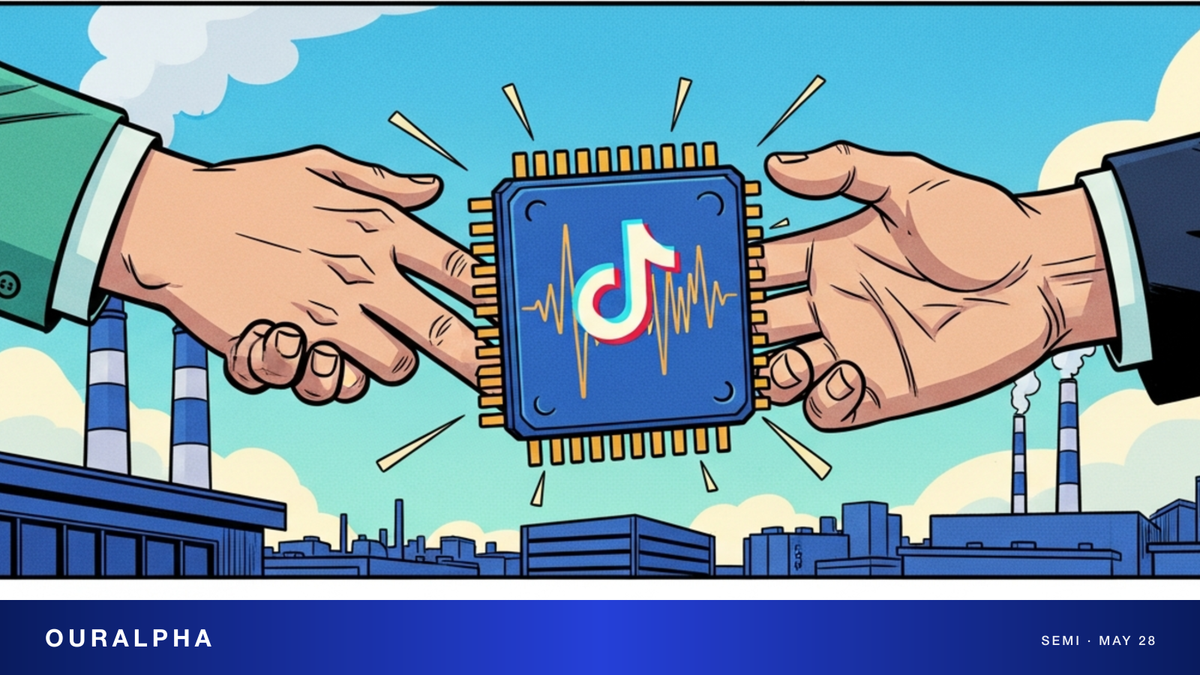
Bloomberg reported May 26 that ByteDance (TikTok's parent) has finished designing its own AI chip — and has inked a deal for Qualcomm (QCOM) to help take that design from blueprint to volume production. Qualcomm isn't selling ByteDance a chip. ByteDance owns the IP; Qualcomm is providing the industrialization muscle to get it into production.
ByteDance is one of China's largest consumers of AI training compute — the appetite from Douyin/TikTok's recommendation engine, the Doubao LLM, and a raft of internal AI projects is enormous. With US export controls capping NVIDIA's top-end chips (B200/B300) from shipping to China and the available H20 being a substantially nerfed product, pursuing custom silicon is a rational call for a company of ByteDance's scale.
But the real story here goes beyond "Chinese customer works around export controls." This is the third visible crack in the hyperscaler custom-silicon wave.
Three Cracks, Read Together
The custom AI chip buildout among hyperscalers over the past 18 months:
| Customer | Custom Chip | Production Path | Status |
|---|---|---|---|
| TPU v5 / v6 | Broadcom (AVGO) + TSMC (TSM) | 6+ years in production; ~50% of internal AI workloads run on TPU | |
| Amazon | Trainium 2 / Inferentia | Annapurna Labs (in-house design) + TSMC | 2–3 years in production; internal share rising |
| Meta | MTIA (Meta Training and Inference Accelerator) | In-house + Broadcom collaboration + TSMC | Second-gen in production; inference-focused |
| Apple | M / A series + server-side AI silicon | In-house design + TSMC | M series mature; server AI chip targeting 2026 production |
| Microsoft | Maia AI / Cobalt CPU | In-house design + TSMC | First-gen deployed on Azure; iterating |
| ByteDance (new) | Unnamed proprietary AI chip | ByteDance design + Qualcomm productization | Disclosed by Bloomberg 5/26; production timeline unspecified |
Look at all six together and the picture is clear: the era when every major hyperscaler was purely an NVIDIA customer is slowly turning the page. Each of NVIDIA's most important accounts is running some version of a self-sufficient compute strategy, treating NVDA as a supplemental supplier rather than the only one.
What This Means for NVDA — Two Layers
Laying it out honestly:
Layer one: single-customer concentration is being diluted. NVDA has pulled 60%+ of its revenue from hyperscalers over the past 24 months. Every chip those customers design in-house is dollars that don't flow to NVIDIA — ranging from hundreds of millions to tens of billions per customer depending on deployment scale. Google, Amazon, and Meta's custom silicon already accounts for an estimated 30–50% of their internal AI compute — meaning NVIDIA's theoretical ceiling with those accounts has already been compressed. ByteDance is one more name on that list.
Layer two: the total AI compute TAM is still expanding. Over that same 18-month window, new classes of AI compute buyers have been accelerating into the market:
- Sovereign AI buildouts (Saudi Arabia, UAE, India, Japan, South Korea and other national-scale AI infrastructure projects)
- Mid-market enterprises running their own AI workloads — not hyperscalers, but real buyers
- GPU cloud operators (CoreWeave, Lambda, Crusoe, Nebius and peers)
- Global research institutions and universities
- Autonomous vehicle, robotics, and biopharma companies
Can this wave of new demand offset the share being carved out by hyperscaler custom silicon? For now, yes — BofA's May 27 upgrade of the 2026 global semiconductor TAM to $1.3T rests partly on exactly this logic.
Net impact: NVDA's revenue growth is now anchored to two competing variables — the pace of hyperscaler in-housing (a headwind) versus the rate of new-customer entry (a tailwind). At the moment the tailwind is winning, as Q1 FY27 data center revenue growing +92% YoY demonstrates. But the growth rate will gradually normalize — from the +90%+ range toward +40–50% YoY — as the in-housing trend matures.
ByteDance's Custom Silicon and the China-Specific Layer
This story carries China-specific factors that go beyond the standard hyperscaler playbook.
First, export controls are forcing Chinese customers to self-develop. NVIDIA's top-end chips (B100/B200/B300) face hard limits on China shipments, and the available H20 is significantly performance-constrained. For a buyer of ByteDance's scale, building proprietary silicon is more attractive than scaling on a hobbled product.
Second, ByteDance went to Qualcomm, not Huawei HiSilicon. That detail matters. Huawei's Ascend series is the flagship Chinese AI chip, but it's bottlenecked by SMIC's 7nm yield instability. Qualcomm fabs through TSMC, which means ByteDance gets access to stable advanced-node capacity. The path ByteDance has chosen is effectively "Chinese design IP + global leading-edge foundry" — a pragmatic hybrid that sidesteps the domestic fab constraints.
Third, the upside for QCOM is being underappreciated. Qualcomm isn't selling chips here, but the design services fees and back-end integration work are not trivial. QCOM has been actively looking to grow beyond mobile baseband SoCs, and AI chip productization is a meaningful new vector. QCOM is outside OurAlpha's coverage universe, so we won't size it here — but it's worth flagging.
What to Watch
1. ByteDance's actual production timeline. The Bloomberg report contains no specific dates. If volume production hits in H2 2026, the market will immediately quantify it into NVDA's forward models.
2. Whether other Chinese hyperscalers accelerate their own programs. Alibaba, Tencent, and Baidu all have custom chip projects in flight. The current environment gives each of them more reason to push toward production faster.
3. NVDA's next China revenue disclosure. The Q2 FY27 earnings report (late August) will include a data center revenue breakdown. If China's share continues to shrink, ByteDance-type programs are the medium-term structural cost.
4. Qualcomm's AI business disclosure. QCOM reports late July and will break out its Auto + AI segment. That's the most direct read on the economic value of the ByteDance partnership.
The most important takeaway for investors: hyperscaler custom silicon is not an NVDA death knell — it is the marker of NVDA growth normalization. Reading this news as a "NVDA has peaked" signal is an overreaction. But stacked alongside the other in-housing moves of the past 18 months — Google TPU share gains, Amazon Trainium 2, Meta MTIA second-gen — it suggests that NVDA's transition from +90% YoY growth to +40–50% YoY growth could arrive 6–12 months sooner than the consensus currently expects.
Sources
- Qualcomm strikes AI chip deal with ByteDance — Bloomberg via WIFC
- Custom AI ASICs Examined: Broadcom, Google TPU, Meta MTIA — Tom's Hardware
- Qualcomm to Help ByteDance Bring Self-Designed AI Chip to Production — Bloomberg
- China AI Chip Self-Sufficiency Push Accelerates — Reuters
- NVIDIA Q1 FY2027 Earnings Disclosure — SEC EDGAR
This content is for informational purposes only and does not constitute investment advice, trading advice, or any guarantee of returns.