Chips Lead Wall Street's Rebound From the Fed-Driven Selloff — HBM and AI Capex Remain the Story

US stocks bounced back June 18 with semiconductors in the lead, recovering from a Fed-hawkish selloff that had dragged the Dow down ~500 points days earlier. HBM supply and AI capex remain the dominant chip-sector narrative heading into Micron's earnings.

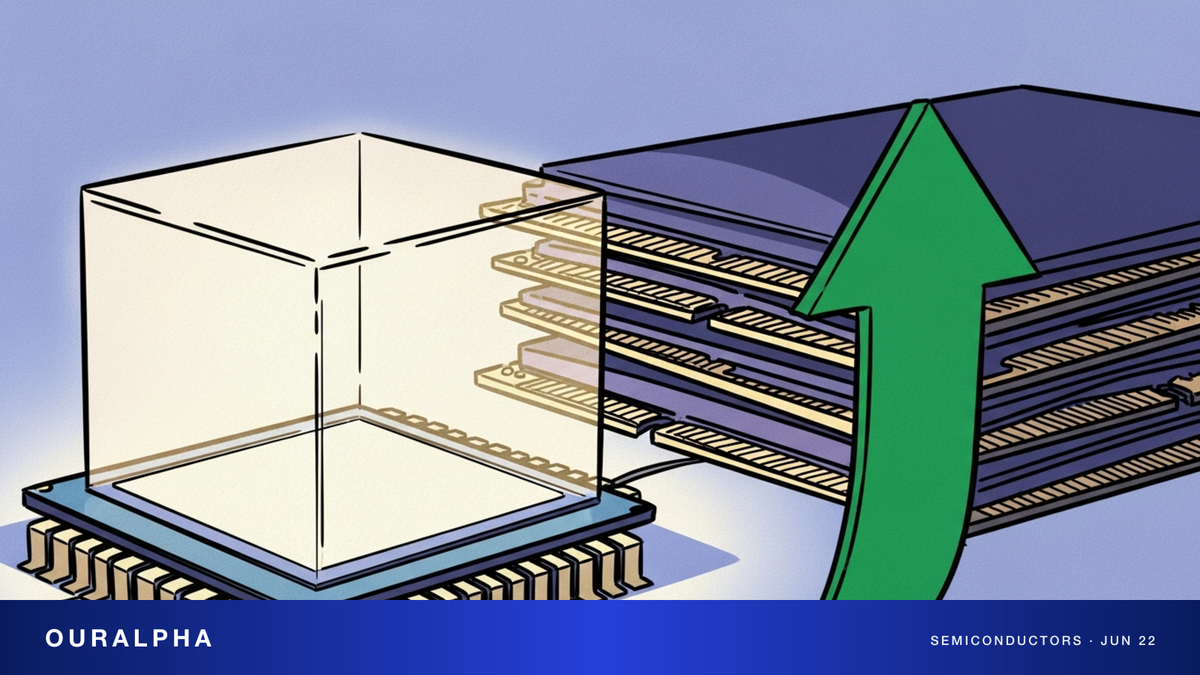
Semiconductor stocks lead US market rebound — processor chip with upward arrow — OurAlpha
The same small chip that's been driving AI demand pulled the broader market back from the selloff.

Bottom line: US stocks closed higher across the board on June 18, led by chips, bouncing back from a Fed-hawkish selloff earlier in the week. HBM and AI capex remain the market's central narrative.

  • The Dow closed at 51,564.70, up 0.14%; the S&P 500 gained 1.08%; the Nasdaq surged 1.91%; small-cap Russell 2000 also rose.
  • For the full prior week, the Nasdaq led major indexes with a cumulative gain of ~2.43%.
  • Market narrative centers on HBM (High Bandwidth Memory) and AI capex, with NVDA and Micron (MU) as the bellwether names.
  • Micron said its HBM capacity is sold out through end of 2026, and its HBM4 36GB 12-Hi product has entered mass production.
  • Micron reports earnings after the close on June 24 — the chip sector's key event this week.
  • Context: On June 16–17, a hawkish Fed pivot sent stocks sliding, with the Dow dropping ~500 points on June 16.

US stocks closed broadly higher on June 18, with the technology and semiconductor sectors leading the charge as markets recovered from a two-day selloff triggered by a hawkish Federal Reserve. According to TheStreet and other outlets, tech and chip stocks were the primary drivers on the day, with sentiment stabilizing after back-to-back losses[TheStreet]. This piece sticks to the facts: a recap of June 18 and the prior week's price action, the chip sector's prevailing narrative, and what to watch this week — no forecasts.

June 18: All Three Major Indexes Close Higher

Based on publicly available market data, here's how the major US indexes finished on June 18:

  • The Dow Jones Industrial Average closed at 51,564.70, up 0.14%;
  • The S&P 500 gained 1.08%;
  • The Nasdaq Composite — heavily weighted toward tech — rose 1.91%;
  • The small-cap Russell 2000 also closed higher[Trading Economics].

The divergence in performance tells the story: the Nasdaq's 1.91% gain dwarfed the Dow's 0.14% advance, with the S&P 500's 1.08% sitting in between. That "Nasdaq leads, Dow lags" spread signals a rebound driven by tech and semiconductors rather than a broad-based rally. The Russell 2000's participation does indicate some spillover in risk appetite into small caps. To be clear, this piece doesn't report unverified intraday moves for individual stocks; at the sector level, multiple outlets identified semiconductors as the day's leading group, with Nvidia (NVDA) and Micron Technology (MU) cited as standout names[TheStreet].

Context: The Fed-Driven Selloff That Set Up the Bounce

The June 18 rebound needs to be read against what came before it. According to CNBC, a hawkish shift in Fed communication on June 16–17 put pressure on equities, with the Dow shedding roughly 500 points on June 16 alone[CNBC].

So June 18's gains were, in sequence, a partial recovery from that hawkish-Fed-driven drawdown — chips leading the broader market back up, not stocks simply trending higher in isolation. Both headwinds (a more hawkish Fed, tighter rate expectations) and tailwinds (chip sector strength, a recovery in risk sentiment) were present within the same short window, producing a "down first, then up" pattern across the week's early sessions.

For investors tracking US equities, the key distinction here is that Fed policy signals are a macro-level variable affecting broad market valuations, while chip sector strength is being driven by its own industry-specific narrative. These two forces can offset or amplify each other over short timeframes. This piece simply notes that both were in play simultaneously — no call on which prevails going forward.

Prior Week: Nasdaq Leads the Pack

Zooming out to the full prior week, the pattern held: tech outperformed. The Nasdaq Composite led major indexes for the week, posting a cumulative gain of approximately 2.43%[Trading Economics].

That weekly performance is consistent with June 18's intraday sector structure: after a mid-week pullback on Fed hawkishness, tech and semiconductors were the primary contributors to index gains for the week[CNBC]. One distinction worth making: the weekly return is a net figure — it incorporates both the June 16–17 drops and the June 18 rebound. It does not reflect a steady grind higher throughout the week.

That ~2.43% Nasdaq weekly gain is the arithmetic result of "mid-week decline plus Friday rebound," not a signal of uniformly positive sentiment across all five sessions. For anyone reading market recaps, it's worth keeping that distinction in mind: the same positive weekly return can reflect either a smooth uptrend or a sharp drop followed by a sharp recovery — and the two carry very different implications.

The Dominant Narrative: HBM and AI Capex

The thesis underpinning the chip sector's current market attention comes down to two threads: HBM (High Bandwidth Memory — the high-speed stacked memory used in AI accelerators) and AI capex (the capital expenditure companies are deploying to build out AI compute infrastructure). Nvidia (NVDA) and Micron (MU) are the two names most often cited in this context.

On the memory supply side, Micron has disclosed several HBM-related data points. The company has stated that its HBM capacity is sold out through the end of 2026 — meaning its high-end memory output is already committed across the visible horizon. It has also announced that its HBM4 36GB 12-Hi product has entered mass production. Markets are treating these disclosures as read-throughs on AI memory demand and supply tightness.

On the demand side, AI capex is the other recurring thread. The logic: training and inference for large AI models require massive quantities of accelerators and the memory that goes with them. Nvidia's GPUs run on HBM, so when AI capex is in an expansion cycle, upstream suppliers like Micron are seen as direct beneficiaries. Micron's "sold out through 2026" comment lands squarely within that framework.

A caveat: the capacity and product timeline details above are Micron's own statements — the company's characterization of its own situation, not independently audited industry data. The actual trajectory of HBM demand and AI capex will need to be validated by subsequent industry data and quarterly results from Nvidia, Micron, and their peers. This piece makes no directional call, and no judgment on whether any stock is fairly valued.

This Week's Focus: Micron Earnings on June 24

The most immediate catalyst for the chip sector this week is Micron's (MU) earnings release. According to the earnings calendar, Micron reports after the close on June 24[Kiplinger].

As the representative HBM and memory chip supplier, Micron's commentary on HBM supply/demand dynamics, capacity bookings, and AI memory demand will be closely watched as a real-world check on the chip sector's current narrative. Until the numbers are out, expectations remain unverified and the outcome is uncertain. This piece offers only factual context on timing and relevance — no prediction on the print or the stock's reaction.

Recap: Just the Facts

To sum up: after the Dow shed ~500 points on June 16–17 in response to a hawkish Fed, US stocks bounced back on June 18 with chip stocks in the lead — all three major indexes closed higher, and the Nasdaq outperformed both on the day and for the prior week. HBM and AI capex remain the dominant narratives supporting chip sector attention, and Micron's June 24 after-close earnings report is this week's direct catalyst.

A final reminder: the price moves described above are settled historical facts; the future trajectory of HBM demand, AI capex, and Micron's June 24 results remain open questions. This piece has reported only on what has already happened and what companies have already disclosed — no sector or stock calls. For any investment decision, primary sources — company filings and authoritative market data — should be the baseline.

This content is for informational purposes only and does not constitute investment advice, trading advice, or any guarantee of returns.

Keep Reading

Alphabet’s Antitrust Headache Deepens: Sweden Orders $1.5B Payout to Klarna, South Korea Opens New Probe

Alphabet’s Antitrust Headache Deepens: Sweden Orders $1.5B Payout to Klarna, South Korea Opens New Probe

Alphabet edged higher in early trading Tuesday, but antitrust pressure is building. A Swedish court ordered Google to pay Klarna $1.5 billion in damages, while South Korea’s antitrust watchdog launched a fresh probe.

  • Price action: As of 9:30 a.m. ET on July 1, Alphabet (GOOGL) was at $357.98, up 0.17% (+$0.61) from Friday’s close of $357.37. Opened at $358.38, with an intraday range of $357.89–$358.39.
  • Swedish verdict: The Stockholm District Court ruled
Read full story →

Stay ahead of the market — never miss a deep dive

Follow OurAlpha for AI-driven US equity research and market insight, every day.