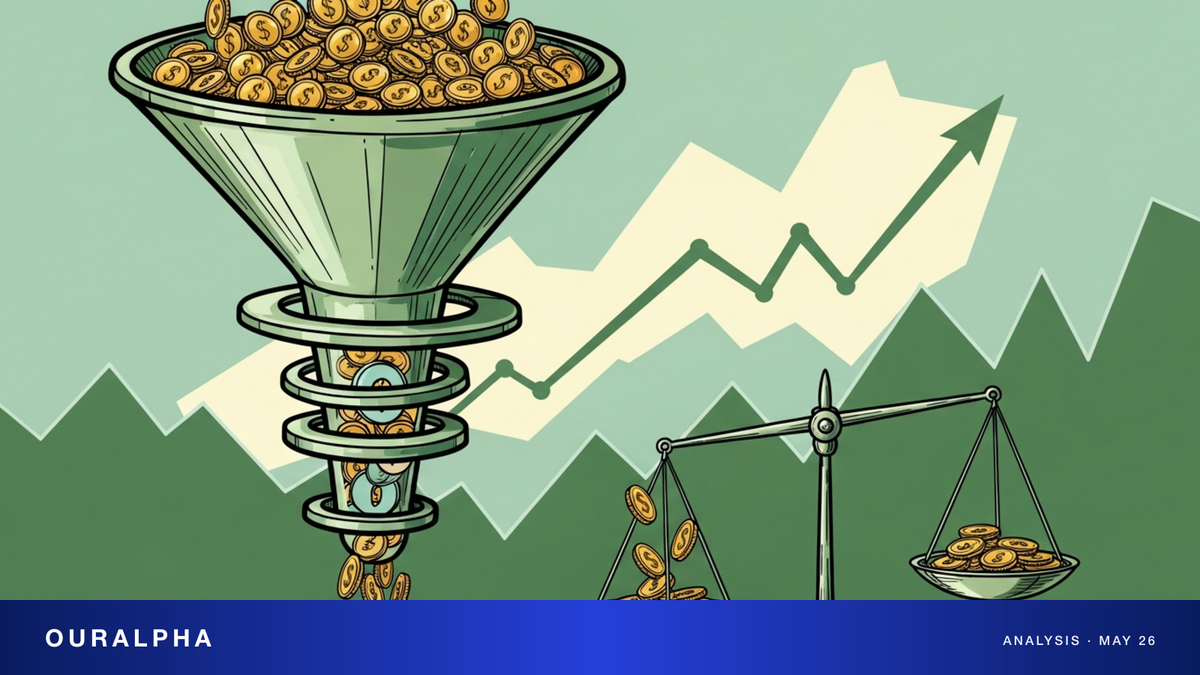
Agentforce Reality Check: Three Hurdles Stand Between $800M ARR and GAAP Profit

Salesforce's Agentforce posted $800M in ARR and 29,000 contracts — the most-cited figures in AI agent commercialization. But clearing three structural hurdles separates those numbers from real GAAP profit, and the most optimistic timeline puts meaningful earnings impact in FY28.

Salesforce Agentforce ARR to GAAP profit financial model analysis
The market doesn't need more AI agent narratives — it needs hard evidence that agents land on the GAAP income statement.

TL;DR · The One-Line Take

Salesforce (CRM) Agentforce posted $800M in ARR and 29,000 cumulative contracts last quarter — the two most-cited figures in AI agent commercialization. But turning ARR into real GAAP profit means clearing three hurdles: contract recognition timing, gross margin compression, and actual agent utilization. This piece breaks down how long each one takes.

  • $800M ARR ≠ $200M quarterly revenue — SaaS contract recognition carries a 6–12 month lag
  • In Agentforce's per-agent cost structure, OpenAI/Anthropic model fees consume 30–40% of gross margin
  • Of 29,000 signed contracts, "actually deployed + monthly active" may represent only 40–60%
  • Real GAAP profit from that ARR? The most optimistic estimate: FY28 (early 2027)

The two most-cited numbers in AI agent commercialization since early 2026: Salesforce's (CRM) Agentforce $800 million in annualized recurring revenue and 29,000 cumulative contracts, both disclosed last quarter.

But neither figure answers the question that actually matters: when does that $800M ARR translate into real profit on the GAAP income statement? Without a clear answer, Salesforce's 32% year-to-date decline is hard to reverse. This piece runs the financials through three checkpoints — ARR to revenue, revenue to gross profit, gross profit to GAAP earnings.

How the $800M ARR Number Is Calculated

Start with what ARR actually means.

ARR = the annualized total of all active SaaS contracts at a point in time. If Salesforce signs a three-year, $15M Agentforce deal with an enterprise client — $5M per year — that adds $5M to ARR. Sum all such contracts and you get last quarter's $800M figure.

Two things to keep in mind:

First, ARR and "cash actually received" are very different. In a three-year contract, some clients pay upfront, others pay quarterly. GAAP revenue must be recognized ratably over the actual service period — meaning a contract signed today gets spread across 36 months, 12 quarters of revenue recognition.

Second, ARR isn't the same as "this year's revenue." A new Agentforce contract effective June 1 can only be recognized for eight months before FY27 closes (January 2027). Rough math: the portion of ARR that flows into FY27 revenue is roughly 50–70%.

Translation: FY27 Agentforce revenue, at its most optimistic, lands at $500–600M — just 1.3–1.5% of the $41–41.3B consensus estimate for Salesforce's total FY27 revenue. Tiny in absolute terms.

But the market isn't watching the absolute value. It's watching the slope of that curve. If Agentforce ARR scales from $800M to $2–2.5B within FY27, then to $5–6B in FY28 — the 5–7x revenue multiples typical of SaaS businesses would give CRM a path back to a price-to-book above 4x. That's why the ARR growth rate, not the level, will be the number that moves the stock when earnings drop Thursday morning.

Three Hurdles From ARR to GAAP Profit

Three checkpoints stand between ARR and real earnings:

Hurdle One: Contract Recognition Lag

As noted above, ARR is booked at signing; GAAP revenue is recognized over the service period. The typical lag is 6–12 months — meaning the $800M ARR visible today maps to a revenue ramp that trails by half a year to a full year.

In practice, this explains Salesforce's 32% YTD decline: the market isn't disbelieving in Agentforce's scale potential — it's pricing in the reality that the financial statement evidence won't arrive until FY28 (early 2027). Six to twelve months of lag, compounded by analyst frameworks that withhold premium multiples during business model transitions (see: Bank of America's stance of no valuation premium during transformation periods), is enough to account for the 32% discount.

Hurdle Two: Agentforce Gross Margin Pressure

This is the question Salesforce has sidestepped on its last several earnings calls.

Agentforce carries a heavy line item in its cost structure: model inference fees. The default configuration runs on OpenAI's GPT-4/GPT-5 family; enterprise deployments can opt for Anthropic Claude. Both vendors charge per token. For clients actually running agents at scale, model API costs can run to 30–40% of what those clients pay Salesforce for the product.

That compresses Agentforce gross margins materially. Salesforce's core SaaS business runs at 75–80% gross margin. Agentforce, with model costs baked in, is estimated at 50–60% — roughly 20 percentage points below the core business.

The structural implication: the faster Agentforce grows, the more it dilutes Salesforce's blended gross margin — unless Salesforce can replace meaningful third-party model spend with proprietary models. The earliest that transition shows up in the numbers: FY28.

Hurdle Three: How Many of Those 29,000 Contracts Are Actually in Use?

This is the least visible of the three hurdles and arguably the most important for valuation.

SaaS has an open secret: signed ≠ deployed ≠ active. An Agentforce contract may take three to six months to go live. Once live, roughly 60% of agents are abandoned within the first 90 days.

Salesforce hasn't disclosed the ratio of active monthly Agentforce agents to registered agents — but comparable products (Microsoft Copilot Studio, Google Vertex AI Agent Builder) show activation rates in the 30–50% range.

If 40–60% of those 29,000 contracts represent genuinely active deployments, the healthy ARR base is closer to $400–500M. The remaining $300–400M carries real churn risk — clients who don't renew when contracts expire could turn Agentforce's ARR growth story into a churn problem.

When Does ARR Become Real Profit?

Stack all three hurdles and the most optimistic timeline for Agentforce's $800M ARR to appear as meaningful GAAP profit is FY28 (early 2027).

The rough roadmap:

  • FY27 full year (Feb 2026–Jan 2027): Agentforce revenue reaches $1.5–2.5B (ARR scaling from $800M to $3–4B by year-end), but gross margin pressure limits GAAP operating profit contribution to under $500M
  • FY28 (Feb 2027–Jan 2028): Agentforce revenue reaches $4–6B; gross margin begins recovering as Salesforce's proprietary models replace third-party spend (estimated 55% → 65%); GAAP operating profit contribution starts moving the EPS needle — potentially +$0.30–0.50 per year
  • FY29 and beyond: If Agentforce ARR clears $10B and gross margin returns to the 75% level of the core SaaS business, Salesforce's overall earnings structure gets reset entirely

Three key catalysts within that window:

1. Thursday morning's earnings: Does the ARR trajectory hold — +169% YoY or better?

2. Dreamforce, December 2026: Does Salesforce announce a milestone — ARR of $3B, one million active agents?

3. Q3 FY27 earnings (November 2026): Does Salesforce provide the first-ever per-unit gross margin figure for Agentforce? That's the single most direct signal that real GAAP profit is achievable on the timeline promised.

The bottom line: the market doesn't need more AI agent narratives. It needs hard evidence that agents land on the GAAP income statement. What Salesforce has to do over the rest of 2026 is translate the ARR curve — step by step — into improving gross margins and expanding operating income. Three hurdles, cleared one at a time. The stock doesn't truly turn until the third one is behind them.

Tonight's print is the first test. Two more years. At least two more hurdles.

This content is for informational purposes only and does not constitute investment advice, trading advice, or any guarantee of returns.

Keep Reading

Alphabet’s Antitrust Headache Deepens: Sweden Orders $1.5B Payout to Klarna, South Korea Opens New Probe

Alphabet’s Antitrust Headache Deepens: Sweden Orders $1.5B Payout to Klarna, South Korea Opens New Probe

Alphabet edged higher in early trading Tuesday, but antitrust pressure is building. A Swedish court ordered Google to pay Klarna $1.5 billion in damages, while South Korea’s antitrust watchdog launched a fresh probe.

  • Price action: As of 9:30 a.m. ET on July 1, Alphabet (GOOGL) was at $357.98, up 0.17% (+$0.61) from Friday’s close of $357.37. Opened at $358.38, with an intraday range of $357.89–$358.39.
  • Swedish verdict: The Stockholm District Court ruled
Read full story →

Stay ahead of the market — never miss a deep dive

Follow OurAlpha for AI-driven US equity research and market insight, every day.