Dave & Buster's Misses on Revenue and Earnings, Shares Drop Over 13% After Hours

Dave & Buster's (PLAY) posted Q1 FY2026 revenue of $559.2M and adjusted EPS of $0.22, both well below consensus, as comparable-store sales fell 5.4%. Shares slid more than 13% in after-hours trading despite adjusted free cash flow swinging to a positive $25.3M.

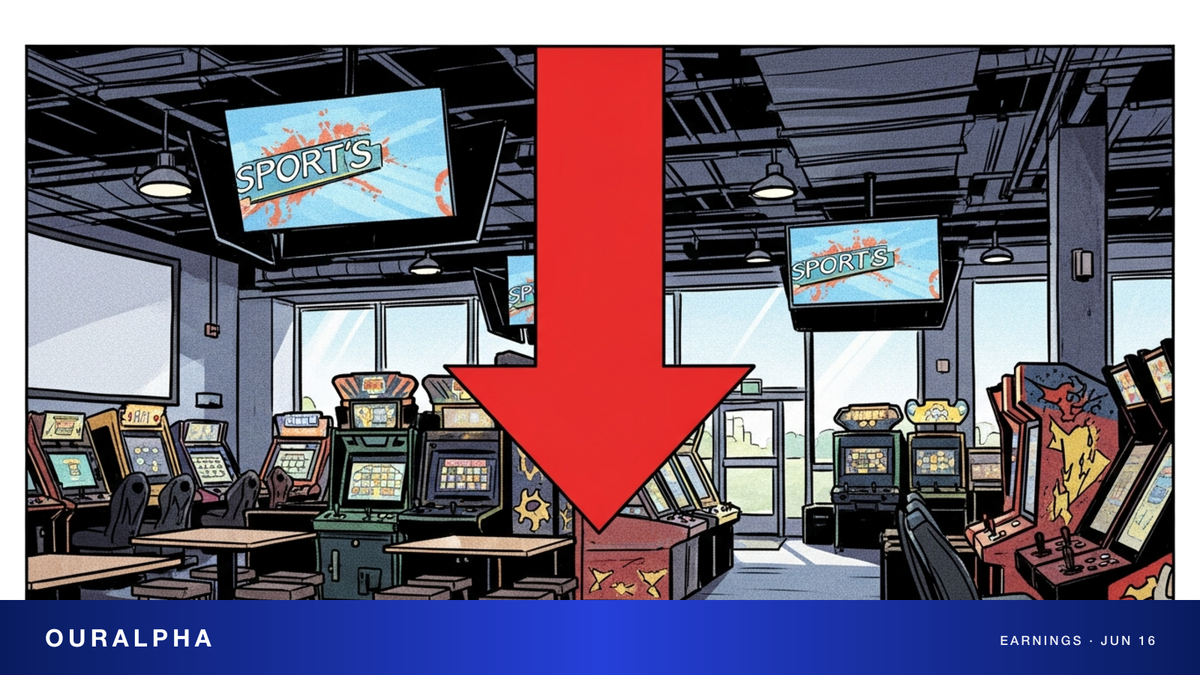
Dave & Buster's earnings decline, arcade and dining venue with downward arrow
Weak foot traffic pressured comps, but a swing to positive free cash flow gave management a floor to stand on.

Bottom line: Dave & Buster's (PLAY) reported Q1 FY2026 results for the quarter ended May 5, 2026. Both revenue and adjusted EPS missed consensus estimates, comparable-store sales fell 5.4%, and the stock tumbled more than 13% in after-hours trading. On the bright side, adjusted free cash flow flipped from negative to positive year over year.

  • Revenue of $559.2M, down 1.5% YoY, missed the $578.38M consensus by roughly 3.3%.
  • Adjusted EPS (non-GAAP) of $0.22, well below the $0.66 consensus and last year's $0.76.
  • GAAP diluted EPS of $0.16, down ~74% from $0.62 in the year-ago quarter.
  • Comparable-store sales fell 5.4% YoY.
  • Adjusted free cash flow of +$25.3M, vs. -$58.8M in the prior-year period.
  • PLAY closed the regular session on June 15 at $12.32, down ~4.72% (earnings were released after the close); shares then fell as much as ~11%–14.77% after hours, last quoted around $10.50.

Dave & Buster's (PLAY) reported Q1 FY2026 results after the close on June 15, covering the quarter ended May 5, 2026. Revenue and adjusted EPS both came in below the sell-side consensus, comparable-store sales declined 5.4%, and the stock dropped more than 13% in after-hours and overnight trading. Adjusted free cash flow, however, swung from negative to positive year over year. Below is a breakdown of the key financials, operating details, management commentary, and the stock's reaction across trading sessions.

Revenue and EPS Both Miss Consensus

Both headline profit metrics fell short of the sell-side consensus.[StockStory]

  • Revenue of $559.2M fell 1.5% YoY and missed the $578.38M consensus by roughly 3.3%.[StockStory]
  • Adjusted EPS (non-GAAP) of $0.22 came in well below the $0.66 consensus and last year's $0.76.[StockTitan]
  • GAAP diluted EPS of $0.16, down ~74% from $0.62 in the year-ago quarter.[StockTitan]
  • Net income of $5.7M, compared with $21.7M a year ago.[StockTitan]
  • Adjusted EBITDA of $123.2M, down from $136.1M in the prior-year period.[StockTitan]

Across every metric — revenue, GAAP and adjusted EPS, net income, and adjusted EBITDA — results deteriorated YoY. Consensus figures are sourced from aggregates cited by StockStory, GuruFocus, and others.

Comps Down, Unit Count Up

Comparable-store sales — the standard measure of performance at established locations — were the quarter's most-watched operating metric.

Even as same-store trends weakened, the company kept expanding its footprint:

  • Company-operated store count reached 244, up from 234 a year ago.[StockTitan]
  • One new domestic company-operated store opened this quarter; three more are planned for Q2.[StockTitan]

On the liquidity front, the picture improved meaningfully from a year ago:

  • Adjusted free cash flow of +$25.3M, vs. -$58.8M in Q1 FY2025 — a full swing to positive.[StockTitan]
  • Available liquidity of $499.1M.[StockTitan]

In short: revenue and earnings were under pressure and comps declined, but the store base grew by 10 locations YoY, adjusted free cash flow turned positive, and available liquidity stood near $500M.

Management Blames Macro Headwinds

CEO Tarun Lal addressed both the quarter's underperformance and the full-year outlook.[StockTwits]

  • He said the company has "the right strategy, team, and momentum."[StockTwits]
  • He expressed being "highly confident" in achieving positive comparable-store sales for the full year and generating more than $100M in free cash flow in FY2026.[StockTwits]
  • He attributed April's softness to elevated gas prices, geopolitical uncertainty, and a notable pullback in consumer confidence.[StockTwits]

These explanations and projections reflect management's own characterization of the operating environment. Investors should weigh them against actual comp and free cash flow data as subsequent quarters report.

Stock Reaction: Regular Session vs. After Hours

PLAY's price action differed sharply across trading sessions — an important distinction since earnings dropped after the regular close on June 15.

  • PLAY closed the regular session on June 15 at $12.32, down ~4.72% — before earnings were released.[Quiver Quantitative]
  • After the report hit, shares fell as much as ~11%–14.77% in after-hours and overnight trading, last quoted around $10.50 — the basis for the "down over 13% after hours" characterization in the headline.[Quiver Quantitative]

The ~4.72% regular-session decline happened before earnings were public; the post-earnings drop is a separate move in after-hours and overnight trading. After-hours quotes can be volatile and thin — the final resting point will be set when the regular session reopens. All after-hours figures cited here come from publicly reported ranges.

To sum up: Q1 FY2026 was a mixed quarter for Dave & Buster's — revenue and EPS missed, comps fell, and the stock got hit hard after hours. At the same time, the store count grew, adjusted free cash flow turned positive, and available liquidity approached $500M. Management expressed confidence in a full-year comp recovery and a $100M-plus free cash flow target, pinning the quarter's weakness on macro factors. Whether comps turn positive as guided, whether the FCF target is met, and how the consumer spending backdrop evolves all remain open questions. This article is a factual summary of the company's earnings release and public reporting, and does not constitute investment advice regarding Dave & Buster's (PLAY) or any other security.

This content is for informational purposes only and does not constitute investment advice, trading advice, or any guarantee of returns.

Keep Reading

Alphabet’s Antitrust Headache Deepens: Sweden Orders $1.5B Payout to Klarna, South Korea Opens New Probe

Alphabet’s Antitrust Headache Deepens: Sweden Orders $1.5B Payout to Klarna, South Korea Opens New Probe

Alphabet edged higher in early trading Tuesday, but antitrust pressure is building. A Swedish court ordered Google to pay Klarna $1.5 billion in damages, while South Korea’s antitrust watchdog launched a fresh probe.

  • Price action: As of 9:30 a.m. ET on July 1, Alphabet (GOOGL) was at $357.98, up 0.17% (+$0.61) from Friday’s close of $357.37. Opened at $358.38, with an intraday range of $357.89–$358.39.
  • Swedish verdict: The Stockholm District Court ruled
Read full story →

Stay ahead of the market — never miss a deep dive

Follow OurAlpha for AI-driven US equity research and market insight, every day.