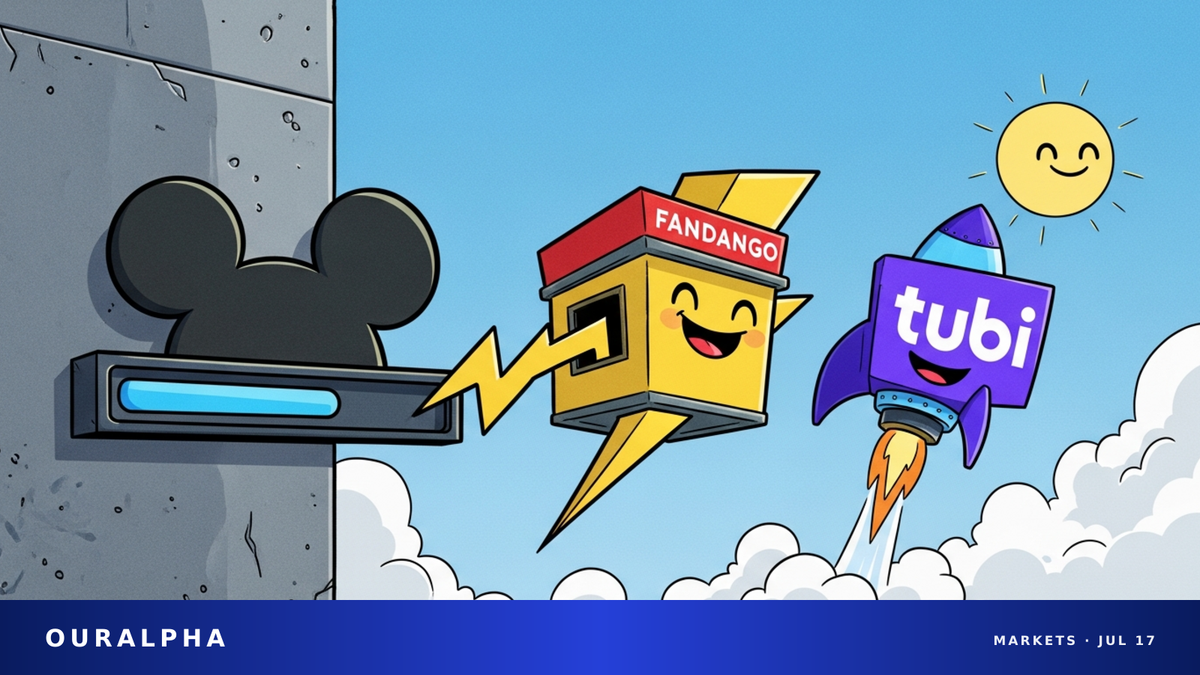
Disney Weighs Free Streaming Play as Fandango Rebrands to Take on Tubi

Disney is exploring a free, ad-supported streaming service to counter Netflix’s ad push, while Fandango rebrands its free tier with over 3,500 hours of content and exclusive Bundesliga coverage. Shares closed at $99.71, up 2.64%.

Disney considers free streaming service Fandango rebrands to compete with Tubi
Disney and Fandango double down on free streaming, taking on Tubi and Pluto TV.

Disney (DIS) is exploring a free, ad-supported streaming service to navigate intensifying competition in the streaming wars. Meanwhile, its Fandango unit announced a major rebrand, folding its free streaming tier under the main brand and adding live Bundesliga matches, directly challenging Tubi, Pluto TV, and others. As of the July 16, 2026 close, Disney shares were at $99.71, up 2.64% from the prior close. U.S. markets were closed for a holiday, with no real-time trading.

  • Disney is weighing a free streaming service to counter Netflix’s expanding ad business.
  • Fandango rebrands: drops the “at Home” suffix, expands free content library to over 3,500 hours, no login required.
  • Fandango adds exclusive English-language Bundesliga live streams via a long-term rights deal with Versant Media’s USA Sports.
  • Disney’s live-action “Moana” opened to just $43 million domestically, far below its $300 million production cost, raising doubts about its remake strategy.
  • Netflix’s latest earnings show its ad revenue target is $3 billion by year-end, with 5% of content budget allocated to live sports.

Disney (DIS) is considering launching a free, ad-supported streaming service to stay competitive in an increasingly crowded market. According to Reuters, the potential move is part of Disney’s search for new growth avenues in streaming, especially as rival Netflix (NFLX) doubles down on advertising and live sports[Reuters]. Separately, Disney-owned ticketing and streaming platform Fandango announced a major rebrand this week, integrating its free, ad-supported streaming service under the main Fandango name and significantly expanding its content library to take on free streaming rivals like Tubi, Pluto TV, and the Roku Channel[CNET]. As of the July 16, 2026 close, Disney shares were at $99.71, up 2.64% (+$2.56) from the prior close of $97.15. The stock opened at $97.275, hit a high of $99.845, and a low of $97.275. U.S. markets were closed for a holiday, with no real-time trading.

Fandango Rebrand: Free Streaming Strategy Gets a Boost

The core of Fandango’s rebrand is dropping the “at Home” suffix from its paid streaming service, “Fandango at Home,” and unifying the free, ad-supported (AVOD) platform under the main brand. According to a company press release, the upgraded free content library now offers over 3,500 hours of programming, including movies, TV series, and franchises, all drawn from parent company Versant Media’s library[CNET]. Users can watch free content without creating an account or logging in, and the platform’s updated “Watch Now” feature enables one-click playback. Fandango says the revamp delivers “better content discovery, richer title presentation, and an enhanced viewing experience.” The move makes Fandango the only unified entertainment brand that simultaneously offers free streaming, movie ticket retail, and paid transactional video-on-demand (rental/purchase).

Bundesliga Exclusive Live Streams: Sports as a Differentiator

As part of the rebrand, Fandango announced it will exclusively stream English-language broadcasts of Germany’s top-flight soccer league, the Bundesliga. These live matches come via a long-term media rights deal with Versant Media’s USA Sports, which previously held the rights at ESPN[CNET]. The move capitalizes on surging U.S. interest in soccer following the 2026 World Cup. Will McIntosh, President of Versant Digital Platforms and Ventures, said: “Expanding and unifying our AVOD streaming service under the Fandango brand is a key step in building a more connected entertainment experience for fans.”[CNET] This strategy aligns with a broader industry shift toward sports content—Netflix revealed in its latest earnings call that its ad revenue growth is heavily dependent on live sports programming, and it has secured rights to the 2027 and 2031 FIFA Women’s World Cups[Forbes].

Disney’s Live-Action Remake Strategy Under Pressure: ‘Moana’ Flops at Box Office

While adjusting its streaming strategy, Disney’s theatrical business is facing headwinds. According to Yahoo Entertainment, Disney’s live-action “Moana” opened to just $43 million domestically over its first weekend, far below its roughly $300 million production budget. The film also underwhelmed internationally, taking in $52 million[Yahoo Entertainment]. That performance is only slightly better than last year’s “Snow White” opening, which ultimately grossed just $87 million domestically. Analysts warn that Disney’s live-action remake strategy is facing “IP oversaturation.” For “Moana,” the 2016 original animated film is one of the most-watched movies on Disney+, but Disney simultaneously pushed ahead with both a live-action remake and an animated sequel, “Moana 2” (released in 2024, grossing over $1 billion globally). The consensus is that consumers are experiencing franchise fatigue from too many iterations of the same IP in quick succession. Of Disney’s last five theatrical live-action remakes, only “Lilo & Stitch” (2025, over $1 billion globally) and the “Lion King” prequel “Mufasa” (2024, $722 million globally) can be considered commercial successes, while “The Little Mermaid” (2023, $570 million globally) and “Snow White” fell short of expectations.

Netflix’s Ad Business Surges, Live Sports as Key Engine

In contrast to Disney’s exploratory phase, Netflix’s ad business is accelerating. According to Forbes, Netflix reiterated in its latest earnings report that its ad revenue target is $3 billion by the end of 2026, with the key driver being its expanding live programming, particularly sports[Forbes]. On its earnings call, Netflix said it expects live events—including podcasts and sports—to account for 5% of its content budget this year. This week, Netflix aired its first MLB Home Run Derby broadcast; while the 5.3 million viewers were the smallest for the event since 2003, industry analysts note that the shift from traditional TV to streaming typically causes a temporary ratings dip. Netflix will also broadcast five regular-season NFL games this coming season, including a season opener from Australia and multiple holiday matchups. Additionally, Netflix has secured rights to the 2027 and 2031 FIFA Women’s World Cups and is already building buzz with related documentaries.

Streaming Landscape Reshaped: Free Models and Sports Take Center Stage

Disney’s consideration of a free streaming service and Fandango’s rebrand reflect deep structural changes sweeping the streaming industry. As giants like Netflix and Amazon Prime Video attract users with ad-supported lower-priced or free tiers, the traditional paid subscription model faces growth constraints. According to a Reuters Breakingviews column, the aftershocks of supersized media M&A continue to shape Netflix’s next moves[Reuters]. Meanwhile, sports content has become the central battleground for user acquisition and ad revenue. Tech giants like Netflix, Amazon, and Apple are spending heavily on sports rights, while traditional media companies like Disney are trying to stay competitive through properties like ESPN. For Disney, Fandango’s free streaming upgrade and a potential Disney-branded free service will be critical moves to catch up in the ad-supported streaming space.

This content is for informational purposes only and does not constitute investment advice, trading advice, or any guarantee of returns.

Keep Reading

TSMC’s Earnings Flash Two Big Signals Nvidia Investors Can’t Ignore

TSMC’s Earnings Flash Two Big Signals Nvidia Investors Can’t Ignore

TSMC (TSM) crushed Q2 estimates on revenue and profit, announced a $100 billion追加 investment in its Arizona fab, and signaled red-hot AI chip demand. Nvidia (NVDA) slipped 2.40% on the trading day (July 16), but analysts say TSMC’s bullish outlook provides a key support for Nvidia shareholders.

  • TSMC’s Q2 revenue surged 33% YoY to over $40 billion, while EPS jumped 77% to $4.31 — both handily beating Wall Street estimates.[Motley Fool]
  • TSMC guided Q3 revenue in a range of $44.6
Read full story →

Stay ahead of the market — never miss a deep dive

Follow OurAlpha for AI-driven US equity research and market insight, every day.