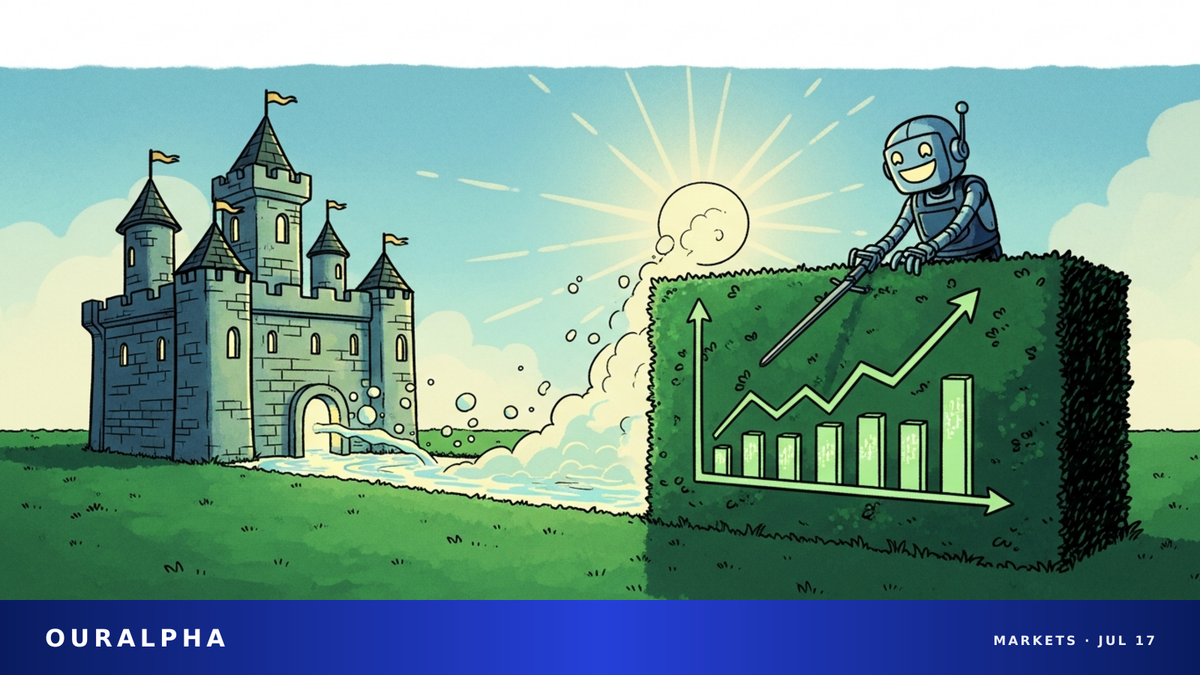
Palantir CTO Warns AI ‘Distillation’ Could Gut Software Moat

Palantir CTO Shyam Sankar warns that AI distillation lets small teams replicate core software functions at a fraction of the cost, potentially upending the industry’s value chain. The warning comes hot on the heels of IBM’s shock profit alert, which sent shares plunging 25%.

Palantir CTO warns AI distillation could erode software company moats
Palantir’s CTO says AI distillation could accelerate the SaaSpocalypse.

Palantir Technologies CTO Shyam Sankar has warned that AI “distillation” could erode the competitive advantages of traditional software companies, reigniting fears of a “SaaSpocalypse.” As of the close on July 16, 2026, Palantir (PLTR) traded at $134.44, up 0.51% from the prior close of $133.76. U.S. markets were closed on July 17 for a holiday, so the quote is static with no intraday movement.

  • Palantir CTO Shyam Sankar warned on social media that AI distillation lets small teams replicate core software functions at a fraction of the cost, potentially “fundamentally reshaping value distribution in the software industry.”
  • The warning follows IBM’s surprise profit alert last week, which triggered a single-day stock crash of over 25% after the company misjudged the AI spending boom.
  • AI distillation uses large models like GPT-4 to generate training data for smaller, cheaper models that perform nearly as well on specific tasks, slashing development costs.
  • Wall Street analysts say that if distillation becomes widespread, companies may reduce reliance on SaaS subscriptions in favor of custom AI tools, threatening the business models of Salesforce, Workday, and others.
  • Meanwhile, frontier AI firms like Anthropic and OpenAI are aggressively hiring security analysts to prevent AI from being used for catastrophic scenarios like bioweapons or cyberattacks.
  • Several U.S. states have passed AI disclosure laws requiring frontier AI developers to submit safety assessments before deployment, but a unified federal framework remains absent.

Palantir Technologies (PLTR) CTO Shyam Sankar recently warned that AI “distillation” could erode the competitive moats of traditional software companies and accelerate the “SaaSpocalypse.” As of the close on July 16, 2026, PLTR traded at $134.44, up 0.51% from the prior close of $133.76. The stock opened at $133.08, hit a high of $136.21, and a low of $128.68. With U.S. markets closed on Friday, July 17, for a holiday, the quote is static with no pre-market or intraday movement.[Business Insider Africa]

AI Distillation: A Dimension-Reduction Attack on Software?

Sankar posted on social media that AI distillation allows small teams or even individual developers to use high-quality training data generated by large language models (like GPT-4 or Claude) to train small models that perform nearly as well on specific tasks. This process dramatically lowers the barrier to entry and cost of software development. “Features that once required hundreds of engineers and years to build can now be done by a few people in weeks,” Sankar wrote. “That’s an existential threat to traditional companies that rely on software licensing and subscription revenue.”[Business Insider Africa]

The warning comes against the backdrop of IBM’s surprise shareholder letter last Tuesday (July 14), eight days before its scheduled earnings report, disclosing that quarterly results “fell short of expectations.” The stock cratered over 25% in a single day, its worst-ever drop. CEO Arvind Krishna wrote that the company “did not anticipate the scale of capital expenditure reallocation,” as clients shifted spending to AI infrastructure (servers, storage, memory), pressuring IBM’s software and consulting revenue.[Business Insider Africa]

SaaSpocalypse Fears Return

IBM’s profit alert quickly reignited market fears of a “SaaSpocalypse”—the idea that AI will erode the value of traditional software companies. For months, investors have worried that as AI agents automate and build custom tools, enterprises will need fewer software subscriptions. While IBM is not a pure SaaS company, and Krishna did not say AI is making its products obsolete, the trend of client spending shifting to AI infrastructure has investors questioning how much AI spending will ultimately flow to traditional software providers.[Business Insider Africa]

Social Capital CEO Chamath Palihapitiya commented on CNBC that IBM’s warning reflects a bigger problem for the AI industry: companies selling intelligence are raking it in, but it’s unclear whether their clients can turn those costs into their own profits. “The downstream ecosystem also has to make money,” Palihapitiya said. “And then the end user—the consumer—has to get value from it. Otherwise, the whole chain breaks.”[Business Insider Africa]

Frontier AI Risks: From Distillation to Catastrophe

Alongside the business risks of AI distillation, the safety risks of frontier AI models themselves are escalating. Anthropic CEO Dario Amodei has long warned that malicious actors could use AI to create bioweapons, nuclear weapons, or launch cyberattacks. Anthropic currently has 32 “very scary” job openings, specifically recruiting chemical and explosives analysts, nuclear weapons analysts, financial fraud analysts, and cybercrime analysts to prevent AI misuse. Salaries for these roles range from $200,000 to $300,000 per year.[Axios]

“Ensuring our models do not provide potentially harmful information is central to responsible development,” an Anthropic spokesperson said. “That’s why we regularly hire experts in various sensitive fields—people who understand these harms and how AI could amplify them—to pressure-test our systems and strengthen defenses before models are deployed.”[Axios]

Meanwhile, Anthropic’s Mythos model—an advanced AI capable of autonomously identifying and exploiting zero-day vulnerabilities—has drawn intense scrutiny from the U.S. government. JPMorgan Chase CEO Jamie Dimon recently warned that broad access to Mythos is a “real issue” and that the U.S. government is watching closely. The U.S. previously banned foreign nationals from accessing Anthropic’s Fable 5 and Mythos 5 models, then lifted the ban without public explanation.[Bloomberg]

Regulatory Fragmentation: States Lead, Federal Lags

Regulatory responses to rapid AI advances remain fragmented. Illinois, New York, and California have passed AI disclosure laws requiring frontier AI developers with annual revenue over $500 million to submit safety assessment reports before deployment and update them annually. Illinois Governor JB Pritzker signed the AI Safety Measures Act (SB315), effective January 2027, requiring developers to establish comprehensive AI frameworks covering catastrophic risk assessment, mitigation measures, governance, cybersecurity, third-party evaluation, and internal use risks.[Dark Reading]

However, a unified federal framework is still lacking. Google DeepMind CEO Demis Hassabis recently called for a U.S.-led global AI regulator, modeled on FINRA, with the authority to coordinate industry-wide deployment slowdowns after evaluating frontier models. Hassabis said artificial general intelligence (AGI) “may be only a few years away” and added, “When we look back at this era decades from now, we will realize we were standing at the foot of the singularity—this is nothing less than the dawn of a new human age.”[The Verge]

Geopolitical Ripples: UK Accelerates Tech Sovereignty

U.S. export restrictions on frontier AI models are also triggering geopolitical ripple effects. A UK House of Commons Science, Innovation and Technology Committee report warned that “the whims of foreign governments” could cut off UK access to critical technologies like AI. The report stated: “The U.S. restriction on Anthropic’s latest AI models should serve as a powerful reminder that the UK may not be able to rely on its allies for access to key technologies.”[Dark Reading]

Raphael Auphan, COO of Swiss tech company Proton, said access to the most advanced AI systems is now a key part of the broader tech sovereignty issue. “If access to the most advanced AI systems can be restricted by another country’s decision—whether for national security, commercial, or political reasons—it exposes the strategic vulnerability of governments, businesses, and researchers who depend on those tools,” Auphan said. “Europe needs to ensure it has sufficient domestic capabilities and trusted alternatives so that its operations and innovation capacity do not depend on decisions made abroad.”[Dark Reading]

The UK’s National Cyber Security Centre (NCSC) and the Department for Science, Innovation and Technology (DSIT) also unveiled the “Cyber Shield” program last week, aimed at building “sovereign” cyber defense capabilities against AI-driven threats. These moves show that the commercial and security risks of AI are driving a global regulatory and geopolitical realignment—and Palantir’s CTO warning is just the latest footnote in that larger trend.[Dark Reading]

This content is for informational purposes only and does not constitute investment advice, trading advice, or any guarantee of returns.

Keep Reading

TSMC’s Earnings Flash Two Big Signals Nvidia Investors Can’t Ignore

TSMC’s Earnings Flash Two Big Signals Nvidia Investors Can’t Ignore

TSMC (TSM) crushed Q2 estimates on revenue and profit, announced a $100 billion追加 investment in its Arizona fab, and signaled red-hot AI chip demand. Nvidia (NVDA) slipped 2.40% on the trading day (July 16), but analysts say TSMC’s bullish outlook provides a key support for Nvidia shareholders.

  • TSMC’s Q2 revenue surged 33% YoY to over $40 billion, while EPS jumped 77% to $4.31 — both handily beating Wall Street estimates.[Motley Fool]
  • TSMC guided Q3 revenue in a range of $44.6
Read full story →

Stay ahead of the market — never miss a deep dive

Follow OurAlpha for AI-driven US equity research and market insight, every day.