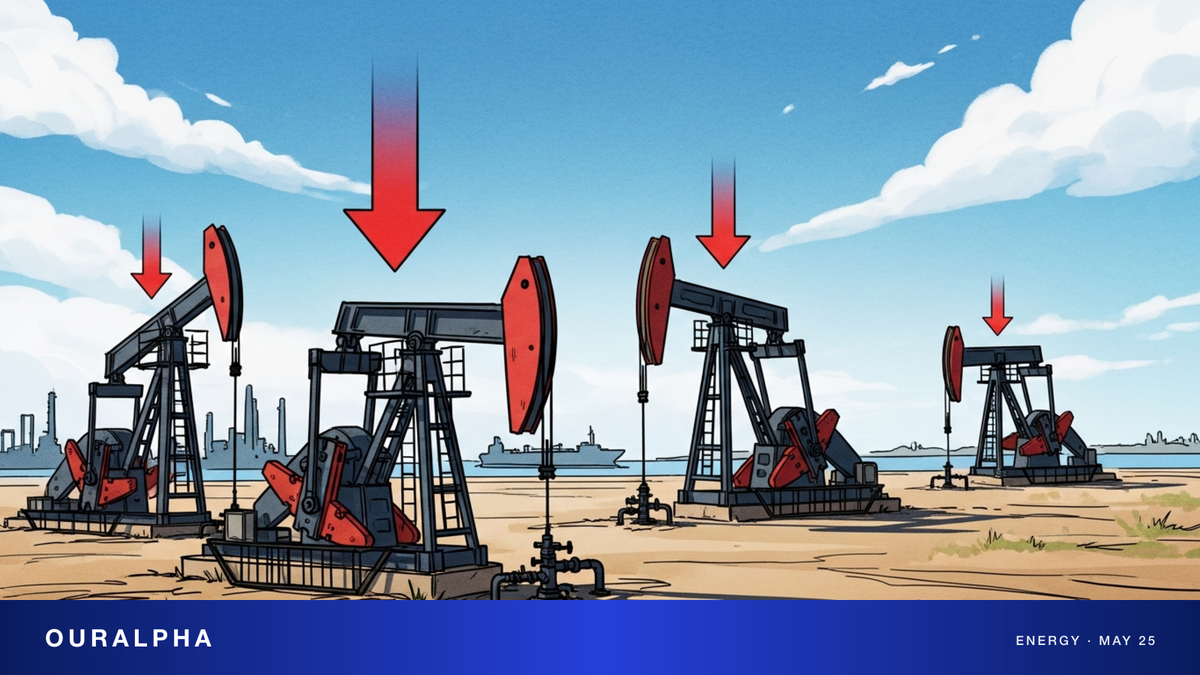
WTI Drops 4%: Which Big Oil Stock Gets Hit Hardest — XOM, CVX, OXY, or COP?
Iran diplomacy headlines knocked WTI down 4% and Brent nearly 5%, ending the cleanest two-week energy trade of the year. The easy money is gone — now it's about figuring out who gives back the most before the next entry point.
TL;DR
Iran diplomatic progress sent WTI down 4% and Brent nearly 5% in a single session. The cleanest two-week energy trade of the year is over — expect the four major integrated energy stocks to give back some ground when Tuesday's regular session opens.
- Over the past two weeks, WTI ran from $80 to $103; XLE outperformed the S&P 500 by roughly 7 percentage points
- Every sustained $5 move in WTI translates to roughly $1.50/share in full-year EPS for Exxon (XOM) and ~$0.75/share for Chevron (CVX)
- Pure upstream exposure means the deepest drawdown: Occidental (OXY) and ConocoPhillips (COP) pull back the most; Exxon (XOM) and Chevron (CVX) have downstream refining as a hedge and hold up better
- $90 oil isn't a problem — $70 is. U.S. shale breakevens sit just above $60
Over the long Memorial Day weekend, simultaneous reports of U.S.-Iran diplomatic contacts blindsided crude markets. Barron's intraday data showed WTI falling 4% on the session, with Brent moving nearly 5% lower in lockstep. Energy had been the single cleanest leadership trade in U.S. equities for two weeks running — but by Tuesday's cash open, futures were already pointing to a giveback. The energy ETF XLE was trading lower in the premarket, and sell-side desks were cutting price targets on the four big-cap integrated names: Exxon Mobil (XOM), Chevron (CVX), Occidental Petroleum (OXY), and ConocoPhillips (COP).
For anyone sitting on an overweight energy position, Tuesday's real question isn't whether the sector eventually recovers — it almost certainly does — but how much further the stocks need to travel before finding a level worth re-entering.
How the Rally Was Built
The past two weeks offered one of the cleanest sector-outperformance windows of the year. WTI ran from above $80 all the way to $103, and XLE beat the S&P 500 by roughly 7 percentage points — during a stretch when the broader index itself only gained around 1%. The divergence within the sector was textbook: the two highest-upstream-beta names — Occidental and ConocoPhillips — led the charge, while the more diversified Exxon and Chevron kept pace but lagged slightly, though both still outperformed the market by a wide margin.
That kind of move attracted fast money quickly. Energy ETFs saw their largest two-week net inflows since 2024, and starting in mid-May, sell-side analysts began ratcheting up 2026 consensus EPS estimates. The math is straightforward: every sustained $5 increase in WTI adds roughly $1.50/share to Exxon's 2026 EPS and about $0.75/share to Chevron's. In other words, the full $20 oil price surge of the past two weeks had already been baked into models.
Monday was Memorial Day — a half-session for futures — and markets spent those hours unwinding some of that optimistic pricing. If WTI settles into a range materially below last week's levels, sell-side analysts will reverse-engineer their annual growth estimates downward, and a significant portion of the two-week energy rally gets handed back.
What Makes This Pullback Different
Energy's setup heading into 2026 is unusual — the sector is sitting at the intersection of three distinct forces, and they don't all move together.
First: geopolitical risk premium. The bulk of the two-week crude rally was driven by fears of Middle East escalation. Monday's session began squeezing that premium back out.
Second: underlying supply/demand fundamentals. Strip out the weekly headlines and the physical oil market has remained genuinely tight — OPEC+ is holding production discipline, the U.S. Strategic Petroleum Reserve has seen no further releases, and Asian demand is picking up. This dynamic is independent of the news cycle and provides a floor under prices.
Third: U.S. shale capital discipline. Over the past three years, shale producers learned a lesson and stuck to it: when oil prices run, don't chase rig counts — return cash to shareholders instead. That discipline has held through this year, even among the largest upstream operators.
Together, these three forces mean the sector has a floor on the downside — a sharp oil pullback won't crater the group without limit — but the upside is also narrower than the bullish narrative of two weeks ago suggested. A WTI retracement to the low $90s doesn't break the sector's medium-term thesis; it just strips out the easiest part of the trade.
For anyone who added energy exposure over the weekend: the trade already captured the meat of the move. Getting the last bit is now meaningfully harder. The question for Tuesday's open is simple: take some off the table now, or ride through what looks like an inevitable near-term pullback and wait for the next geopolitical catalyst?
Who Holds Up, Who Doesn't
One sentence: the purer the upstream exposure, the harder the pullback bites.
Occidental (OXY) and ConocoPhillips (COP) are pure upstream beta plays. Revenue and earnings move almost entirely with the oil price — no refining buffer, no chemicals, no retail fuel margin. They led the rally, and they'll almost certainly lead the giveback on Tuesday. If you're looking to trim ahead of the open, these are the most direct candidates.
Exxon Mobil (XOM) and Chevron (CVX) are integrated majors. A meaningful share of their business is in downstream refining, chemicals, and — in Chevron's case — natural gas. When crude falls, downstream refining actually benefits: feedstock costs drop while refined product prices lag, and crack spreads widen. That structural offset means these two typically see shallower drawdowns during crude sell-offs. Both are also capital-return machines — the combination of dividends and buybacks insulates them somewhat from pure oil price volatility.
That asymmetry is precisely why XOM and CVX carry lower beta and tend to be more stable long-term holds. They didn't run as hard as OXY and COP during the two-week rally, and they won't give back as much on Tuesday either.
$90 Is Fine. $70 Is the Line.
Zoom out: U.S. shale producers have spent three years building a financial structure specifically designed to withstand oil price volatility. Most major operators' breakevens are clustered just above $60 WTI. That means as long as crude stays above $70, the sector's medium-term earnings power isn't fundamentally threatened. A retreat to the $90s essentially just gives back the fastest, easiest gains of this year's trade.
A scenario that actually changes the sector's structure requires one of two things: either a genuine, signed Iran nuclear deal that durably resets Middle East supply — or a hard demand shock in the data (China and India showing weakness, or U.S. employment suddenly cooling). Neither describes what Tuesday's open is pricing in.
To be direct about it: this is a tactical pullback, not a theme reversal. Energy reclaims relative sector leadership when the next geopolitical escalation hits with enough visibility to trade — and at the pace 2026 has been running, that tends to come every 60 to 90 days.
Three Things to Watch Over the Next Two Weeks
1. Tuesday's WTI cash close. A settle below $94 signals that real money is repositioning on the geopolitical narrative. A bounce back above $95 suggests Monday's holiday futures move was mostly a liquidity artifact, not a genuine reset.
2. XLE's performance relative to the S&P 500. If XLE underperforms the broader market by more than 0.2 percentage points per day for 10 consecutive sessions, the sector outperformance window is closed — and capital will start rotating toward a new leadership theme.
3. U.S. rig counts and shale capex commentary. Any signal of "higher prices = more drilling" from major producers would soften the medium-term bull case for crude. So far management teams have held the line on discipline, but this is worth monitoring closely.
For anyone holding energy into Tuesday's open: the right mindset isn't panic — it's clarity. Separate the tactical from the structural. The easiest money has already been made. From here, the edge belongs to whoever has the patience to hold through a week or two of volatility and the position sizing to survive it.
Sources
- WTI Plunges as Iran Diplomatic Track Reopens; Energy Stocks Brace for Pullback — Barron's
- U.S. Crude Oil and Petroleum Data — EIA
- US Shale Producers Maintain Capex Discipline Even at Higher WTI — S&P Global Commodity Insights
- XLE Sector Rotation: Two-Week Outperformance Faces Tuesday Test — Investor's Business Daily
This content is for informational purposes only and does not constitute investment advice, trading advice, or any guarantee of returns.