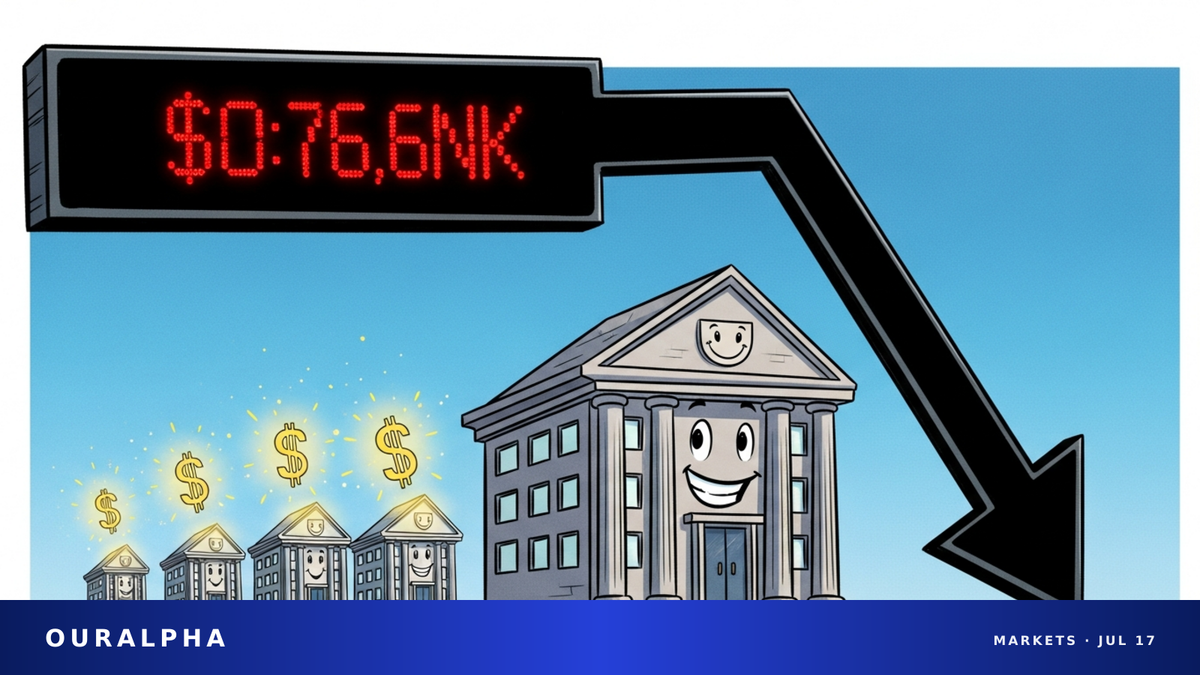
Goldman Sachs Tumbles 5% as Jefferies Flags Four Dividend-Paying Bank Stocks

Goldman Sachs slid more than 5% intraday, while Jefferies issued a bullish call on four dividend-paying money-center banks. The divergence comes as Wall Street’s biggest lenders post double-digit profit growth in Q2.

Goldman Sachs stock falls, Jefferies bullish on dividend-paying bank stocks, Wall Street bank earnings diverge
Goldman Sachs slides more than 5% intraday, while Jefferies backs dividend-paying bank stocks amid a mixed earnings season.

Wall Street bank stocks are diverging as the Q2 earnings season unfolds. Goldman Sachs (GS) took a sharp intraday hit, while Jefferies issued a bullish note on four dividend-paying money-center banks. As of 3:00 p.m. ET on July 16, Goldman was trading at $1,092.95, down 5.13% from its prior close of $1,152.07.

  • Goldman Sachs (GS) was at $1,092.95 intraday, down 5.13% (-$59.12), with a session low of $1,089.76.
  • Jefferies published a bullish report favoring four dividend-paying money-center banks, though the specific names were not disclosed in the source material.
  • Last week, all five of Wall Street’s largest banks — JPMorgan, Goldman Sachs, Citigroup, Wells Fargo, and Bank of America — reported double-digit profit growth for Q2.
  • JPMorgan CEO Jamie Dimon said on the earnings call that markets are “close to as good as it gets,” adding, “We don’t know how long that will last.”
  • Goldman CEO David Solomon said capital demand from AI buildout will “ebb and flow,” and that the market is still in the “early innings” of the AI investment cycle.
  • According to Yahoo Finance, Wall Street banks are expected to generate nearly $39 billion in Q2 trading revenue.

Wall Street bank stocks are diverging as the Q2 earnings season plays out. Goldman Sachs (GS) took a sharp intraday hit, trading at $1,092.95 as of 3:00 p.m. ET on July 16, down 5.13% (-$59.12) from its prior close of $1,152.07, with a session low of $1,089.76. Meanwhile, Jefferies issued a bullish note recommending four dividend-paying money-center banks, though the specific names were not disclosed in the source material.[CNBC]

Q2 Earnings: Wall Street Banks Post Strong Results

On Tuesday, July 14, JPMorgan (JPM), Bank of America (BAC), Citigroup (C), Wells Fargo (WFC), and Goldman Sachs (GS) all reported Q2 earnings before the open. According to Business Insider, all five banks posted double-digit profit growth, with CEOs describing results as “record,” “strong,” and “best quarterly revenue in a decade.”[Business Insider]

According to Yahoo Finance, Wall Street banks are expected to generate nearly $39 billion in Q2 trading revenue.[Yahoo Finance] CNBC previously reported that investors expected the Big Five to post strong revenue from both equity and fixed-income trading in Q2.[CNBC]

JPMorgan’s stock saw wild swings after the report. CNBC technical analyst Frank Cappelleri noted that on earnings day (July 14), JPMorgan fell more than 2% intraday before staging a sharp reversal to close up 2.5%, forming a massive bullish engulfing candlestick on the daily chart.[CNBC]

CEOs Cautious on Market Outlook

Despite the strong results, bank CEOs struck a cautious tone on the earnings calls. JPMorgan CEO Jamie Dimon said the market is “close to as good as it gets,” adding, “We don’t know how long that will last.” On the analyst call, Dimon stated: “We are in a very healthy, active, exuberant market with high prices and high volumes, and we are benefiting from it. But can it get better? How much better? I don’t know.”[Business Insider]

JPMorgan CFO Jeremy Barnum told reporters ahead of the earnings call that “it would be naive not to worry about market exuberance,” particularly around AI. But he added that while worrying is easy, the market could continue to perform well.[Business Insider]

Goldman CEO David Solomon said capital demand from the AI buildout will “ebb and flow,” which is normal. He noted: “Eventually, you get a recalibration, a reset, a pullback, and then acceleration again. That’s the typical path.” Solomon believes the market is still in the “early innings” of the AI investment cycle, adding that he can’t predict whether the recalibration will come in six months or eighteen months.[Business Insider]

Trading and Investment Banking Drive Growth

Q2 was one of Wall Street’s busiest periods in years. According to Business Insider, blockbuster deals including the SpaceX IPO fueled a rebound in investment banking. Market volatility driven by geopolitical factors and shifting sentiment around AI stocks also boosted trading desks. Companies continued to raise capital for AI infrastructure and data centers, with banks actively participating.[Business Insider]

CNBC previously reported that in the three months leading up to Q2 earnings, Bank of America shares rose 11.5%, trading just 2% below their July high; Citigroup gained 11%, sitting 5% below its June 18 peak; and Goldman Sachs rose 17%, 7% below its mid-June high.[CNBC]

Technical and Fundamental Alignment: JPMorgan Gets Bullish Call

CNBC technical analyst Frank Cappelleri noted on July 15 that JPMorgan’s technicals and fundamentals are aligning. He wrote: “As a technical analyst and CMT charterholder, I look at price action first. But when fundamentals reinforce the technical picture, it always catches my attention. JPMorgan appears to have both right now, and that became even clearer after yesterday’s strong earnings.”[CNBC]

Cappelleri noted that after JPMorgan’s July 14 earnings release, the daily chart showed an “extremely large bullish engulfing candlestick” on elevated volume, typically a strong bullish signal.[CNBC]

Goldman Sachs Intraday Slide and Recent Performance

Goldman Sachs shares tumbled intraday, trading at $1,092.95 as of 3:00 p.m. ET, down 5.13% (-$59.12) from its prior close of $1,152.07. The stock opened at $1,147.65, hit a high of $1,152.4522, and a low of $1,089.76. In the three months before earnings, Goldman shares had risen 17%.[CNBC]

This content is for informational purposes only and does not constitute investment advice, trading advice, or any guarantee of returns.

Keep Reading

Visa Launches Stablecoin Platform, Coinbase Slides 4%+ After Hours

Visa Launches Stablecoin Platform, Coinbase Slides 4%+ After Hours

Visa announced a new stablecoin platform centered on OUSD, targeting over 200 million merchants — but Coinbase (COIN) shares slid more than 4% in after-hours trading.

  • Visa launched a stablecoin platform offering banks and fintechs a one-stop integration for stablecoin payments.[Fortune]
  • The platform’s strategic starting point is OUSD, a stablecoin issued two weeks ago by the Open Standard consortium.[Fortune]
  • Visa processes roughly $15 trillion in payments annually and has already settled billions of dollars in stablecoin transactions.[Fortune]
  • Coinbase (COIN) traded at $160.
Read full story →

Stay ahead of the market — never miss a deep dive

Follow OurAlpha for AI-driven US equity research and market insight, every day.