Alphabet's $80B Raise and a Berkshire Top-Up Still Couldn't Stop a 4% Drop. Here's Why.

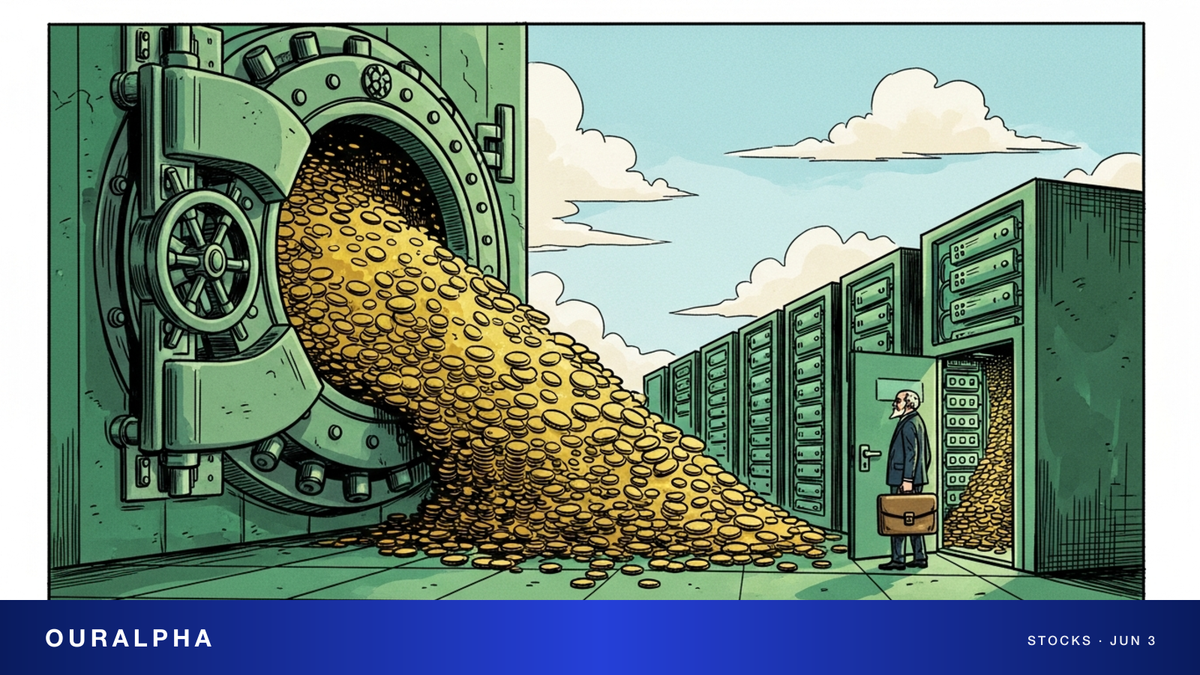
Alphabet just launched the largest single equity offering in corporate history — $80 billion for AI infrastructure — with Berkshire Hathaway quietly taking $10 billion of it. Wall Street's response: sell first, ask questions later.

Alphabet headquarters with a stock chart showing GOOGL's 4% decline on June 2, 2026
Alphabet's $80 billion equity raise — the largest in corporate history — sent GOOGL down nearly 4% on June 2, 2026, erasing more than $100 billion in market cap in a single session.

TL;DR

Alphabet (GOOGL) announced the largest single equity offering in its history — $80 billion, all earmarked for AI compute. Berkshire Hathaway (BRK.A) took $10 billion of that via private placement, a meaningful step-up from a position it has been building since Q3 2025 — yet on June 2, the market responded by wiping roughly $100 billion off GOOGL's market cap, a drop of ~4%.

  • Three-tranche structure: $30B underwritten ($15B mandatory convertible preferred + $15B common stock) + $40B ATM program + $10B Berkshire private placement
  • 2026 capex guidance raised to $180–190B; Amazon (~$200B) and Microsoft (~$190B) are actually higher or on par
  • Berkshire private placement pricing already disclosed: Class A at $351.81/share + Class C at $348.20/share — essentially at-market; this is the Greg Abel era's first major GOOGL top-up, not a fresh initiation
  • What actually matters: Q3 free cash flow, Google Cloud growth, whether the ATM program keeps capping the stock, and Berkshire's next 13F

After the close on June 1, Alphabet dropped an $80 billion equity offering — an eye-popping number with almost no precedent in corporate history. Buried in the same announcement: Berkshire Hathaway would privately subscribe to $10 billion of it.

Much of the media coverage framed this as "Buffett's first major bet on Google." That's not quite right. Berkshire has been building a GOOGL position since Q3 2025; its Q1 2026 13F already showed roughly 57.8 million shares worth about $16.6 billion — the fifth-largest position in the portfolio. This $10 billion is an add to an existing large stake, and it comes after Buffett stepped down as CEO on January 1, 2026, with Greg Abel taking over. The more precise read: this is the first major GOOGL top-up of the Abel era, executed by the Abel/Combs/Weschler team.

Conventional wisdom says "record equity raise + Berkshire doubling down" should at least hold a stock flat. On June 2, GOOGL opened lower, fell as much as 3.5%–3.8% intraday, and erased more than $100 billion in market cap in a single session. So what exactly is the market worried about?

$80 Billion — How It's Split: Three Tranches and One Critical Detail

This isn't a simple secondary offering. The announcement spells out a three-tranche structure that is easy to misread at first glance.

The first tranche is a $30 billion underwritten public offering — but it's split in two: $15 billion in mandatory convertible preferred stock and $15 billion in Class A/C common stock. The mandatory convertible preferred is the detail most coverage glosses over. It doesn't dilute EPS on day one the way straight common stock does; instead, it converts to common stock in three years, with the company paying a fixed dividend in the interim. The near-term EPS hit is far lighter than a straight $30 billion common offering — but three years from now, that dilution lands all at once.

The second tranche is a $40 billion at-the-market (ATM) program — shares sold in the open market at prevailing prices over roughly the next 12 to 18 months, on the company's own schedule. ATM programs offer flexibility and market-rate pricing, but they also function as a persistent dilution overhang: every time the stock rallies, the market has to wonder whether management is quietly selling into the strength.

The third tranche is the $10 billion Berkshire Hathaway private placement. The pricing is already public: $5 billion in Class A shares at $351.81 per share, $5 billion in Class C shares at $348.20 per share — essentially at-market, no meaningful premium or discount. With a lockup period attached, these shares are effectively pulled out of the float for now.

Add the three tranches together and Alphabet is issuing roughly 1.8% of its existing share count (rough math against the ~$4.34 trillion market cap at announcement). That's real dilution — not a shelf authorization that may never be used — but it's nowhere near the 3%–4% some headlines suggested.

The use of proceeds is straightforward: the announcement says the capital will "fund investments in world-class AI compute infrastructure to meet unprecedented customer demand" — data centers, power infrastructure, custom TPU chips, and reserved capacity for major clients like Anthropic.

Berkshire Adding vs. the ATM Overhang: Why the Market Only Believed Half the Story

To understand June 2's selloff, you have to see the two forces pulling in opposite directions.

On one side: Berkshire's continued conviction. From a Q3 2025 initiation to a $16.6 billion position by Q1 2026, GOOGL was already Berkshire's fifth-largest holding. Adding another $10 billion bumps that weight higher still. Given that this is the first major add since Buffett handed the keys to Abel, it should have read as a strong endorsement — the Abel/Combs/Weschler team's vote of long-term confidence in GOOGL's value.

On the other side: structural dilution anxiety. The concern isn't the Berkshire block — at-market pricing, locked up, and out of the float. It's the $40 billion ATM program. An ATM is essentially a tap the company can turn on whenever the stock is strong, which means every meaningful GOOGL rally now comes with an implicit ceiling. The mandatory convertible preferred adds another ticking clock: three years from now, that $15 billion converts to common stock in one shot.

A useful historical parallel is Amazon during AWS's high-capex build-out phase. In 2014–2015, Amazon plowed essentially all its profit back into AWS infrastructure. The market's verdict for roughly 18 months was "this company doesn't earn anything" — the stock went sideways until AWS revenue and margins actually materialized, at which point the multiple was repriced sharply higher.

Alphabet is running the AI-era version of that same playbook now. The investment is real. The question the market can't yet answer is whether customer monetization will keep pace with the burn rate — and that uncertainty is what the June 2 selloff is actually pricing in.

The Mag 7 Capex Arms Race: Alphabet Isn't Even the Biggest Spender

The announcement also included a guidance raise worth paying attention to. Alphabet now expects 2026 capex of $180–190 billion, with 2027 spending "significantly higher."

A lot of coverage described this as Alphabet leading the Mag 7 on capital spending. That's inaccurate. Putting the latest guidance side by side:

  • Amazon (AMZN) 2026: ~$200 billion (actual Mag 7 leader)
  • Microsoft (MSFT) 2026: ~$190 billion
  • Alphabet (GOOGL) 2026: $180–190 billion
  • Meta (META) 2026: $125–145 billion (revised up; the prior $115–135B range is stale)

Four companies combined: roughly $700–725 billion — all of it flowing into AI compute: data centers, power infrastructure, Nvidia (NVDA) GPUs, custom silicon, and networking. In absolute dollars, Alphabet is not the leader; Amazon and Microsoft are both more aggressive. But on a capex-to-revenue ratio, Alphabet is arguably the most stretched of the group, given its smaller revenue base relative to Amazon and Microsoft.

There are really only two explanations for spending at this scale.

Explanation one: AI demand is genuinely outstripping supply. Alphabet's announcement cited "unprecedented customer demand," and Google Cloud's backlog is presumably already large enough to keep management awake at night. Anthropic alone may have locked in hundreds of billions in future compute commitments.

Explanation two: this is a "better to overbuild than under-build" arms race. Every Mag 7 company is terrified of falling behind on AI infrastructure, so all of them are building two to three years of potential excess capacity rather than cede positioning.

Both explanations can be true simultaneously — but they carry very different implications. The first says the spending has a clear monetization runway. The second says brace for several quarters where capex eats the profit.

What to Watch Next: Four Key Signals

Short-term price action is noise. Whether this raise turns out to be "burning your way to an AI throne" or "burning through a capital trap" comes down to four signals.

Signal 1: Q3 free cash flow (FCF). Capex of $180–190 billion will squeeze Alphabet's FCF to the limit — possibly negative in certain quarters. If the Q3 earnings report shows a sharp FCF deterioration, the market's anxiety about the ATM program will only intensify.

Signal 2: Google Cloud revenue growth. This is the proof-of-concept for the entire funding thesis. If Cloud growth holds at 30%+ and accelerates, the market will pay for the capex. If growth slips toward the low 20s, the $190 billion instantly gets re-labeled "misallocated capital."

Signal 3: Share buyback pace. Alphabet has historically used large buybacks to offset equity-based compensation dilution. If the $80 billion raise forces management to pull back on repurchases, that's a second-order dilution hit on top of the offering — a double punch to EPS.

Signal 4: Berkshire's next 13F. The market will be watching whether the Abel team continues adding GOOGL in the open market — not just via the private placement block. Berkshire has added consistently from Q3 2025 through Q1 2026; if the Q2 2026 13F shows additional open-market purchases, the "long-term conviction" narrative gets real teeth.

The June 2 selloff looks less like a fundamental re-rating and more like the market marking down "largest-ever equity raise plus ATM overhang" before it has the data to rule otherwise. The real answer arrives with the Q3 earnings report and the year-end Berkshire 13F. Until then, rather than fixating on daily price swings, investors are better served tracking these four signals.

This content is for informational purposes only and does not constitute investment advice, trading advice, or any guarantee of returns.

Keep Reading

Alphabet’s Antitrust Headache Deepens: Sweden Orders $1.5B Payout to Klarna, South Korea Opens New Probe

Alphabet’s Antitrust Headache Deepens: Sweden Orders $1.5B Payout to Klarna, South Korea Opens New Probe

Alphabet edged higher in early trading Tuesday, but antitrust pressure is building. A Swedish court ordered Google to pay Klarna $1.5 billion in damages, while South Korea’s antitrust watchdog launched a fresh probe.

  • Price action: As of 9:30 a.m. ET on July 1, Alphabet (GOOGL) was at $357.98, up 0.17% (+$0.61) from Friday’s close of $357.37. Opened at $358.38, with an intraday range of $357.89–$358.39.
  • Swedish verdict: The Stockholm District Court ruled
Read full story →

Stay ahead of the market — never miss a deep dive

Follow OurAlpha for AI-driven US equity research and market insight, every day.