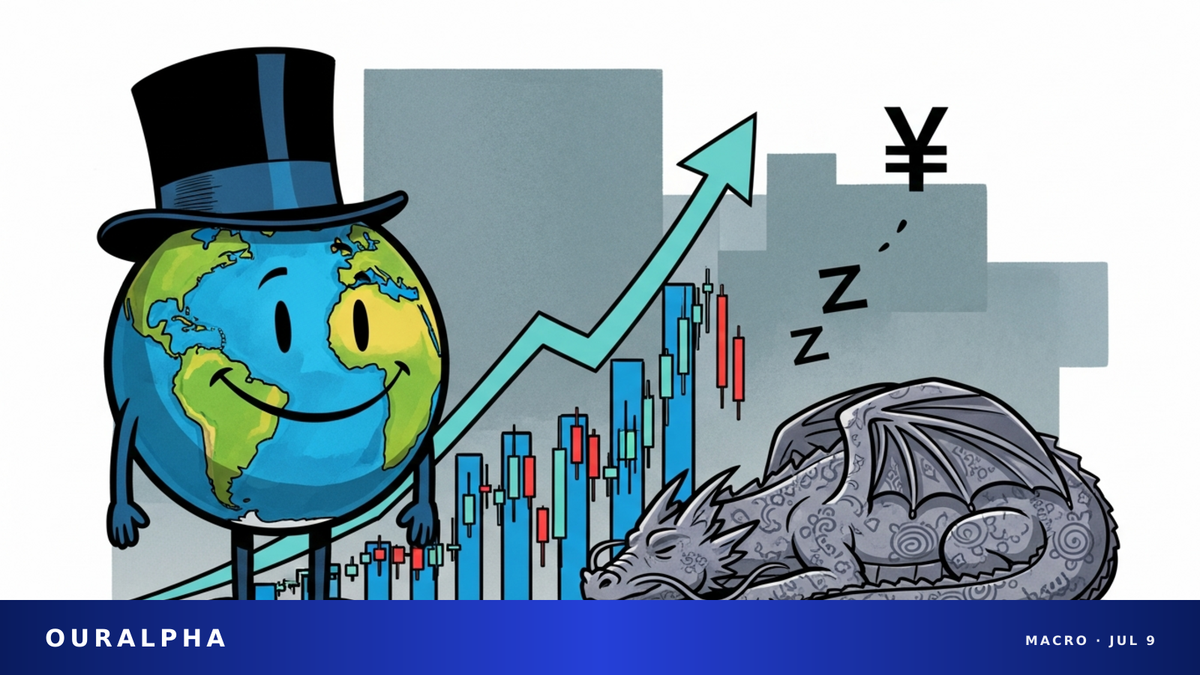
Iran Strikes and Yen Plunge Rattle Global Markets

Renewed U.S.-Iran hostilities and a deepening yen crisis sent stocks sliding and oil surging. Investors brace for more volatility as inflation fears and recession risks collide.

Iran strikes and yen plunge rattle global markets
The dual shock of Middle East conflict and Japan's debt crisis has global markets on edge.

Renewed Middle East hostilities and Japan’s deepening debt crisis are whipsawing global markets caught between inflation and recession fears. As of 9 a.m. ET on July 9, investors are still digesting yesterday’s sharp selloff, a spike in oil prices, and the yen’s relentless slide.

  • On July 8, the S&P 500 fell 1.5% and the Dow Jones Industrial Average plunged more than 800 points after President Trump declared the ceasefire with Iran “over.”[WBGO]
  • Brent crude spiked 8% to $80.12 a barrel on July 8, while WTI jumped 7.7% to $75.83. In Asian trading on July 9, Brent added another 1.1% to $78.88.[Times of Israel][Greenwich Time]
  • The yen hit 162.30 against the dollar on July 6, down 3.6% year-to-date and nearly 11% over the past year, approaching 40-year lows.[Fortune]
  • Market pricing for a Fed rate hike in July has risen to more than one-third, up from about one-quarter the day before, according to the CME FedWatch tool.[WBGO]
  • Japan’s 10-year bond yield climbed, and the 2-year U.S. Treasury yield briefly hit 4.23%, near last month’s highs.[Bloomberg]
  • Asian markets were mixed on July 9: Japan’s Nikkei 225 rebounded 1.6%, but Hong Kong’s Hang Seng fell 0.8%.[Greenwich Time]

Global financial markets were rocked on July 8-9, 2026, as the fragile U.S.-Iran ceasefire collapsed and Japan’s debt crisis sent the yen spiraling lower. Investors are now caught between rising inflation pressures and slowing growth. As of 9 a.m. ET on July 9, the mood remains tense as the market digests the triple shock of a steep U.S. stock selloff, surging oil prices, and a weakening yen.

Middle East Hostilities Roil Oil and Equities

Speaking at the NATO summit in Turkey, President Trump declared the U.S.-Iran ceasefire “over” and said the U.S. would “hit Iran hard” that night.[Times of Israel] The U.S. military then launched airstrikes on dozens of targets along Iran’s coast in retaliation for Iranian attacks on vessels trying to transit the Strait of Hormuz.[WBGO] Iran responded by striking targets in Bahrain, Kuwait, and Qatar.[Greenwich Time]

The escalation sent shockwaves through markets. On July 8, Brent crude spiked 8%, briefly topping $80 a barrel before settling near $78.88, while WTI jumped 7.7% to $75.83.[Times of Israel] ING commodity strategists Warren Patterson and Ewa Manthey noted in a commentary: “The oil market continues to rally as the U.S.-Iran ceasefire appears to be hanging by a thread.” They added that tanker-tracking data shows fewer vessels transiting the Strait of Hormuz, reigniting supply fears.[Greenwich Time]

U.S. equities tumbled. The Dow plunged more than 800 points, or 1.5%, just two days after hitting an all-time high.[WBGO] Barron’s reported that the stock market, which had been calm through early summer, was jolted awake by Trump’s renewed Iran war threats, sending volatility gauges soaring.[Barron's] Chris Beauchamp, chief market analyst at IG, said: “The re-eruption of war between the U.S. and Iran, or at least the latter’s re-blockade of the Strait, has triggered a wave of selling in European markets that are highly dependent on energy costs.”[Times of Israel]

Yen Crash: A Slow-Motion Train Wreck

Alongside the Middle East turmoil, Japan’s financial markets are in turmoil. The yen hit 162.30 against the dollar on July 6, down 3.6% year-to-date and nearly 11% over the past year, nearing 40-year lows.[Fortune] Fortune described the yen’s slide as “a slow-motion train wreck.”

Robin Brooks, a senior fellow at the Brookings Institution and former chief economist at the Institute of International Finance, has been warning about the yen. He notes that Japan’s massive debt—240% of GDP—forces the Bank of Japan to cap bond yields to control interest costs, masking the debt crisis while also sapping investor appetite for yen-denominated assets, putting downward pressure on the currency.[Fortune] He argues that intervention efforts by Japanese authorities are “doomed to fail.”

Multiple factors are driving the yen lower. The oil price shock from the Iran conflict is adding to Japan’s inflation pressures, while the market sees the BOJ as slow to respond. Meanwhile, the Fed and other major central banks may tighten further, making Japan’s monetary policy look even more accommodative. Prime Minister Sanae Takaichi’s plans to increase the fiscal deficit to stimulate the economy are also fueling inflation expectations, adding to the yen’s downward pressure.[Fortune] While a weaker yen helps Japanese exporters, Fortune notes it risks friction with trading partners like the Trump administration and fuels domestic inflation through higher import costs, especially for energy.

Inflation Fears and Fed Rate-Hike Bets Rise

The Middle East conflict and yen weakness are compounding global inflation uncertainty. The IMF had already cut its 2026 global growth forecast to 3%, down from 3.5% last year.[WBGO]

Market expectations for Fed policy have shifted sharply. According to the CME FedWatch tool, the probability of a rate hike in July has risen to more than one-third, up from about one-quarter before the ceasefire collapsed.[WBGO] Bloomberg reported that escalating Middle East tensions and the oil spike have reignited inflation fears, prompting money markets to pull forward expectations for the next Fed rate hike from December to October.[Bloomberg]

Bond markets also saw heavy volatility. On July 8, the 2-year Treasury yield rose 5 basis points to 4.23%, near last month’s highs, while the 10-year yield hit its highest level since late May.[Bloomberg] The Fed’s June meeting minutes showed several officials saw a case for raising rates, even though they ultimately voted to hold steady. The minutes reflected growing inflation concerns even as labor market worries eased slightly.[Bloomberg]

Asian Markets Diverge: Chip Stocks Bounce on AI Hope

Asian markets were mixed on July 9, not fully following Wall Street lower. Japan’s Nikkei 225 rebounded 1.6% after earlier losses, led by chip-equipment maker Tokyo Electron, which surged 5%.[Greenwich Time] South Korea’s KOSPI edged up 0.1% after plunging 5.4% on Wednesday.[Greenwich Time]

Bloomberg noted that Asian chip stocks were lifted by optimism over AI-driven demand. SK Hynix’s U.S. listing was more than 7 times oversubscribed, and its Seoul-listed shares rose 7.8%.[Bloomberg] Takashi Ito, senior strategist at Nomura Securities, said: “While developments in the Middle East remain worrying, the market doesn’t seem to see this as a full exit signal. The prevailing logic is that investors can continue to invest in AI and chip stocks that are expected to deliver high long-term returns.”[Bloomberg]

Not all markets were buoyed by AI. Hong Kong’s Hang Seng fell 0.8%, and Apple supplier Luxshare Precision dropped 5% on its Hong Kong debut.[Greenwich Time] China’s June PPI rose 4.1% year-over-year, up from 3.9% in May, with some economists attributing the increase to cost pressures from the Iran war.[Greenwich Time]

This content is for informational purposes only and does not constitute investment advice, trading advice, or any guarantee of returns.

Keep Reading

Tesla Earnings Preview: Why Wall Street Is Betting on a Blowout Quarter

Tesla Earnings Preview: Why Wall Street Is Betting on a Blowout Quarter

As Q2 earnings season kicks into high gear, all eyes are on Tesla (TSLA). As of 4:00 PM ET on July 9, shares closed at $406.13, up 3.06% from the prior session. A growing chorus of analysts and institutions expects Tesla to deliver a "blowout" quarter, fueled by AI infrastructure spending and a resilient economy. But the market is also on edge — when expectations run this hot, even a minor miss can spark volatility.

  • As of 4:00 PM ET on July
Read full story →

Stay ahead of the market — never miss a deep dive

Follow OurAlpha for AI-driven US equity research and market insight, every day.