Nasdaq's AI Weight Reshuffle Is Coming — Will the S&P 500 Follow?
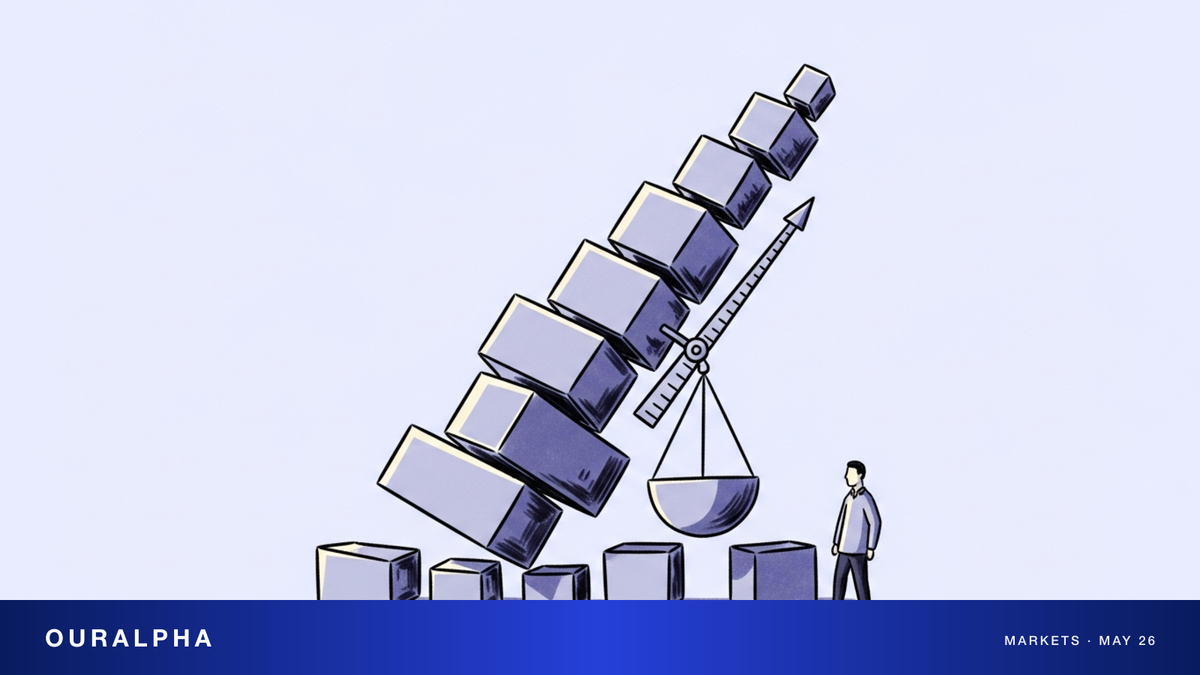
Nasdaq may execute another special rebalance in H2 2026 to address NVDA, AAPL, and MSFT's combined 35%-plus grip on the QQQ. The bigger structural question: whether the S&P 500 eventually adopts its own concentration caps — and reprices $6 trillion in passive flows.
TL;DR
On May 25, 2026, 24/7 Wall St. published a detailed analysis arguing that Nasdaq is planning another special rebalance of Big Tech's index weights — similar to July 2023 — to address the extreme concentration of NVDA, AAPL, and MSFT, which together now account for more than 35% of the Nasdaq-100 (tracked by QQQ).
- The July 2023 special rebalance cut the then-Magnificent 7's combined weight from over 50% back to roughly 44%
- This time, the pressure point is even narrower: the top 3 alone are above 35%
- The real second-order question: will the S&P 500 (SPY) follow with its own rule changes? The S&P remains purely market-cap weighted with no concentration caps
- Once executed, passive index funds tracking QQQ and SPY — trillions in combined AUM — must rebalance to new weights, with meaningful short-term impact on individual stocks
On May 25, 2026, 24/7 Wall St. published a long-form piece arguing that Nasdaq is preparing another special rebalance of Big Tech's index weights — mirroring the July 2023 episode — to address the extreme concentration of NVDA, AAPL, and MSFT, which together now exceed 35% of the Nasdaq-100 (the index tracked by QQQ).
The implications run deeper than they appear. This reshuffle directly determines the relative performance of individual Mag 7 names in H2 — once executed, passive index funds mechanically rebalance to new weights, creating non-fundamental relative swings of 3-5% in single stocks. This piece breaks down three things: what rule Nasdaq is changing, which stocks are most exposed, and whether the S&P 500 might follow suit.
How Nasdaq's Rebalance Rules Work
To understand this rebalance, start with the July 2023 precedent.
On July 24, 2023, Nasdaq executed a special rebalance with one goal: pull the combined weight of NVDA, MSFT, AAPL, AMZN, GOOGL, META, and TSLA — the then-Magnificent 7 — in the Nasdaq-100 from over 55% back down to roughly 44%.
The specific rule at play: the Nasdaq-100 caps any single component at 24%, and requires that the combined weight of all components above 4.5% not exceed 48%. The 2023 trigger was the second threshold being breached.
By May 2026, similar pressure had built again — but in a narrower configuration.
NVDA alone is approaching the 24% cap. AAPL and MSFT together add another 11-12%. All three combined exceed 35%. With QQQ's AUM sitting near $320 billion, the combined passive exposure to just these three names exceeds $110 billion.
24/7 Wall St.'s core argument: Nasdaq is internally evaluating whether to trigger a new special rebalance in H2 2026, cutting NVDA's individual weight and lifting the rest of the index proportionally. If executed, July or October are the most likely windows — both months have historically hosted Nasdaq-100 special rebalances.
Which Stocks Are Most Exposed
A special rebalance works mechanically — Nasdaq recalculates every component's weight using a set of formulas and requires passive funds to rebalance accordingly. For this specific episode:
Likely to be trimmed:
- NVDA — the single largest cut; weight could be pulled from near 24% down to the 18-20% range, implying $20-30 billion in passive outflows
- AAPL — also likely trimmed, but by a smaller margin than NVDA
- MSFT — depending on the exact formula, may hold steady or take a small trim
Likely to benefit:
Based on how the 2023 rebalance played out, passive flows redistributed across the remaining 90-plus Nasdaq-100 components, with the biggest relative gains going to names ranked 8th through 20th by weight. This year's candidates include:
- AVGO (Broadcom) — currently around 4.5% in the Nasdaq-100, likely to be bumped higher
- TSMC is not in the Nasdaq-100 — it trades on NYSE under global index rules, so it is unaffected here
- COST, ADBE, NFLX — traditional large-cap index members that benefit in relative weight
- AMD, Palantir, CrowdStrike — mid-cap AI names with smaller bases; the relative benefit is proportionally larger
For individual investors, two practical takeaways: First, if you're heavily concentrated in NVDA single-stock, expect a non-fundamental passive selling headwind in H2 — one that has nothing to do with earnings or guidance. Second, QQQ as a whole is unaffected — this is purely an internal weight redistribution; total market cap doesn't change.
Will the S&P 500 Follow with Rule Changes?
This is the real second-order question.
The S&P 500 (tracked by SPY) is purely market-cap weighted — no caps of any kind. In theory, a single company could reach 30% or 40% of the index if its market cap supported it. The Nasdaq-100 has a 24% single-name cap; the S&P 500 has none.
That structural gap hasn't mattered much — until recently. Since 2026, the Mag 7's combined S&P 500 weight has approached 35%, exceeding the peak concentration of tech and telecom stocks at the height of the 1999 dot-com bubble. This is the highest single-sector concentration the S&P 500 has ever seen.
If NVDA's S&P 500 weight crosses 10% — it sits around 8% today — the S&P Index Committee faces an uncomfortable choice: let it keep climbing and allow one stock to drive the entire index, or change the rules and introduce Nasdaq-style concentration caps.
24/7 Wall St. closed with a pointed observation: the probability that the S&P 500 adopts new concentration rules rises every quarter. If it happens — possibly not until 2027 — it would be the single biggest structural shift in US equities since 2026: more than $6 trillion in passive S&P exposure would be forced to rebalance.
Should You Reposition Ahead of Time?
If Nasdaq executes a special rebalance in July or October, here are four ways to think about positioning:
1. Don't go all-in on NVDA single-stock. It faces the largest passive selling pressure of any Mag 7 name in H2. Consider shifting some exposure into SOXX (semiconductor ETF) or QQQ itself to dilute single-stock concentration risk.
2. Ranks 4-10 in the Nasdaq-100 are relative beneficiaries. AVGO, COST, and ADBE could all see incremental passive inflows. If the underlying fundamentals hold, that rebalancing tailwind is an additional return driver on top of the thesis.
3. Leave SPY alone for now. S&P rule changes are a 2027 story at the earliest — no near-term impact. But for longer-horizon positioning, the equal-weight S&P 500 ETF (RSP) is more resilient than SPY by construction, with no inherent concentration risk.
4. Watch the passive-vs.-active flow window. Once a special rebalance is officially announced — typically 1-2 weeks in advance — active funds may front-run while passive funds rebalance on a daily cadence. That window is when single-stock volatility peaks.
Put simply: this is the biggest non-fundamental catalyst for Mag 7 internals in H2 2026. Fundamentals don't change — but the weights do. Whoever captures the inflow gets a relative outperformance window. Whether to position ahead of time comes down to whether you're willing to wait out a multi-month trade for a passive rebalancing premium to materialize.
Sources
- The Nasdaq's AI Fast-Track Will Reshape Big Tech — And Put the Index in a Different League From the S&P 500 — 24/7 Wall St.
- Nasdaq-100 Index Methodology — Special Rebalance Rules — Nasdaq
- S&P 500 Index Methodology — Market-Cap Weighting Rules — S&P Global
- Invesco QQQ Trust — Holdings & Weights — Invesco
This content is for informational purposes only and does not constitute investment advice, trading advice, or any guarantee of returns.