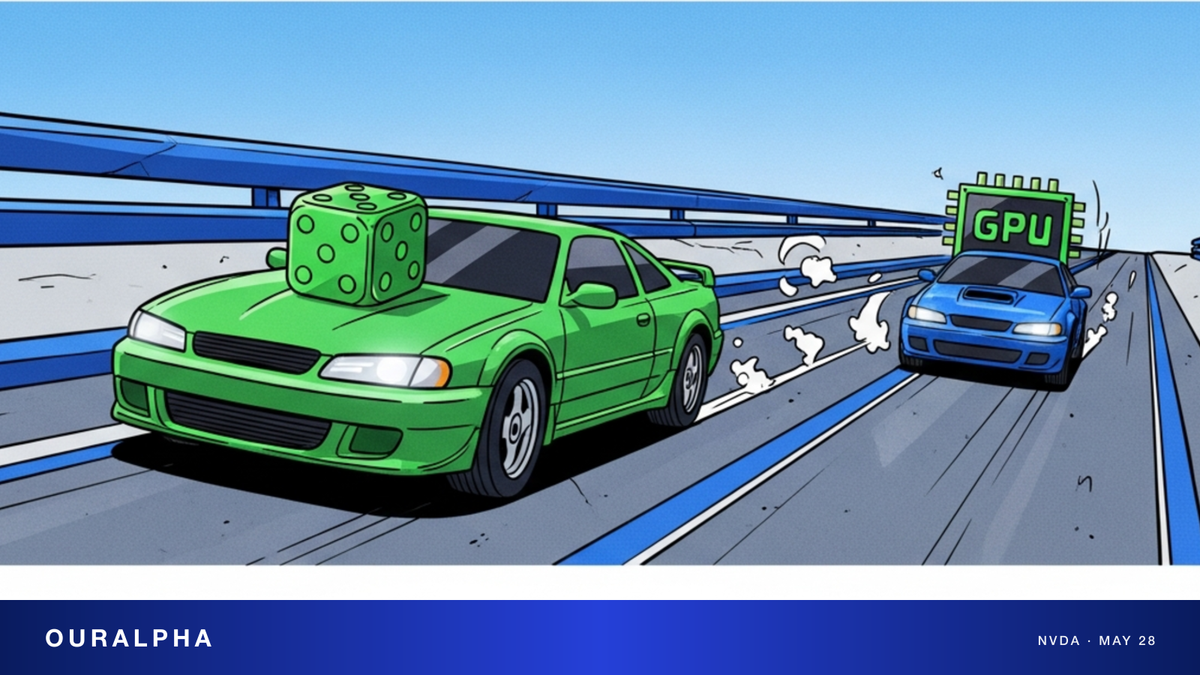
Nvidia Lost 10% in Six Days. The Money Didn't Leave AI — It Rotated.

NVDA pulled back 9.5% from its all-time high while Micron surged 19% and CoreWeave kept climbing. This isn't the AI narrative breaking — it's capital rotating from GPU design to the second tier of the compute stack.

NVIDIA stock chart showing pullback from all-time high of $236.54 to $213.95 in May 2026
NVDA hit an intraday all-time high of $236.54 on May 14, then retreated 9.5% to $213.95 by May 27 as capital rotated into HBM, power infrastructure, and GPU cloud rental plays.

TL;DR

Nvidia (NVDA) hit an all-time high of $236.54 on May 14. By May 27 it closed at $213.95 — a 9.5% drawdown over six trading sessions. Meanwhile, Micron (MU) popped 19% to cross the $1T market cap threshold, CoreWeave (CRWV) kept climbing, and Vistra (VST) held near its own highs. This is not an AI narrative cracking. It's a sector rotation — capital shifting from the first stop on the AI compute chain (GPU design) to the second: HBM, ASIC foundry, power infrastructure, and GPU cloud rental.

  • NVDA: May 14 $236.54 → May 27 $213.95 (−9.5%); MU +19%, TSM at new highs in the same window
  • May 20: NVDA Q1 FY27 earnings — revenue $81.6B (+85% YoY), data center $75.2B (+92%), quarterly FCF $49B (record) — fundamentals are intact
  • The divergence: NVDA's forward PE is already ~35x; HBM/ASIC/power/cloud rental are still in early re-rating
  • Key signals ahead: NVIDIA GTC China / Computex keynote in June, TSMC Q2 results in July

Nvidia (NVDA) touched an intraday all-time high of $236.54 on May 14 and closed at $213.95 on May 27 — a 9.5% pullback over six trading sessions. In that same window, Micron popped 19% to cross $1T in market cap, CoreWeave kept strengthening, and Vistra held near its own record high.

That combination — the marquee name pulling back while sector peers rally — is textbook rotation, not an AI narrative collapse. Capital is moving from GPU design to the "second tier" of the AI compute stack: HBM, ASICs, power infrastructure, and GPU cloud rental.

NVDA's Fundamentals Are Fine — Q1 FY27 Confirmed It

On May 20, Nvidia reported Q1 FY2027 results:

Metric Q1 FY27 Actual Consensus Est. YoY
Revenue $81.6B $79.2B +85%
Data Center Revenue $75.2B $73.5B +92%
Networking Revenue (within DC) $14.8B +199%
Non-GAAP EPS $1.87 $1.77
Gross Margin 74.9% −0.1pp QoQ
Quarterly FCF $49B Record high
Quarterly Dividend Raised 25x + new buyback authorization

Every line beat consensus. So why did the stock sell off after earnings?

First, the stock had already run from $208 on May 1 to $236.54 on May 14 — an outsized beat was already priced in before the print dropped.

Second, gross margin dipped 0.1pp QoQ. Tiny in isolation, but the market is hyper-sensitive to any sign that NVDA's GM expansion cycle is peaking — and bears ran with it.

Third, the 25x dividend hike and buyback authorization read to some as a capital-return story rather than a growth story. It's a stretch, but in a tape conditioned to expect aggressive reinvestment from AI hyper-growers, "we're returning cash" carries an implied signal that management sees fewer internal uses for it — fair or not.

Where the Rotation Money Went

Stack up the AI-chain names over the same period:

Ticker May 14 Price May 27 Price Change Role
NVDA $236.54 $213.95 −9.5% GPU design
MU (Micron) ~$751 $895.88 +19% HBM / DRAM
TSM Near highs Near highs ~Flat Foundry
AVGO (Broadcom) Near highs Near highs ~Flat ASIC / networking
VST (Vistra) Near highs Near highs ~Flat AI power
CRWV (CoreWeave) Strengthening GPU cloud rental

The capital logic is clear: NVDA has become the shorthand for AI compute. At ~35x forward PE and a $4T+ market cap, further outperformance requires new catalysts — Rubin production ramp, China export restrictions easing, something genuinely incremental.

HBM, ASIC, power, and cloud rental are still in the early stages of re-rating. MU was at 5x forward PE four months ago; it's at 12x now. VST was priced as a traditional utility a year ago; it now trades at an AI power premium. CRWV has been public for just over a year, and the market is still in price-discovery mode on the GPU-cloud business model. The multiple expansion runway is longer on all of them.

Healthy Rotation, or Is NVDA Actually Topping?

Honest framework: this pullback looks more like healthy rotation than a top signal. Four reasons:

First, a 9.5% drawdown is modest. NVDA has pulled back 15–20% multiple times over the past 24 months — every instance was price digestion after a fast run, not fundamental impairment.

Second, data center revenue +92% YoY is the most direct evidence that hyperscaler capex is flowing. As long as any major cloud player — Microsoft, Meta, Google, Amazon — keeps capex intact, NVDA's backlog holds.

Third, there was no broad semiconductor selloff. SMH held firm while NVDA slipped. That's rotation within the sector, not an exit from it.

Fourth, post-earnings sell-the-news after a beat is a well-established NVDA pattern — six trading sessions of digestion is not an anomaly.

That said, two risks deserve watching:

One: 35x forward PE is at the high end of NVDA's historical range. If Q2 FY27 revenue or data center growth can't sustain the ~85% YoY pace, multiple compression becomes a real headwind.

Two: China uncertainty isn't going away. NVDA's China sales are already heavily restricted to export-compliant SKUs like the H20. Any escalation in US–China AI export controls will pressure the multiple further.

Three Catalysts That Matter Most

One: Computex (early June) + NVIDIA GTC China (if held). Jensen Huang's keynotes will set the next narrative arc. Rubin ramp timeline, enterprise AI shipments, and Sovereign AI case studies are the key signals.

Two: TSMC Q2 results + capex guidance (July). TSMC is the binding constraint on NVDA's production capacity. TSMC's Q2 print and full-year capex guide will shape how the market reads NVDA's ability to ship against its backlog.

Three: Hyperscaler Q2 earnings capex guidance (late July–August). Any major cloud player cutting 2026 full-year capex will amplify NVDA multiple compression significantly.

Bottom line: At $213.95, NVDA is a "strong fundamentals + valuation already pricing in high growth + short-term rotation headwind" story. For investors without a position, this pullback isn't a textbook buy-the-dip setup — it looks more like a "wait for an August-to-October Rubin production confirmation signal before acting" window. For existing holders, this is noise, not a trend change — though anyone overweight might use the dip as a rebalancing opportunity.

This content is for informational purposes only and does not constitute investment advice, trading advice, or any guarantee of returns.

Keep Reading

Alphabet’s Antitrust Headache Deepens: Sweden Orders $1.5B Payout to Klarna, South Korea Opens New Probe

Alphabet’s Antitrust Headache Deepens: Sweden Orders $1.5B Payout to Klarna, South Korea Opens New Probe

Alphabet edged higher in early trading Tuesday, but antitrust pressure is building. A Swedish court ordered Google to pay Klarna $1.5 billion in damages, while South Korea’s antitrust watchdog launched a fresh probe.

  • Price action: As of 9:30 a.m. ET on July 1, Alphabet (GOOGL) was at $357.98, up 0.17% (+$0.61) from Friday’s close of $357.37. Opened at $358.38, with an intraday range of $357.89–$358.39.
  • Swedish verdict: The Stockholm District Court ruled
Read full story →

Stay ahead of the market — never miss a deep dive

Follow OurAlpha for AI-driven US equity research and market insight, every day.