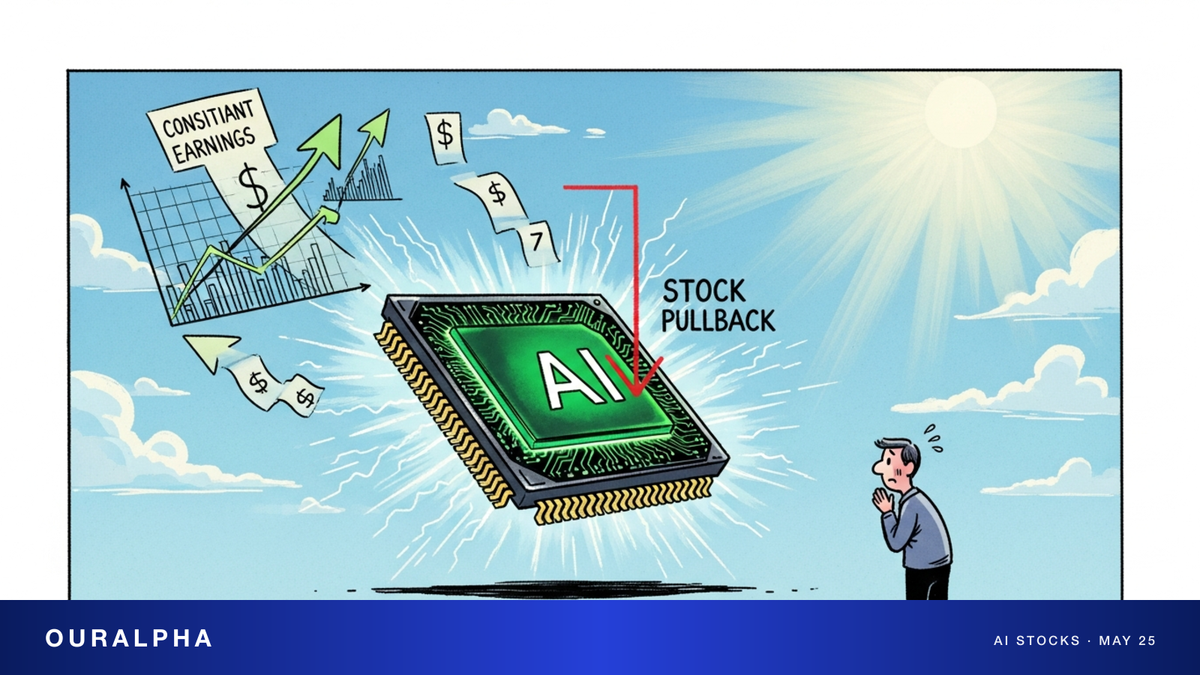
Nvidia Beat on All Three Lines — So Why Is NVDA Down 1.94%?
Nvidia crushed revenue, operating margin, and guidance, yet shares slid for three straight days after earnings. The market isn't saying AI is broken — it's saying "strong" is no longer enough.
TL;DR
Nvidia (NVDA) closed Friday at $215.33, down 1.94%, with a market cap of roughly $5.25 trillion. The company beat on revenue, operating margin, and forward guidance — all three — yet shares fell for three consecutive days. Investopedia's read: nothing broke in the fundamentals; the market had simply priced expectations so high that "strong" wasn't enough.
- Data center revenue topped even the most aggressive sell-side estimates; Blackwell shipments exceeded last quarter's company guidance; gross margin held at the 73% second-half target
- Options markets had priced in 7%+ implied move for the day — when results came in "strong but not explosive," unwinding those positions dragged the stock lower
- Three forces compressed the upside surprise window: hyperscaler capex visibility is fully baked in, Blackwell is now a known platform, and cloud-native ASICs are in production
- The AI theme isn't broken — the baton is passing to adjacent infrastructure names (Vertiv, Eaton, ASML, Arista, and others)
Nvidia (NVDA) closed Friday at $215.33, off 1.94% on volume well above its 20-day average, with a market cap of roughly $5.25 trillion — still the single most actively traded stock in the US market. The pullback came less than a week after an earnings report that beat consensus on revenue, operating margin, and forward guidance, the kind of trifecta that historically drives 3–5% single-day gains. Instead, the stock gave it all back and then some over multiple sessions.
Investopedia framed it cleanly: strong fundamentals, falling stock — the market isn't telling investors the AI thesis is broken; it's telling them that pre-earnings consensus had already been set so high that "strong" simply wasn't enough.
How Strong Was the Quarter?
The numbers were unambiguously good.
Data center revenue growth exceeded even the most aggressive sell-side estimates. Blackwell shipments came in above the guidance management had set last quarter. Gross margin held at the 73% level flagged for the second half of the year. Q3 guidance implied continued sequential acceleration in data center demand, and management explicitly confirmed that major cloud customers are adding orders, not pulling back.
In any other quarter, that scorecard would have produced a clear upside move on the day. Instead, the stock declined for three straight sessions, sliding from around $228 before the print to Friday's close of $215.33.
The most direct explanation: the market had been positioned for something bigger. In the two weeks before earnings, whisper numbers pushed Blackwell capacity estimates higher still; sell-side notes pulled forward timelines for the next-generation Rubin platform; options markets priced in an implied move of 7% or more for the session. When results came in "strong but not explosive," position unwinds did the mechanical work of pushing the price lower — the underlying business hadn't changed.
Why the Upside Bar Got So Compressed
Three forces have been steadily narrowing the window for Nvidia to surprise to the upside.
First, hyperscaler capex visibility is now fully priced in. Twelve months ago, AI infrastructure spending was still a question mark. Today it's a commitment — the debate has shifted from "will they spend?" to "at what pace?" Microsoft, Google, Amazon, and Meta have all confirmed multi-quarter capex acceleration. The demand-side variable that used to fuel upside surprises is essentially gone; what's left is supply-side execution.
Second, Blackwell is now a known platform. The open questions around yield, advanced packaging, and HBM memory availability that dominated discussion a year ago have largely been answered. That's unambiguously good for the business — but it also removes the option value the stock carried through the Hopper-to-Blackwell transition.
Third, the competitive picture is shifting at the margin. The three major cloud providers' homegrown ASICs — Google's TPU, Amazon's Trainium, Microsoft's Maia — are scaling up and beginning to displace incremental Nvidia silicon on specific internal workloads. The market still reads them as complementary rather than substitutes, but the mere existence of a second source caps the most aggressive bull-case assumptions on Nvidia's data center pricing power.
What to Do Now
This pullback is the sharpest stress test the AI theme has faced in 2026. The honest answer: the thesis isn't broken. Nvidia remains the dominant platform for AI infrastructure, and its data center revenue trajectory is still the single most important line item in corporate America's earnings picture. What has changed is the price the market is willing to pay for incremental upside.
That asymmetry matters for portfolio construction. If the AI theme is going to keep lifting the broader market, leadership has to broaden beyond Nvidia. Adjacent infrastructure names — power and cooling (Vertiv, Eaton, Quanta Services), upstream semis (ASML, Lam Research LRCX), networking (Arista, Cisco CSCO) — carry less stretched multiples and offer meaningful operating leverage to the same demand backdrop. The post-earnings tape is the market's invitation to make that rotation.
Tactically, Friday's close at $215 puts the stock roughly 5% below its post-earnings peak and about 12% below the most bullish sell-side targets. With the next earnings cycle three months out — and Blackwell production ramping deeper while Rubin platform details are likely to be firmed up — that is probably the more appropriate window for investors who hold Nvidia as a multi-year AI position to add.
Four Things to Watch
1. Hyperscaler capex commentary on the next round of earnings calls. Any upward revision to Microsoft, Google, or Amazon capex guidance would immediately reset Nvidia's upside case.
2. Gross margin trajectory. Management's color on where Blackwell margins land in the second half of 2026 is the single most important variable for the forward P/E.
3. A credible Rubin production timeline. The first time management puts a believable mass-production date on Rubin, the stock gets its option value back.
4. Nvidia's performance relative to AI infrastructure peers. As long as the infrastructure adjacents keep outperforming Nvidia, the post-earnings dip reads as healthy rotation — not thesis breakdown.
The bear case requires a material pullback in hyperscaler capex — not a sentiment reset. $215 is the latter, not the former.
Sources
This content is for informational purposes only and does not constitute investment advice, trading advice, or any guarantee of returns.