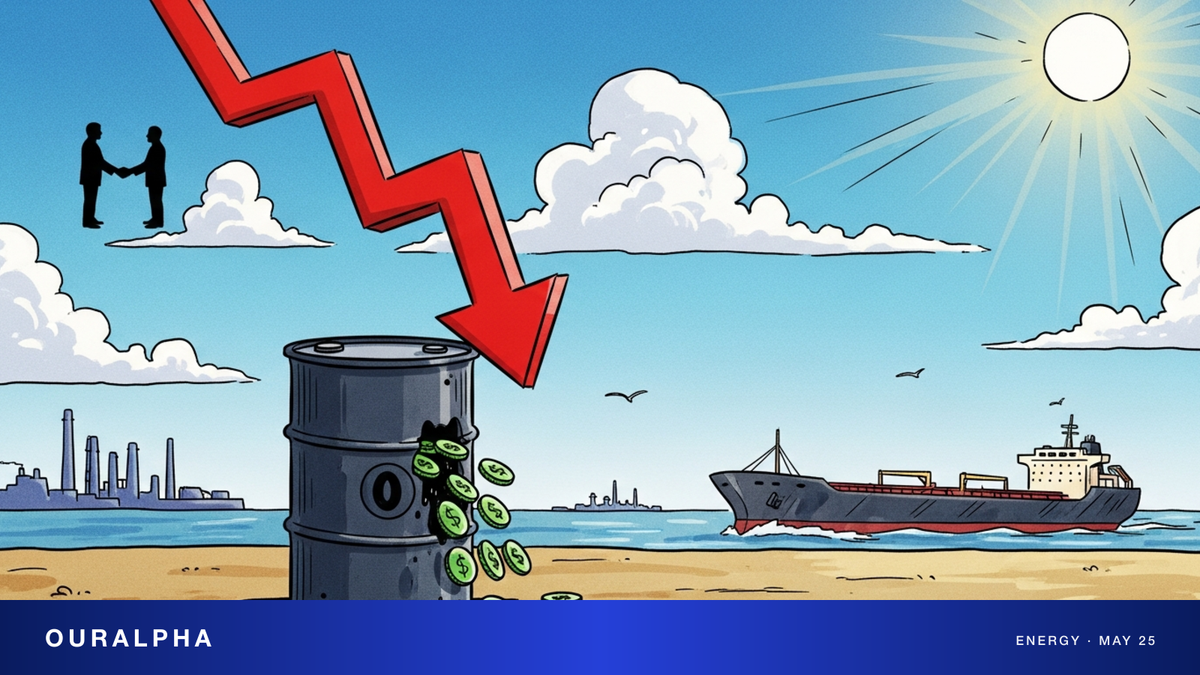
One Diplomatic Headline Sends WTI Down 4%

A weekend media blitz on US-Iran backchannel talks wiped out two weeks of geopolitical risk premium in a single holiday session. Energy stocks are on the back foot; airlines, freight, and long-duration tech are catching a tailwind.

Oil Prices Tumble as Iran Deal Hopes Lift U.S. Stock Futures

TL;DR

In thin Memorial Day trading on 5/25, WTI crude futures fell more than 4% intraday, touching $92; Brent dropped nearly 5%. The catalyst wasn't a signed deal — it was weekend reports that Washington and Tehran are exploring a diplomatic framework designed to keep the Strait of Hormuz open. Markets aren't pricing in a done deal; they're pricing in a meaningful drop in worst-case-scenario odds.

  • WTI closed Friday above $96, hit ~$92 in Monday holiday trading, settled near $93
  • Energy ETF (XLE) pointed lower pre-market; XOM, CVX, OXY, and COP all marked down
  • Concurrent moves: short-end Treasuries ticked up, dollar flat, CAD and NOK weakened
  • Three sector rotations in motion: energy gives back gains + airlines/freight/consumer get a tailwind + AI and long-duration growth stocks reclaim a macro bid

In Monday's holiday session on 5/25, WTI June futures fell more than 4%, touching an intraday low near $92; Brent followed, dropping close to 5% into the upper-$90 range. Barron's intraday data showed the oil sell-off happening in lockstep with a rally in U.S. equity futures — the classic "stocks up, oil down" combination that signals markets rapidly stripping out the geopolitical risk premium that had been built into the energy complex over the prior two weeks.

The trigger wasn't a confirmed agreement. It was a weekend round of media reports that Washington and Tehran are exploring a diplomatic framework aimed at preventing a disruption to the Strait of Hormuz. Markets aren't pricing a signed deal — they're pricing a material reduction in tail-risk probability.

Key Price Action

WTI had closed Friday above $96 before touching ~$92 in Monday's holiday session and settling near $93. Brent moved in parallel, falling into the upper-$90 area. The energy sector ETF (XLE) pointed lower in pre-market futures, with large-cap integrators ExxonMobil (XOM), Chevron (CVX), Occidental Petroleum (OXY), and ConocoPhillips (COP) all marked down.

In rates, short-dated Treasuries edged higher as the inflation impulse from crude eased; the 10-year yield dipped a few basis points in overnight trade. The dollar index held roughly flat, but commodity-linked currencies — the Canadian dollar and Norwegian krone — weakened, consistent with an oil-driven narrative.

Second-Order Transmission

A single-day oil move of this magnitude almost always ripples well beyond energy. Honestly read, Monday's signal suggests markets are repositioning on three fronts simultaneously.

First, energy's recent outperformance is starting to unwind. ExxonMobil, Chevron, Occidental, and ConocoPhillips were among the strongest performers in the cyclical rotation of the past two weeks. If WTI holds a path toward $90, consensus 2026 EPS models for the group face meaningful downward revision.

Second, fuel-cost-sensitive industries get a fresh tailwind — airlines (Delta DAL, United UAL, American AAL), express and freight carriers (FedEx FDX, UPS), and logistics-sensitive consumer names (Walmart WMT, Costco COST, Target TGT) all stand to benefit. Every sustained $5 drop in WTI translates to roughly $1 billion in annualized fuel-cost relief for the U.S. airline industry.

Third, with the most visible inflation input fading, long-duration growth stocks — Nvidia (NVDA), AMD, Broadcom (AVGO), and the broader AI infrastructure basket — reclaim a macro tailwind after two weeks of being caught in a "higher oil, higher rates" crossfire.

Diplomatic Signal or Position Unwind?

The honest framework here: this is a positioning unwind, not a signed agreement. The same risk that pushed WTI to $103 can push it back to $103 within 48 hours if the diplomatic story falls apart.

So the right question isn't "is the oil shock over?" — it's "if the US-Iran de-escalation holds, what does the asymmetry on both sides of my book look like?"

For portfolios that spent the weekend over-hedging into energy and underweighting airlines and transport, Monday's move is the beginning of a de-hedge, not a signal to flip the book entirely. The market structure remains fragile: holiday-thin liquidity amplifies price swings, and Tuesday and Wednesday's spot-market follow-through will tell investors whether this is genuine momentum or a headline-driven head-fake.

One second-order risk that's easy to overlook in the first 24 hours: high-yield (HY) credit. Energy-heavy high-yield spreads tighten sharply when oil rallies and widen when it falls. If WTI holds in the lower range through the week, expect HY credit spreads to drift modestly wider even as equities climb. That divergence is often a reliable signal for whether the equity rally has legs.

Three Things That Matter This Week

First, WTI spot closes Tuesday and Wednesday. If the contract holds below $94 and options implied vol continues to compress, the geopolitical premium is genuinely being priced out.

Second, XLE's performance relative to the S&P 500 and equal-weight indices. This is the most direct gauge of whether capital is actually rotating out of energy.

Third, Friday's April PCE print. If the US-Iran de-escalation holds and crude stays soft, energy's contribution to core inflation flips from a positive impulse to neutral or negative — and the path pricing ahead of the June Fed meeting gets reshuffled.

One frame worth keeping: the question is no longer "what does $100 oil mean for the AI trade?" — it's "can $90 oil clear the runway for AI stocks to lead the next leg higher?"

This content is for informational purposes only and does not constitute investment advice, trading advice, or any guarantee of returns.

Keep Reading

Alphabet’s Antitrust Headache Deepens: Sweden Orders $1.5B Payout to Klarna, South Korea Opens New Probe

Alphabet’s Antitrust Headache Deepens: Sweden Orders $1.5B Payout to Klarna, South Korea Opens New Probe

Alphabet edged higher in early trading Tuesday, but antitrust pressure is building. A Swedish court ordered Google to pay Klarna $1.5 billion in damages, while South Korea’s antitrust watchdog launched a fresh probe.

  • Price action: As of 9:30 a.m. ET on July 1, Alphabet (GOOGL) was at $357.98, up 0.17% (+$0.61) from Friday’s close of $357.37. Opened at $358.38, with an intraday range of $357.89–$358.39.
  • Swedish verdict: The Stockholm District Court ruled
Read full story →

Stay ahead of the market — never miss a deep dive

Follow OurAlpha for AI-driven US equity research and market insight, every day.