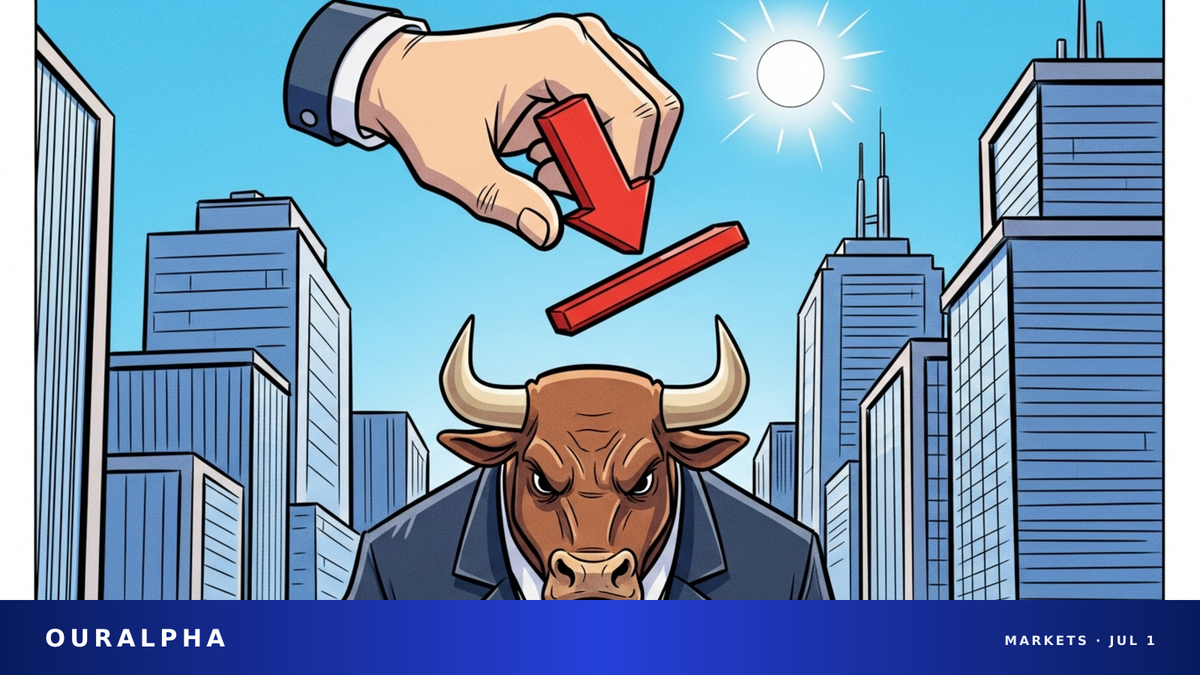
Oppenheimer Downgrades Goldman Sachs, Morgan Stanley; Wall Street Banks Under Pressure

Oppenheimer cut ratings on Goldman Sachs and Morgan Stanley, flagging structural headwinds for traditional investment banking. The firm is bullish on alternative asset managers Blackstone and KKR instead.

Oppenheimer downgrades Goldman Sachs, Wall Street banks under pressure
Oppenheimer's rare downgrade of Goldman Sachs and Morgan Stanley puts pressure on the Wall Street banking sector.

Oppenheimer issued a rare downgrade of Goldman Sachs (GS) and other top investment banks while signaling a preference for alternative asset managers. Goldman shares slipped in after-hours trading on the news.

  • As of 4:00 p.m. ET on June 30, Goldman Sachs (GS) closed at $1,011.37, down 0.87% from the prior close of $1,020.21.
  • Oppenheimer cut Goldman Sachs (GS) to "Market Perform" from "Outperform."
  • The firm also downgraded Morgan Stanley (MS) and expressed a bullish view on alternative asset managers Blackstone (BX) and KKR.
  • Oppenheimer analysts see structural challenges for traditional investment banking, while alternative asset managers benefit from capital inflows and fee income growth.
  • The rating change is notable given Oppenheimer's previously more optimistic stance on large investment banks.

In a research report published on June 30, Oppenheimer issued a rare downgrade of major U.S. investment banks, including Goldman Sachs (GS) and Morgan Stanley (MS), while expressing a bullish view on alternative asset managers Blackstone (BX) and KKR. Goldman shares came under pressure in after-hours trading on the news. As of 11:10 p.m. ET on June 30, Goldman Sachs was trading at $1,011.37, down 0.87% (-$8.84) from its prior close of $1,020.21, with an intraday range of $1,006.11 to $1,026.32.[Reuters]

Downgrade: From Bullish to Cautious

According to an exclusive report from Reuters, Oppenheimer analysts downgraded Goldman Sachs (GS) to "Market Perform" from "Outperform."[Reuters] The report noted that this rating change is unusual, as Oppenheimer had previously held a relatively positive view on the large investment banking sector. The downgrade signals a shift in the firm's expectations for Goldman's future stock performance, suggesting it no longer sees potential for above-market returns.

Oppenheimer analysts pointed to a series of structural challenges facing traditional investment banking, including intensifying competition, a shifting regulatory landscape, and uncertainty around the recovery in dealmaking activity. These factors, they argued, could limit earnings growth for large investment banks. The report also downgraded Morgan Stanley (MS), though Reuters did not disclose the specific rating change.[Reuters]

Alternative Asset Managers Get the Nod

In stark contrast to its cautious stance on traditional banks, Oppenheimer explicitly endorsed alternative asset managers in the same report. The firm believes companies like Blackstone (BX) and KKR are benefiting from sustained capital inflows, stable management fees, and more attractive growth prospects.[Reuters]

Analysts explained that the business model of alternative asset managers is more resilient in the current environment. These firms continue to grow their assets under management, generating stable and predictable fee income, while their investments in private equity, real estate, and infrastructure offer higher growth potential. In contrast, traditional investment banks rely more heavily on volatile trading and underwriting revenue.

Market Backdrop and Industry Moves

The rating changes come at a time when the U.S. stock market is near highs but sector rotation is intensifying. Goldman Sachs itself recently issued a bullish outlook on commodities. According to Kitco News, Samantha Dart, co-head of global commodities research at Goldman Sachs, said in a June 30 research report that "gold is not done," maintaining a bullish outlook on the metal.[Kitco News] Goldman expects ongoing structural demand from central banks to push gold prices to $4,900 per ounce by the end of 2026 and reiterated its year-end target of $5,400 per ounce. Dart noted that diversification demand from emerging-market central banks is a core support for gold prices, but acknowledged that the Federal Reserve's hawkish stance could pressure prices in the near term.[Kitco News]

Separately, concerns over debt levels at large tech companies are also rising. A June 28 report from 24/7 Wall St. examined Oracle's (ORCL) debt risk, noting that while the company has a $638 billion AI backlog, it is relying heavily on borrowing to expand its cloud infrastructure. This contrasts with cash-rich competitors like Microsoft, Amazon, and Google.[24/7 Wall St.] The report argued that Oracle's dependence on a single customer (OpenAI) and its high leverage are key reasons its stock is down 57% from its 52-week high.

This content is for informational purposes only and does not constitute investment advice, trading advice, or any guarantee of returns.

Keep Reading

Uber (UBER) Slides in Pre-Market as Lime IPO Prices at $25

Uber (UBER) Slides in Pre-Market as Lime IPO Prices at $25

Uber (UBER) is under pressure in pre-market trading Tuesday, with shares at $72.16 as of 5:00 a.m. ET, down 4.42% from Monday's close of $75.50. The move comes after reports that its backed micromobility company Lime has priced its IPO at $25 per share.

  • As of 5:00 a.m. ET on July 1, Uber (UBER) was trading pre-market at $72.16, down 4.42%.
  • Reuters, citing a Bloomberg News report, said Uber-backed Lime has set its IPO price at
Read full story →

Stay ahead of the market — never miss a deep dive

Follow OurAlpha for AI-driven US equity research and market insight, every day.