Chip Stocks Fall for the Fourth Time in Five Sessions as Semiconductor Selloff Deepens

Semiconductor stocks slid again Wednesday, marking their fourth down day in five sessions. The SOX dropped ~3.6%, tech is now ~11% off its recent highs, and hotter-than-expected CPI data is keeping rate fears alive.

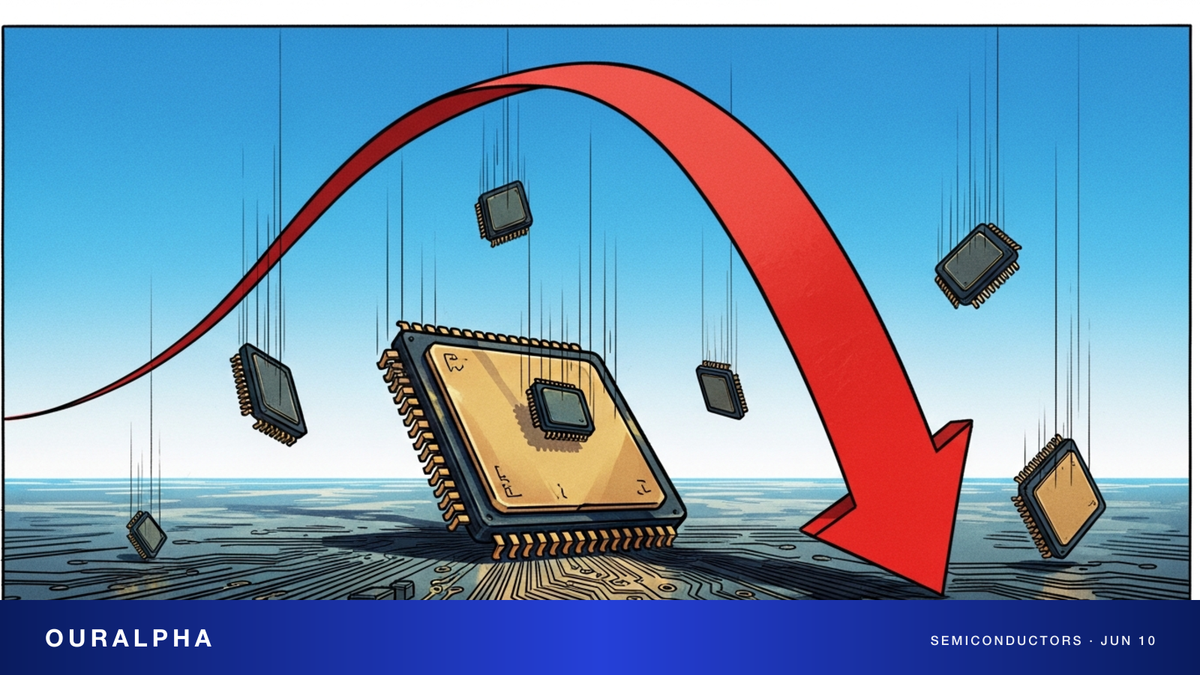
Semiconductor sector decline illustration with falling microchip and red downward arrow, OurAlpha US stock market news
Chip stocks have shifted from order-chasing to valuation digestion — single-day swings are getting bigger.

Bottom line: Semiconductor stocks fell again Wednesday (June 10), notching their fourth down day in the past five sessions. Geopolitical risk compounded the pressure, pulling the Nasdaq and S&P 500 lower as well.

  • The iShares Semiconductor ETF (SOXX) fell more than 3% intraday; the Philadelphia Semiconductor Index (SOX) dropped ~3.6%, per Reuters.
  • Micron (MU), AMD, and Broadcom (AVGO) all declined — each falling for the fourth time in five sessions.
  • May CPI came in at 4.2% YoY, the highest reading since April 2023, reinforcing "higher for longer" rate fears.
  • S&P 500 closed down 1.62% at 7,266.99; Nasdaq fell 1.98% to 25,169.50; the Dow shed 1.87%, or roughly 953 points.
  • Per MarketWatch, the tech sector has pulled back ~11% from its recent peak; the SOX is down ~12.3% from its high.
  • Context: The SOX had surged nearly 70% YTD before June 5, when it crashed more than 10% in a single session — its worst day in six years.

Semiconductor stocks came under renewed pressure Wednesday (June 10). Several large-cap chip names extended their losing streaks, with the iShares Semiconductor ETF (SOXX) falling more than 3% intraday; per Reuters, the Philadelphia Semiconductor Index (SOX) dropped ~3.6% on the day[CNBC]. It was the fourth down day for chip stocks in the past five sessions. Broader markets also fell: the S&P 500 closed down 1.62% at 7,266.99, the Nasdaq Composite slid 1.98% to 25,169.50, and the Dow Jones Industrial Average dropped 1.87%, or roughly 953 points[TheStreet].

Market Action and Notable Laggards

Per CNBC, Wednesday's chip-stock decliners included Micron (MU), AMD, and Broadcom (AVGO) — all three falling for the fourth time in five sessions[CNBC].

Beyond sector-specific dynamics, two macro and geopolitical developments weighed on the broader market Wednesday.

First, inflation ran hot. May CPI came in at 4.2% YoY — the highest since April 2023 — with energy prices surging 23.5% YoY amid the conflict with Iran. Core CPI did offer a partial offset, rising just 0.2% MoM, slightly below expectations[Trading Economics]. The hotter headline print reinforced "higher for longer" rate expectations, a headwind for richly valued growth stocks.

Second, geopolitical risk flared. Per TheStreet, President Trump signaled an escalation of military strikes against Iran, souring risk sentiment across markets[TheStreet].

How Far Off the Highs

To size up this pullback, investors have been watching cumulative drawdowns from recent peaks rather than day-to-day moves.

  • Per MarketWatch, the tech sector has now retreated ~11% from its recent high.
  • On the same basis, the SOX is down ~12.3% from its peak.
  • A drawdown of 10% or more is the conventional threshold for a technical correction.

Note that these drawdown figures are media-calculated estimates based on rolling closing prices, not officially published fixed values, and will shift with each session's close.

How the Selloff Started

The current chip-stock correction began June 5. Per multiple reports, the SOX plunged 10.26% that day — its worst single-session performance since March 2020 — wiping out more than $1 trillion in sector market cap[Crypto Briefing].

Markets broadly attributed the June 5 selloff to two catalysts:

  • Broadcom (AVGO) guided for next-quarter AI chip revenue of approximately $16 billion, short of the ~$17.2 billion analysts had expected.
  • A stronger-than-expected jobs report reinforced "higher for longer" rate fears, pressuring high-multiple growth names[CNN Business].

Going into that session, the SOX had already rallied nearly 70% YTD, leaving valuations and positioning stretched[Crypto Briefing].

The Market Debate

Views on the nature of this selloff remain divided.

Analysts cited by Yahoo Finance and others argued that underlying demand for AI compute and data-center infrastructure hasn't reversed course — that this looks more like a valuation reset and position rebalancing after a massive run. Others cautioned that the string of down days signals growing skepticism about whether AI capex can ultimately generate sufficient returns. Whether this is a correction within an ongoing bull run or the start of a genuine trend reversal remains an open question.

Key catalysts to watch: upcoming inflation and labor market data, Fed commentary, and forward capital expenditure and order guidance from major cloud providers and chipmakers.

This content is for informational purposes only and does not constitute investment advice, trading advice, or any guarantee of returns.

Keep Reading

Alphabet’s Antitrust Headache Deepens: Sweden Orders $1.5B Payout to Klarna, South Korea Opens New Probe

Alphabet’s Antitrust Headache Deepens: Sweden Orders $1.5B Payout to Klarna, South Korea Opens New Probe

Alphabet edged higher in early trading Tuesday, but antitrust pressure is building. A Swedish court ordered Google to pay Klarna $1.5 billion in damages, while South Korea’s antitrust watchdog launched a fresh probe.

  • Price action: As of 9:30 a.m. ET on July 1, Alphabet (GOOGL) was at $357.98, up 0.17% (+$0.61) from Friday’s close of $357.37. Opened at $358.38, with an intraday range of $357.89–$358.39.
  • Swedish verdict: The Stockholm District Court ruled
Read full story →

Stay ahead of the market — never miss a deep dive

Follow OurAlpha for AI-driven US equity research and market insight, every day.