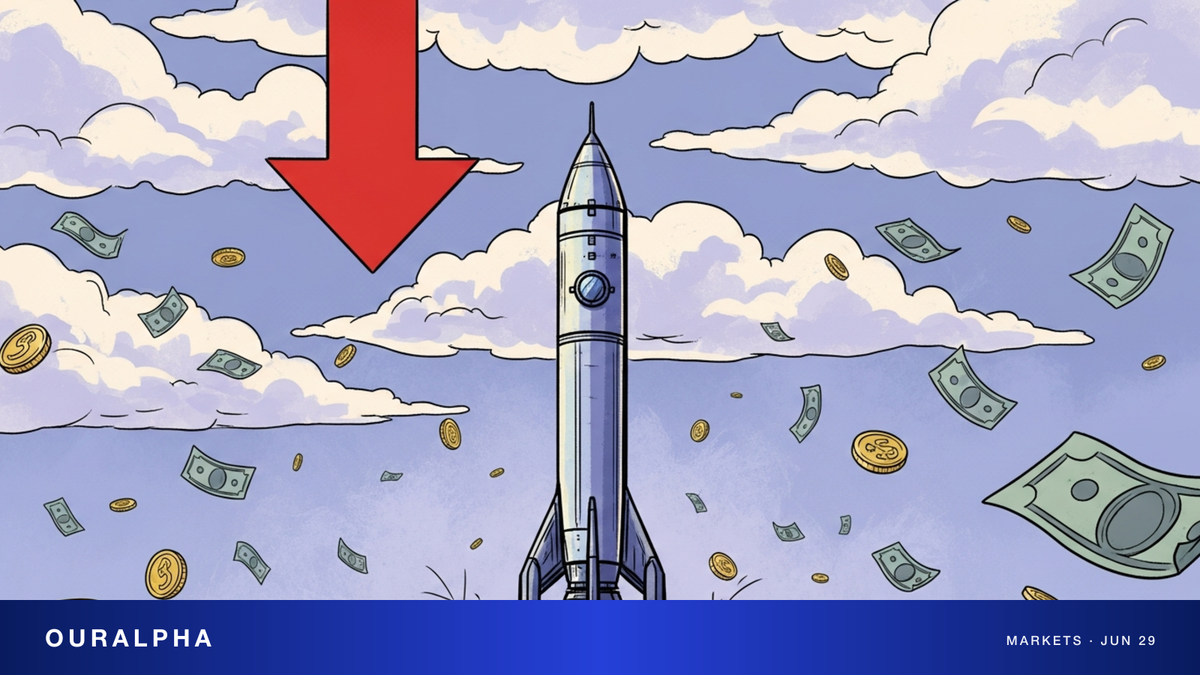
SpaceX's $25B Bond Drew 3.5x Orders. Traders Are Still Counting the Losses.
SpaceX's $25 billion bond drew 3.5x demand at issuance — then promptly slid in secondary trading. The stock shed roughly 16% in three sessions, erasing most of its IPO gains.
Bottom line: Less than two weeks after its IPO, SpaceX (SPCX) sold $25 billion in bonds to roughly $89 billion in demand — 3.5x oversubscribed — but the new notes have slid sharply in secondary trading while the stock shed roughly 16% over the three sessions following the announcement.
- Deal size: $25 billion; demand peaked at ~$89 billion, ~3.5x oversubscribed.
- Coupons: 5.35% on the 2031 notes, 6.65% on the 2056 notes.
- Credit investors viewed the coupon range as appropriate for investment-grade paper.
- Secondary market: the 2056 spread widened by as much as 28 bps from issue (Bloomberg).
- Stock: down roughly 16% (one report: 16.4%) over the three sessions following the bond announcement.
- Use of proceeds: net proceeds will fully repay outstanding borrowings under the bridge loan facility; remainder for general corporate purposes.
Less than two weeks after its IPO, SpaceX (SPCX) priced a $25 billion bond deal that drew roughly $89 billion in orders — nearly 3.5x oversubscribed.[CNBC] The new notes have since slid sharply in secondary trading, and the stock shed roughly 16% over the three sessions following the announcement.[Bloomberg] Blowout primary demand followed by rapid secondary weakness: two very different stories about the same trade.
Deal Size and Oversubscription
CNBC reported the following key figures on the offering:[CNBC]
- Total deal size: $25 billion.
- Peak demand: approximately $89 billion in orders.
- Oversubscription: roughly 3.5x.
- Timing: less than two weeks after SpaceX's IPO.
Per TradingKey, the $89 billion in demand reflected strong primary appetite from credit investors.[TradingKey] The rapid back-to-back sequencing of SpaceX's equity and debt raises put both transactions under simultaneous market scrutiny.
Coupon and Credit Pricing
The offering included tranches across different maturities with the following coupons:[CNBC]
- 2031 notes: 5.35% coupon.
- 2056 notes: 6.65% coupon.
- Range: 5.35% on the short end to 6.65% on the long end.
Credit investors treated primary demand as robust, and the coupon range was viewed as consistent with investment-grade levels.[CNBC] At issuance, pricing showed no unusual stress — spreads landed where investment-grade buyers typically expect.
Secondary Market Widening
That strong primary reception didn't carry over to secondary trading. Bloomberg reported that a major dealer's bid on the 2056 notes widened significantly from issue.[Bloomberg]
- Issue spread: 175 bps over Treasuries.
- Secondary move: widened by as much as an additional 28 bps from issue.
- Trader reaction: one trader said they couldn't recall a recent deal widening this fast (Bloomberg).
A 28 bps widening translates to a price decline on the long-end bonds relative to where they priced. Bloomberg reported traders were caught off guard by the speed of the move.[Bloomberg] Worth noting: the 3.5x oversubscription and the subsequent secondary weakness aren't contradictory — they reflect primary demand versus secondary price discovery for the same bonds at different stages.
Stock Down Three Days Running
SpaceX shares also sold off sharply in the wake of the bond announcement.[Yahoo Finance]
- Period: three consecutive trading days after the bond announcement.
- Cumulative decline: roughly 16%.
- Alternative figure: 16.4%, erasing most of the stock's gains since its IPO debut.
Yahoo Finance reported the slide wiped out most of SpaceX's post-IPO gains.[Yahoo Finance] Given how recently the stock began trading, a 16% three-day pullback left shares well below the highs reached shortly after the IPO.
Selloff Drivers and Use of Proceeds
Bloomberg reported that the stock selloff was driven primarily by broader sentiment rather than the bond yields themselves.[Bloomberg] The coupon level, in other words, wasn't cited as the direct trigger — wider market sentiment was seen as the bigger factor.
SpaceX disclosed the following use of proceeds:[CNBC]
- Net proceeds will fully repay outstanding borrowings under the bridge loan facility.
- Proceeds will also cover associated fees.
- The remainder will be used for general corporate purposes.
Repaying the bridge loan is the primary stated use. Taken together — $89 billion in primary demand, secondary spreads widening by up to 28 bps, and a ~16% three-day stock drop — the deal and its aftermath capture SpaceX's complicated re-entry into capital markets in the weeks following its IPO.
Sources
This content is for informational purposes only and does not constitute investment advice, trading advice, or any guarantee of returns.